- English
- French
- German
- Portuguese
- Spanish
- Russian
- Japanese
- Korean
- Arabic
- Greek
- German
- Turkish
- Italian
- Danish
- Romanian
- Indonesian
- Czech
- Afrikaans
- Swedish
- Polish
- Basque
- Catalan
- Esperanto
- Hindi
- Lao
- Albanian
- Amharic
- Armenian
- Azerbaijani
- Belarusian
- Bengali
- Bosnian
- Bulgarian
- Cebuano
- Chichewa
- Corsican
- Croatian
- Dutch
- Estonian
- Filipino
- Finnish
- Frisian
- Galician
- Georgian
- Gujarati
- Haitian
- Hausa
- Hawaiian
- Hebrew
- Hmong
- Hungarian
- Icelandic
- Igbo
- Javanese
- Kannada
- Kazakh
- Khmer
- Kurdish
- Kyrgyz
- Latin
- Latvian
- Lithuanian
- Luxembou..
- Macedonian
- Malagasy
- Malay
- Malayalam
- Maltese
- Maori
- Marathi
- Mongolian
- Burmese
- Nepali
- Norwegian
- Pashto
- Persian
- Punjabi
- Serbian
- Sesotho
- Sinhala
- Slovak
- Slovenian
- Somali
- Samoan
- Scots Gaelic
- Shona
- Sindhi
- Sundanese
- Swahili
- Tajik
- Tamil
- Telugu
- Thai
- Ukrainian
- Urdu
- Uzbek
- Vietnamese
- Welsh
- Xhosa
- Yiddish
- Yoruba
- Zulu
Top Two Track UPVC Sliding Window Designs for Budget Housing Projects
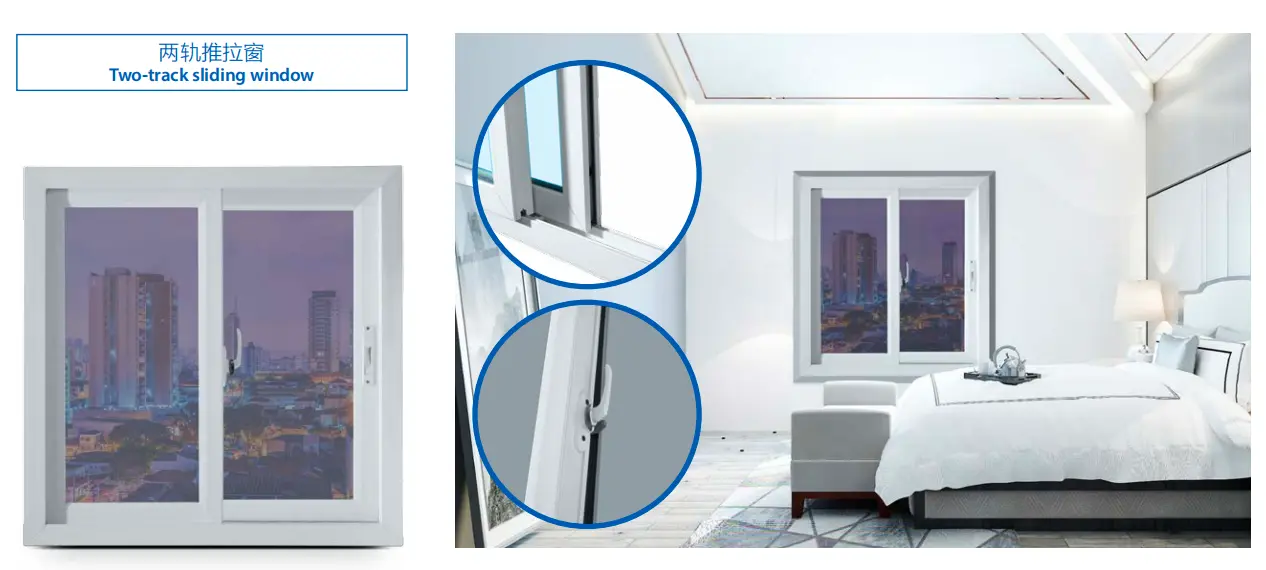
Choosing the right Two Track UPVC Sliding Windows comes down to matching a simple mechanism with the openings that actually need it. Two Track UPVC Sliding Windows build the frame from a multi-chamber UPVC profile reinforced with steel and pair it with a two-panel horizontal sliding system, which keeps cost down without giving up the ventilation a small opening needs, but the performance you deliver still depends on four variables: the profile series, the internal reinforcement, the glazing specification, and the sealing system. For trade buyers supplying budget housing, rental properties and refurbishment projects, understanding how those four interact is what makes a volume order repeatable rather than a one-off.
Understanding Two Track UPVC Sliding Windows: Key Features and Benefits
What Makes UPVC the Right Material for a Budget Sliding Window?
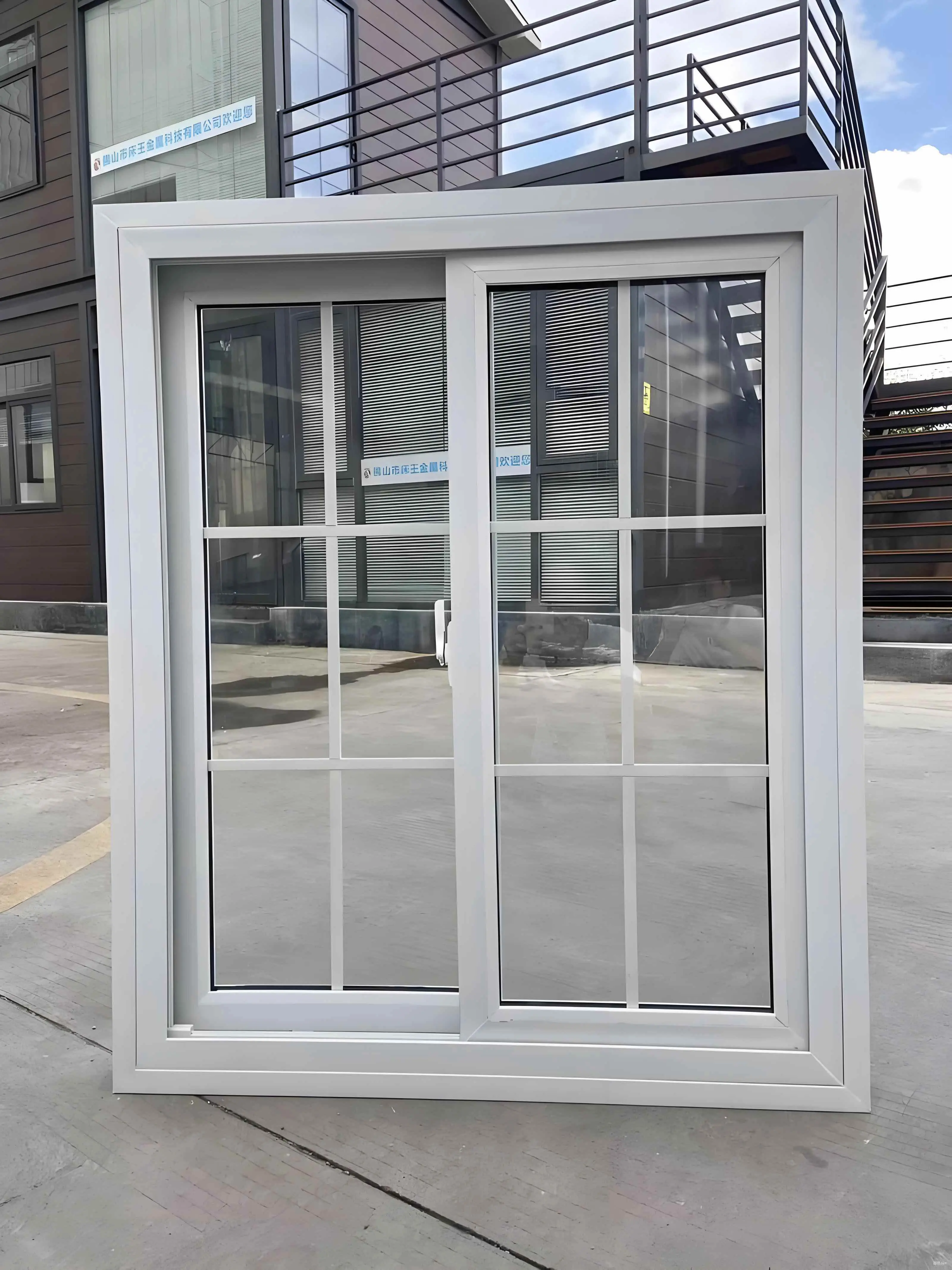
UPVC does not need a thermal break at all, because the polymer itself conducts heat slowly, so a multi-chambered profile already insulates without the polyamide insert that aluminium requires. The chambers trap still air, and the frame is reinforced with steel to carry the sash weight and hold the section straight over long spans. The standard configurations are the 70 mm and 80 mm two-track systems, which is where the depth of the profile and the reinforcement strategy differ.
What you get on top of that is durability with almost no upkeep. UPVC resists corrosion, fading and weather damage, so there is no repainting cycle and no rot, and the surface finish is available in standard white or a wood grain that suits refurbishment work on older elevations. The visible drainage holes are part of the design, not a defect: they channel water out of the frame before it can reach the interior.
Why Two Tracks Instead of Three?
A two-track design uses only two panels and a simpler internal structure, which reduces manufacturing complexity and translates directly into a lower unit price. For most standard residential openings that is enough: you still get two sliding sashes, a central lock that secures the window when closed, and built-in stoppers as an additional security layer, plus smooth operation on stainless steel rails.
The practical limit is the screen. Where a three-track system gives the insect screen its own dedicated track, a two-track system cannot keep a permanently installed screen without blocking one sash, so if your market treats insect protection as a household expectation, price the three-track option alongside it and let the customer decide. Glass options stay flexible either way: single glazing for the most basic applications, or double glazing where thermal and acoustic performance matter, with sound reduction around 25 to 30 dB.
Bulk Procurement Considerations for Trade Buyers
Volume planning starts with the minimum order. A supplier who accepts a starter order of 10 to 20 units lets you test specification, installation practice and market response without locking working capital into a full container. From there, capacity and lead time decide how fast you can scale. With component stock on hand and an integrated supply chain, standard delivery sits in the 25 to 30 day range from order confirmation.
Packing drives landed cost as much as unit price does. Knock-down configurations, where frames, sashes and glass ship as separate modules, use less container space than fully assembled units, and the simpler two-track structure helps here as well because there are fewer parts to protect. The trade-off is that someone on site has to assemble them correctly, so the quality of the supplier documentation becomes part of the product you are selling.
Climate Considerations: How Weather Conditions Affect Two Track UPVC Sliding Window Performance
Cold Climate Requirements and Thermal Engineering
Multi-chamber UPVC with double glazing is a genuinely capable cold-climate assembly, typically reaching a whole-window U-value of around 1.2 to 1.6 W/m²K, which is why UPVC is the default answer in many heating markets. The chambers slow conduction, the steel reinforcement keeps the profile straight so the gaskets stay compressed evenly, and there is no metal pathway through the frame for heat to follow, which is what keeps the interior surface warm enough to stay above the dew point.
The honest limit is the sliding seal rather than the frame. A brush sealing system does not compress the way a casement gasket does, so where a specification demands a high air permeability class, a casement window remains the more defensible answer even in a cold market. UPVC sliding is at its best where the winter is real but the airtightness requirement is mainstream rather than extreme.
Hot and Humid Climate Adaptations
In hot and humid markets the priority shifts from insulation to keeping water out and the frame stable. UPVC does not corrode, so humid air and salt-laden coastal air have little effect on the frame itself, and the brush sealing system plus visible drainage holes shed normal rainfall. The material does expand and contract more than aluminium with temperature swing, which is exactly why the steel reinforcement matters on longer spans.
Colour stability is the other issue in high-UV markets. UPVC profiles rely on UV stabilisers to resist chalking, and white holds up best; a dark finish absorbs more heat and stresses the profile, so in a tropical market the safer specification is white or a light wood grain rather than a deep colour on a sun-facing elevation.
Coastal and High-Wind Zone Specifications
Coastal projects are where UPVC has a real structural advantage, because the frame simply does not corrode, and the hardware can be specified with corrosion-resistant finishes for salt environments. The reinforcement inside the profile does the wind-carrying work, so the wall thickness and fixing method of that steel liner is the detail to verify rather than the polymer surface.
Wind load capacity is designed for low-rise building applications, which suits the housing and small commercial work this product is aimed at. For a coastal or high-wind site with a tight permitted deflection band, or for anything above low-rise, a higher-classified system should be quoted instead, because the frame, seal and glass have to be engineered as one system rather than assembled from catalogue parts.
Comparing Two Track UPVC Sliding Windows to Other Options
Performance Analysis Against Aluminium and Three Track Systems
Against an unbroken aluminium slider, UPVC wins clearly on thermal performance: the polymer conducts slowly, so no barrier insert is needed and a double-glazed unit typically reaches 1.2 to 1.6 W/m²K, compared with roughly 5.5 to 7.0 W/m²K for a plain aluminium frame. Aluminium counters on strength, on much thinner sightlines, and on the ability to carry larger glass panels, which is why large commercial openings usually go to aluminium and standard residential ones usually go to UPVC.
Against a three-track UPVC system, the difference is functional rather than thermal. Both use the same profile and the same sealing principle, so the U-value is essentially the same; the three-track version adds a dedicated screen track and a third panel at a higher price. Choosing between them is a question of whether the market expects an integrated insect screen, not a question of performance.
Glazing Options and Energy Performance
Glass specification moves the final performance number more than most buyers expect, but the frame sets the ceiling. Single glazing is adequate only in the mildest applications. Double glazing is the specification to quote by default in any market with a real winter or a real noise problem, because it delivers both a measurable sound reduction, roughly 25 to 30 dB, and a genuine thermal improvement.
Within that ceiling, a low-E coating and an argon fill still help, and a warm-edge spacer reduces heat flow at the edge of the unit, which is otherwise the coldest part of the assembly. Laminated glass is the alternative direction: it does not add insulation, it adds impact safety, UV protection and sound reduction, and it is often the deciding factor on projects near roads, rail lines or in areas with a security requirement.
Procurement Factors: Making Informed Purchase Decisions
Technical Verification and Compliance Standards
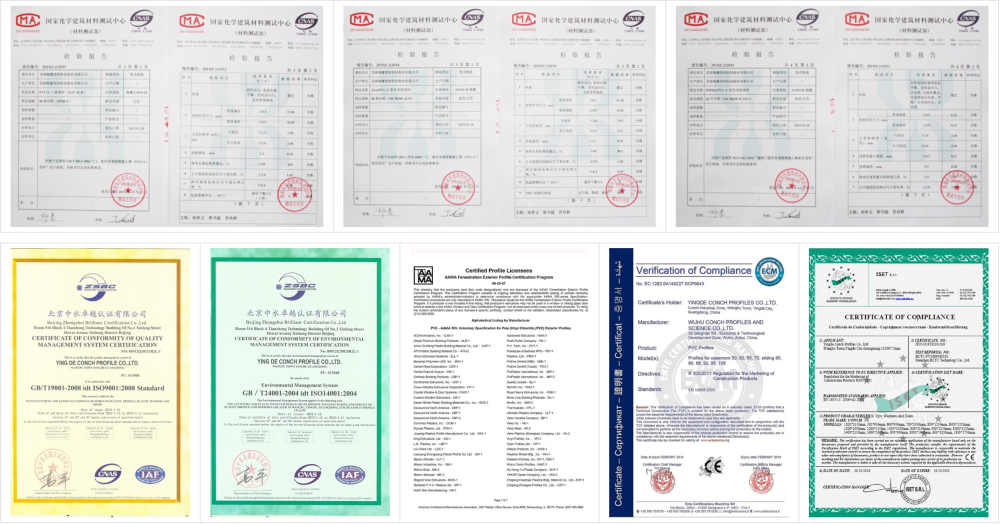
Certification paperwork is what allows you to defend a specification to a client. ISO quality management certification shows production is controlled, CE marking demonstrates conformity with European requirements, and AAMA standards define performance criteria for air infiltration, water penetration and structural loading in North American projects. For UPVC specifically, the profile itself is covered by its own standard, EN 12608-1, which sets requirements for PVC-U profiles used to fabricate windows and doors. EN 14351-1 is the product standard for the finished window, while EN 12207 and EN 12208 give the air permeability and watertightness classifications a specifier will ask you to quote.
Customization Capabilities and Order Flexibility
Standard sizes rarely fit every opening, and on refurbishment projects the existing reveals vary from wall to wall, so the ability to cut to specific measurements matters more than on a new build. Beyond size, the practical levers are the profile series, chosen between 70 mm and 80 mm, the colour, white or wood grain, and hardware upgrades including restrictors for child safety and higher-grade locks. With full OEM and ODM support, the question for a buyer is how far the factory will go on drawings and non-standard requirements, because that decides whether a volume order is routine or a negotiation.
Logistics and Installation Support
Container planning affects cost per unit more than most buyers expect. Knock-down packing, where frames, sashes and glass ship in separate modules, cuts the volume required and lowers freight per unit, and it requires assembly documentation good enough for another crew to follow. Verify that documentation before you order. Detailed installation guides and technical consultation shorten installer training and reduce the field errors that turn into warranty claims.
Sampling is the other practical point on a first order. A supplier who offers samples lets you evaluate quality firsthand before committing, with the customer covering shipping, which is the cheapest insurance against a specification mismatch. On the customs side, an experienced exporter will provide commercial invoices, packing lists and certificates of origin formatted for the destination country, plus correct Harmonised System code classification.
Maintenance and Longevity: Protecting Your Investment Value
Climate-Specific Maintenance Protocols
UPVC needs very little attention, and what it needs is concentrated on the moving parts and the drainage. Clean the tracks and clear the drainage holes as part of routine cleaning, apply a few drops of lubricating oil to the rollers annually, and wash the frames with a mild, pH-neutral detergent solution. Avoid abrasive cleaners and solvents, which attack the surface finish, and avoid anything that scratches the visible drainage slots.
Early Warning Signs and Component Replacement
Brush sealing strips are the first consumable to go, typically every three to five years, and replacing a worn strip is a low-cost way to recover dust and draught resistance on an otherwise sound window. Rollers that rattle or that need force to move indicate a worn wheel or track, and the central lock is worth checking annually because a lock that no longer engages fully is both a security weakness and a sign that the sash has shifted.
Blocked drainage holes are the most commonly missed item and cause water to back up inside the frame, so they should be cleared routinely. Fogging between the panes means the desiccant is saturated or the edge seal has failed, allowing moisture into the cavity, and the sealed unit has to be replaced rather than repaired. Where a sash starts dragging at one corner after several seasons, that usually points to roller wear or a settling frame rather than a defect in the profile.
Performance Enhancement Options
The two upgrades worth offering on an existing installation are sealing and glazing, both of which avoid touching the frame. Replacing the brush strips restores the original draught and dust performance at almost no cost, and where the customer wants a real step change in thermal or acoustic performance, upgrading the glazed unit to a double-glazed specification with a warm-edge spacer does more than any hardware change. Both extend service life at a fraction of replacement cost and are easy retrofit conversations with a repeat customer.
Disclaimer: Actual performance depends on the test reports for each specific product and on the quality of installation. Results in different climates depend on correct specification and on following the manufacturer instructions.
Conclusion
Choosing the right Two Track UPVC Sliding Windows comes down to balancing climate, market expectation and cost. A multi-chamber UPVC profile with steel reinforcement, an appropriate glazing specification and a well-executed brush sealing system deliver dependable performance in budget housing, rental and refurbishment projects, while keeping the unit price where volume business works. What separates a dependable supplier from a commodity vendor is verifiable certification, real customisation capability, and logistics support. Buyers who check those three things, and who keep their supplier technical documentation on file, get a product that performs where it is specified and does not generate callbacks where it is not.
FAQ
Q1: What is the difference between a two track and a three track UPVC sliding window?
A: A two-track design uses only two panels and a simpler internal structure, which reduces cost while covering most standard residential openings. A three-track system adds a dedicated track for a permanently installed insect screen and a third panel, so it supports ventilation and insect protection at the same time. Both use the same profile and sealing principle, so the thermal performance is essentially the same.
Q2: Are two track UPVC sliding windows suitable for cold climates?
A: Multi-chamber UPVC with double glazing is genuinely capable in cold climates, typically reaching a whole-window U-value around 1.2 to 1.6 W/m²K, and UPVC is the default answer in many heating markets. The honest limit is the sealing principle rather than the frame: brush sealing does not compress the way a casement gasket does, so where a specification demands a high air permeability class, casement remains the more defensible answer.
Q3: What sizes and finishes are available?
A: The standard systems are the 70 mm and 80 mm two-track ranges, and windows can be cut to custom width and height from your project drawings. Finish options are standard white or wood grain, with hardware upgrades available including corrosion-resistant finishes for coastal environments, restrictors for child safety and higher-grade locks.
Q4: What are typical lead times and minimum order quantities?
A: With component stock on hand and integrated supply chain management, standard delivery is usually 25 to 30 days from order confirmation, depending on customisation complexity and order volume. Initial orders of 10 to 20 units are accepted so that a new market can be tested without committing to a full container.
Partner with Haolv Building Materials for Two Track UPVC Sliding Windows
Haolv Building Materials Co., Ltd. has been manufacturing windows and doors for 19 years, and supplies procurement teams who need a dependable two track UPVC sliding window supplier. Our ISO, CE and AAMA certified factory in Hunan Province works with CONCH to keep raw material quality consistent, and our 25 to 30 day delivery schedule is supported by integrated supply chain management.
We accept initial orders of 10 to 20 units with neutral packaging or OEM branding, which makes it practical for building material sellers in Africa, South Asia and Eastern Europe to enter the market without committing to a full container. Samples are available so you can evaluate quality before committing, and our engineering team supports your installers with detailed installation guides and technical consultation. Email us at kristin@haolvwindows.com to discuss your market requirements and request quotes matched to your container plan.
References
1. European Committee for Standardization. (2016). EN 14351-1: Windows and doors — Product standard, performance characteristics.
2. European Committee for Standardization. (2016). EN 12608-1: Unplasticized polyvinylchloride (PVC-U) profiles for the fabrication of windows and doors — Classification, requirements and test methods — Part 1: Non-coated PVC-U profiles with light coloured surfaces.
3. European Committee for Standardization. (2000). EN 12207: Windows and doors — Air permeability — Classification.
4. European Committee for Standardization. (2003). EN 12208: Windows and doors — Watertightness — Classification.
5. International Organization for Standardization. (2015). ISO 9001: Quality management systems — Requirements.
6. National Fenestration Rating Council. (2021). Certified Products Directory: Energy Performance Ratings.
Fast simple channel to send demands lock favorable price for building window door bulk purchases.