- English
- French
- German
- Portuguese
- Spanish
- Russian
- Japanese
- Korean
- Arabic
- Greek
- German
- Turkish
- Italian
- Danish
- Romanian
- Indonesian
- Czech
- Afrikaans
- Swedish
- Polish
- Basque
- Catalan
- Esperanto
- Hindi
- Lao
- Albanian
- Amharic
- Armenian
- Azerbaijani
- Belarusian
- Bengali
- Bosnian
- Bulgarian
- Cebuano
- Chichewa
- Corsican
- Croatian
- Dutch
- Estonian
- Filipino
- Finnish
- Frisian
- Galician
- Georgian
- Gujarati
- Haitian
- Hausa
- Hawaiian
- Hebrew
- Hmong
- Hungarian
- Icelandic
- Igbo
- Javanese
- Kannada
- Kazakh
- Khmer
- Kurdish
- Kyrgyz
- Latin
- Latvian
- Lithuanian
- Luxembou..
- Macedonian
- Malagasy
- Malay
- Malayalam
- Maltese
- Maori
- Marathi
- Mongolian
- Burmese
- Nepali
- Norwegian
- Pashto
- Persian
- Punjabi
- Serbian
- Sesotho
- Sinhala
- Slovak
- Slovenian
- Somali
- Samoan
- Scots Gaelic
- Shona
- Sindhi
- Sundanese
- Swahili
- Tajik
- Tamil
- Telugu
- Thai
- Ukrainian
- Urdu
- Uzbek
- Vietnamese
- Welsh
- Xhosa
- Yiddish
- Yoruba
- Zulu
Aluminum Front Entry Doors Buyer Guide for Villa and Lobby Entrances
A front entrance is the one door in a building that is judged before anyone touches a handle. It also carries the heaviest leaf, the most hardware and the least tolerance for a mistake, which is why aluminum front entry doors have to be specified differently from an interior door: the configuration decides the load path, the panel decides the security, the threshold decides the access, and the glazing decides both the daylight and the acoustics. For trade buyers and procurement teams supplying villas, apartment lobbies and commercial entrances, those four decisions are the order. Everything else is a finish choice on top of them.
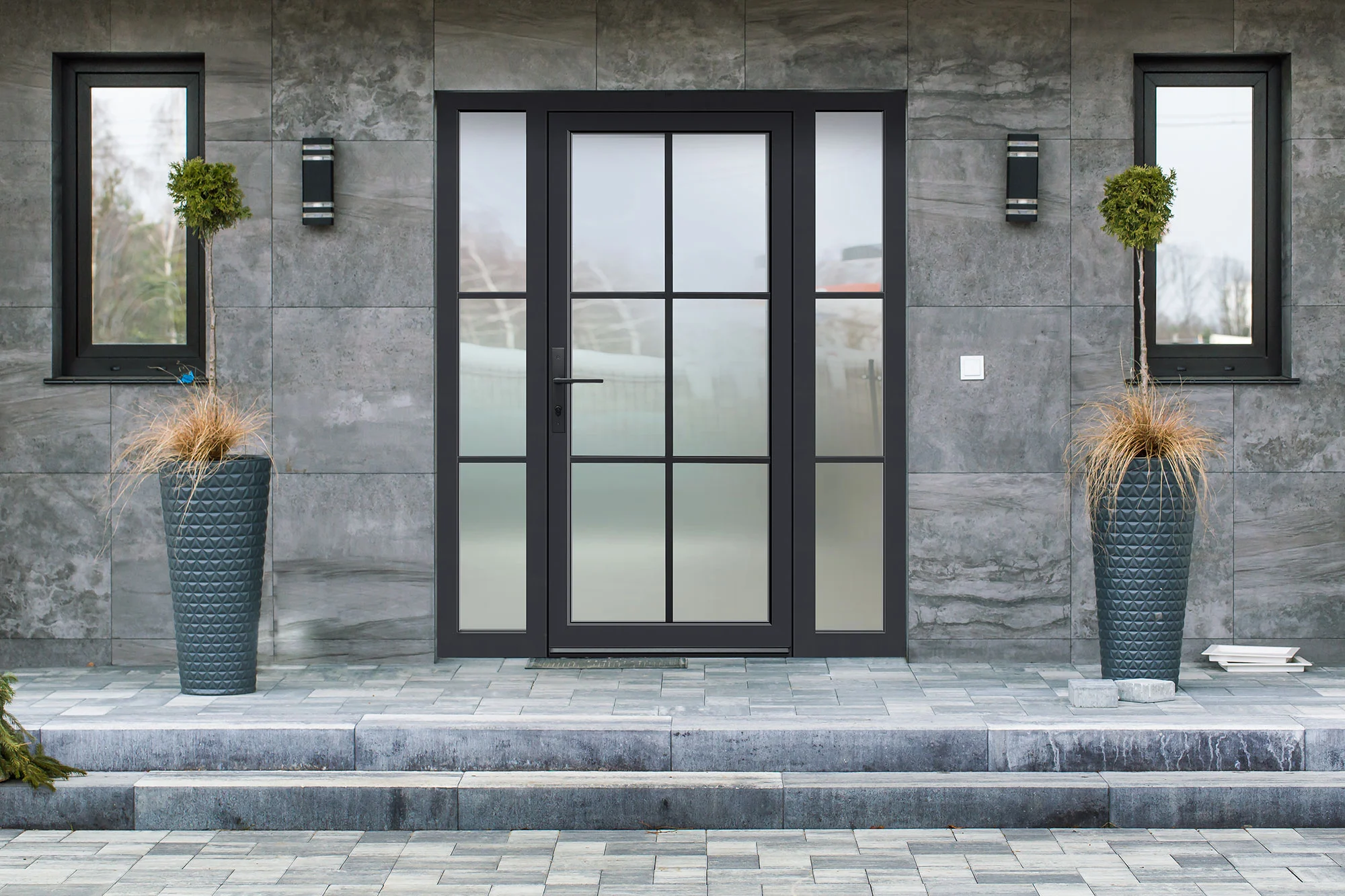
Understanding Aluminum Front Entry Doors: Key Features and Benefits
Swing Or Pivot: Which Configuration Carries The Leaf?
A swing door hangs on hinges fixed to the frame, so the load goes through the frame jamb and the fixing into the wall. That is the familiar arrangement, and it stays economical up to a leaf of about 1.2 m wide and 2.4 m high. Beyond that the hinge loads climb quickly, the leaf starts to drop at the leading edge, and the lock has to pull the door back to square every time it closes.
A pivot door carries the leaf on a top and bottom pivot set, so the weight goes into the floor and the head rather than into one jamb. That is what makes a 1.5 m leaf or a full-height entrance practical, and it is why pivot doors appear on villa entrances and hotel lobbies. The trade-off is that the pivot needs a floor fixing, and the leaf swings through a wider arc than a hinged door of the same width, so the entrance geometry has to be drawn before the door is ordered. The product page offers single or double swing and pivot configurations, on 100, 120 and 140 series thermal break sections.
Solid Panel Or Glass: What Decides The Security And The Daylight?
A solid aluminium panel gives the highest privacy and the simplest security story: there is no glass to break, and the panel itself stiffens the leaf against twisting. An aluminium and glass combination brings daylight into a lobby and lets a resident see who is at the door, at the cost of a glazing specification that has to be laminated or tempered for the risk position. The product page supports both, with glass thickness from 8 to 32 mm in tempered, laminated, double or triple build.
The structural point buyers miss is that glass does not stiffen a leaf the way a panel does. A wide glazed leaf needs a heavier stile and rail section, and it needs the hinges sized for the glass weight rather than for the aluminium weight. Ask for the leaf weight per line item, because that number, not the width, is what selects the hinge or pivot set.
Bulk Procurement Considerations for Trade Buyers
Entrance doors are usually the smallest line on a project and the most visible one, which makes them the item a client inspects first. Fix the RAL number rather than a colour name, fix the finish system because powder coating and anodizing cannot be mixed on one entrance, and fix the hardware brand or at least the hardware grade, since a multi-point lock from two different sources can look identical and behave nothing alike.
Mixed containers suit this product because the same section serves a single villa door, a pair of lobby doors and a service door, with only the leaf size and the hardware changing. Initial orders of 10 to 20 units are accepted with neutral packaging or OEM branding, samples let a distributor check the leaf weight and the finish before the container is released, and standard production runs on a 25 to 30 days lead time from order confirmation.
Climate Considerations: How Weather Conditions Affect Entrance Door Performance
Cold Climate Requirements and Thermal Engineering
An entrance door is a large opening in a wall that is otherwise insulated, so it becomes the thermal weak point of the elevation. A thermal break section interrupts the metal path between the inner and outer faces, and on a 100 to 140 series entrance the depth is what allows a thick enough break and a deep enough rebate to hold a warm seal. A door without a break will show condensation on the inner face on the first cold morning, and no amount of glazing upgrade will fix the frame.
The bottom of the door is where the detail is usually lost. A threshold that sits on a thermal separator, a double brush and EPDM seal at the leaf bottom, and a continuous seal at the jambs are what stop cold air from tracking in under the leaf. On the product page the sealing system is EPDM plus brush sealing, which is the correct combination for an entrance that has to seal against both air and driven rain.
Hot and Humid Climate Adaptations
In a hot humid market the entrance has to shed water and resist ultraviolet rather than hold heat in. The threshold becomes the critical detail: water driven against the door runs down the leaf, reaches the bottom seal and has to be drained outward rather than sitting in the track. A raised threshold with a drainage path works better than a flush one in a monsoon climate, which is why threshold choice is a climate decision and not only an access one.
Solar exposure matters on a dark leaf. A dark RAL finish in direct sun reaches a surface temperature well above ambient, and the leaf grows enough to change the lock alignment if the hardware has no adjustment. Specify a finish system rated for the UV load of the site, and choose a lock with adjustable keeps so seasonal movement can be taken up on site rather than by replacing hardware.
Coastal and High-Wind Zone Specifications
A coastal entrance faces two loads at once: wind pressure on a large leaf, and salt on every moving part. Wind pressure on a 1.5 m by 2.4 m leaf is substantial, and it acts on the leaf face rather than on the frame, so the leaf section, the pivot or hinge set and the number of locking points all have to be checked against the design pressure. A three-point lock on a wide leaf will flex before the section fails.
Salt is managed by material selection rather than by maintenance. Stainless steel hinges, a marine grade finish and a threshold that does not hold water are the three items that decide whether the entrance still closes smoothly after five years. Ask for the hardware material and the finish system in writing, and check that the salt spray rating is quoted for the exposure class of the site.
Comparing Aluminum Front Entry Doors to Other Materials
Performance Analysis Against Traditional Frame Materials
Against steel, aluminium wins on weight and on corrosion, and it loses on absolute stiffness for the same section depth. That is why an aluminium entrance carries a deeper section, a thermal break and a reinforced frame, which the product page lists for this range. A steel door is heavier, needs a paint cycle and rusts at the threshold; an aluminium door holds its finish and its geometry without that maintenance.
Against timber, aluminium wins on dimensional stability and on security hardware, because a multi-point lock and a pivot set can be fixed into a metal section with predictable results. Timber still wins on the interior face and on heritage entrances where a painted door is expected. A wood grain finish on aluminium is the usual compromise, and it should be specified as a finish system with a batch reference rather than as a colour sample.
Glazing Options and Energy Performance
The range covers tempered glass for safety, laminated glass for security and sound, double or triple glazing for insulation, in thicknesses from 8 to 32 mm. On an entrance the laminated option is usually the right default, because it holds the pane together after impact and it adds mass, which is what reduces sound. The product page quotes 35 to 50 dB acoustic reduction, a range that depends heavily on the glass build and on the seal rather than on the frame alone.
The glass build has to match the leaf depth. An 8 to 12 mm laminated unit suits a glazed entrance panel with a shallow rebate, while a double or triple unit needs a deeper leaf and a heavier hinge set. Write the glass build, the leaf thickness and the hinge rating on the same line of the order, because a glazing schedule issued on its own is where a substitution appears between the quotation and the production release.
Procurement Factors: Making Informed Purchase Decisions
Technical Verification and Compliance Standards
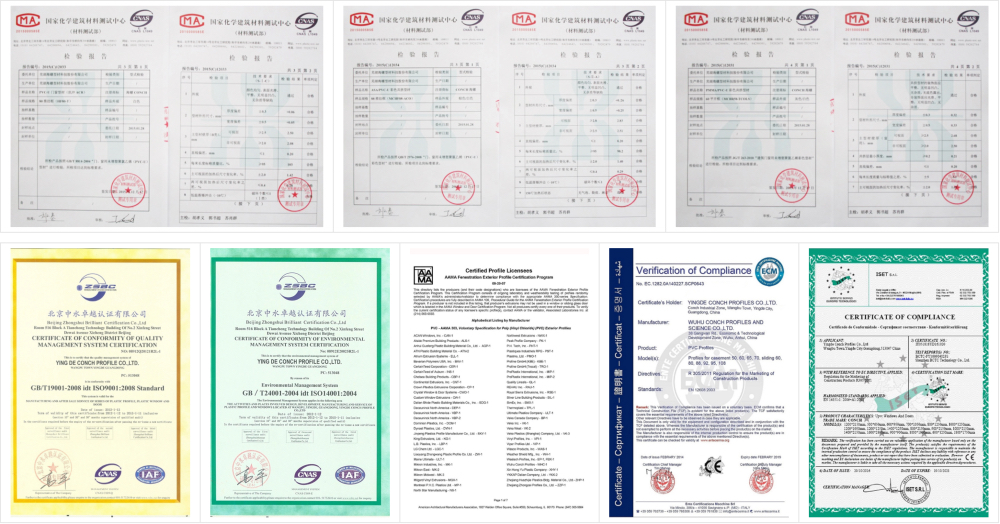
For an entrance door, compliance is a document trail covering the product family, the air, water and wind performance claimed, and the hardware that carries the security. Ask for the certification documentation, the test reports behind the figures quoted, and the hardware datasheet that states the lock points and the anti-pry and anti-lift features. Then check that each report describes the leaf size and the glass build you are ordering, because a report for a smaller leaf proves nothing about a 1.5 m pivot door.
Customization Capabilities and Order Flexibility
The customization that matters on an entrance is dimensional and mechanical: leaf size to the opening, solid panel or panel plus glass, any RAL colour, handle and lock selection, low or flush threshold, and pivot or hinge configuration. OEM and ODM work is available, so a distributor can carry its own label, and a sample can be approved for leaf weight and finish before the production slot is committed.
Logistics and Installation Support
An entrance door travels as a leaf and a frame, and the leaf is the fragile part: it has to be crated on edge with the corners protected, and it should not be stacked under anything. Ask whether the door ships hung in its frame or as separate components, because a hung door is easier to install but harder to protect in transit, and a component door puts the alignment work on site.
Site alignment decides whether the entrance closes properly for the next twenty years. The frame has to be plumb and square before it is packed and fixed, the threshold has to be level and drained, and the pivot or hinge set has to be adjusted after the frame is loaded rather than before. Ask for the fitting instructions and the adjustment procedure in writing at order stage, and keep one setting record per door on site.
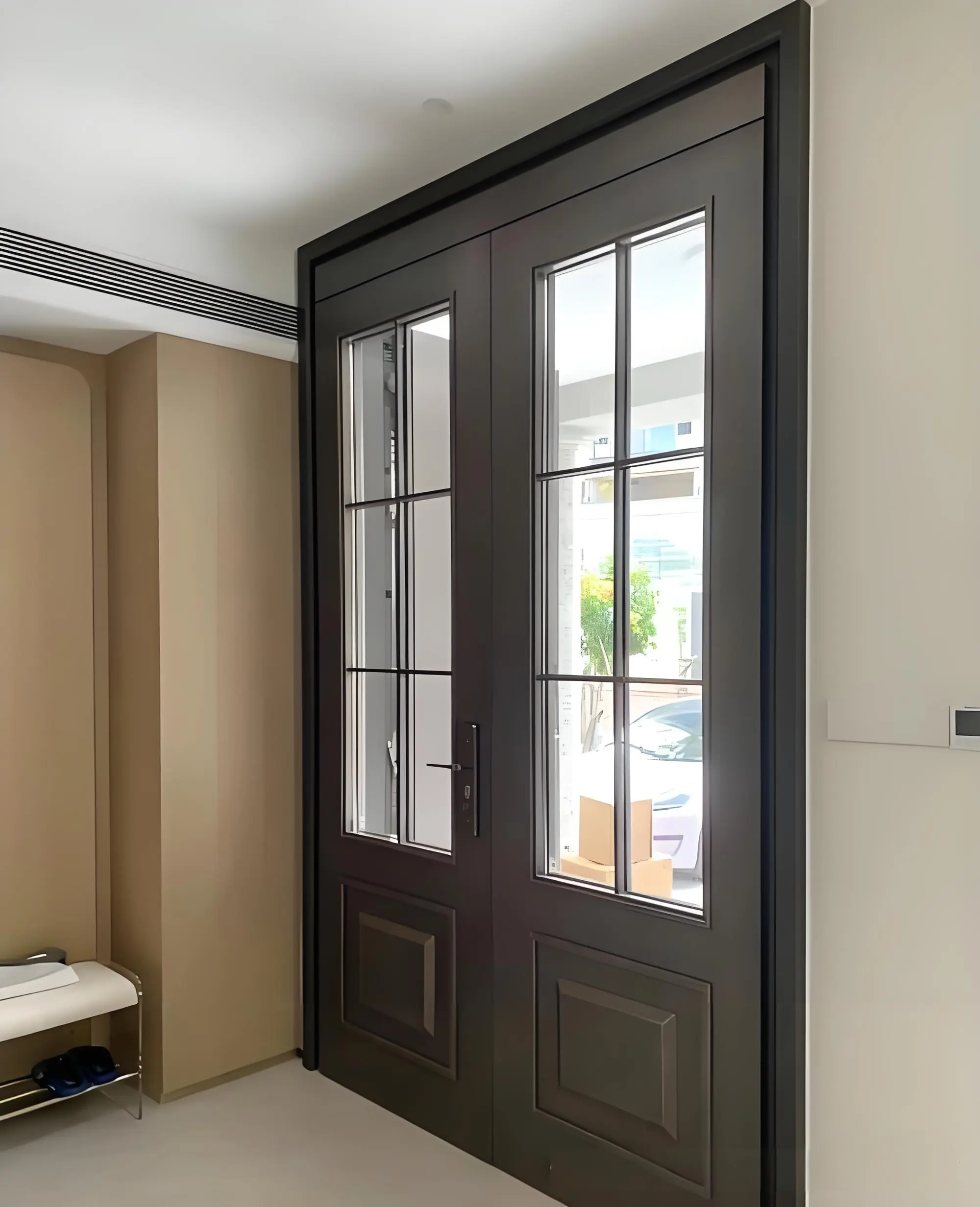
Maintenance and Longevity: Protecting Your Investment Value
Climate-Specific Maintenance Protocols
The routine is short: clear the threshold drain before the wet season, lubricate the lock and the hinges once a year with a dry film rather than grease, and wash the finish with fresh water. On a coastal site, rinse the hardware and the threshold every few months so salt comes off before it pits the surface, and check the bottom seal, which is the part that sees the most water and the most foot traffic.
Early Warning Signs and Component Replacement
A leaf that has to be lifted to close is telling you the hinges or the pivot have dropped, or that the frame has settled. A lock that needs a push before the key turns is telling you the same thing, one step later. Deal with both early, because a lock forced against a dropped leaf wears out the gearbox and the keep rather than the adjustment screw.
The parts that age first are the bottom seal, the gaskets and the hinge or pivot bearing. A hardened gasket stops recovering and shows as a draught or as water tracking past a corner; a worn pivot bearing shows as a leaf that swings on its own. On a building with several entrances, replacement is a scheduled item, so keep the seal profile and the pivot reference with the building documents.
Performance Enhancement Options
An installed entrance can still be improved: a laminated upgrade or a security film where the risk position has changed, a supplementary brush seal at the leaf bottom where a draught has appeared, and an adjustable keep to restore lock alignment on a leaf that has moved. None of these replaces a correct original specification, but on a refurbishment they are a sensible step before the door is replaced.
Disclaimer: Actual performance depends on the test reports for each specific product and on the quality of installation. Results in different climates depend on correct specification and on following the manufacturer instructions.
Conclusion
An entrance door is decided by four choices made in the right order: the configuration, because swing or pivot sets the load path and the maximum leaf; the panel, because solid or glazed decides security and daylight; the threshold, because it decides both access and drainage; and the glazing, because it decides the acoustics and the thermal result. Make those four choices against the project rather than against a catalogue, write the leaf weight and the hardware grade onto the order, and the entrance will still close cleanly long after the rest of the facade has been forgotten.
FAQ
Q1: Should I choose a swing door or a pivot door?
A: Follow the leaf size. A swing door stays economical up to about 1.2 m wide by 2.4 m high, because the hinge loads stay manageable. Beyond that a pivot set is the better answer, since the weight goes into the floor and the head rather than into one jamb, but the entrance geometry has to be drawn first.
Q2: How secure are these doors?
A: Security comes from the lock and the leaf, not from the material alone. The range uses multi-point locking with anti-pry and anti-lift features and heavy-duty hinges or pivot hardware. A solid panel leaf is the simplest specification; a glazed leaf needs a laminated unit and a heavier stile to reach the same level.
Q3: What threshold should I specify?
A: It depends on the climate and on access. A low or flush threshold is the right choice for barrier-free access and for a lobby where a trolley has to pass, while a raised threshold with a drainage path sheds driven rain better in a monsoon climate. Both are available on this range, so the decision should be made against the site rather than by default.
Q4: What are the lead time and the minimum order?
A: Standard delivery is 25 to 30 days from order confirmation, and initial orders of 10 to 20 units are accepted with neutral packaging or OEM branding. Samples are available so a distributor can check the leaf weight, the hardware and the finish before committing to a full container.
Partner with Haolv Building Materials for Aluminum Entrance Door Supply
Haolv Building Materials Co., Ltd. has been manufacturing windows and doors for 19 years, and supplies procurement teams who need a dependable aluminum entrance door supplier. Our factory in Hunan Province works from ISO, CE and AAMA certification documentation, works with CONCH to keep raw material quality consistent, and runs a 25 to 30 day delivery schedule supported by integrated supply chain management.
We accept initial orders of 10 to 20 units with neutral packaging or OEM branding, which makes it practical for building material sellers in Africa, South Asia and Eastern Europe to enter the market without committing to a full container. Our engineering team works from your drawings and specifications to configure the series, the leaf size, the panel or glazing build, the threshold and the hardware, and provides application guidance and project based technical support. Email us at kristin@haolvwindows.com to discuss your market requirements and request quotes matched to your container plan.
References
1. European Committee for Standardization. (2016). EN 14351-1: Windows and doors - Product standard, performance characteristics.
2. European Committee for Standardization. (2000). EN 12207: Windows and doors - Air permeability - Classification.
3. European Committee for Standardization. (2003). EN 12208: Windows and doors - Watertightness - Classification.
4. European Committee for Standardization. (2003). EN 12210: Windows and doors - Resistance to wind load - Classification.
5. American Architectural Manufacturers Association. (2022). AAMA 101: Voluntary Standard for Aluminum, Vinyl (PVC) and Wood Windows and Glass Doors.
6. International Organization for Standardization. (2015). ISO 9001: Quality management systems - Requirements.
Fast simple channel to send demands lock favorable price for building window door bulk purchases.