- English
- French
- German
- Portuguese
- Spanish
- Russian
- Japanese
- Korean
- Arabic
- Greek
- German
- Turkish
- Italian
- Danish
- Romanian
- Indonesian
- Czech
- Afrikaans
- Swedish
- Polish
- Basque
- Catalan
- Esperanto
- Hindi
- Lao
- Albanian
- Amharic
- Armenian
- Azerbaijani
- Belarusian
- Bengali
- Bosnian
- Bulgarian
- Cebuano
- Chichewa
- Corsican
- Croatian
- Dutch
- Estonian
- Filipino
- Finnish
- Frisian
- Galician
- Georgian
- Gujarati
- Haitian
- Hausa
- Hawaiian
- Hebrew
- Hmong
- Hungarian
- Icelandic
- Igbo
- Javanese
- Kannada
- Kazakh
- Khmer
- Kurdish
- Kyrgyz
- Latin
- Latvian
- Lithuanian
- Luxembou..
- Macedonian
- Malagasy
- Malay
- Malayalam
- Maltese
- Maori
- Marathi
- Mongolian
- Burmese
- Nepali
- Norwegian
- Pashto
- Persian
- Punjabi
- Serbian
- Sesotho
- Sinhala
- Slovak
- Slovenian
- Somali
- Samoan
- Scots Gaelic
- Shona
- Sindhi
- Sundanese
- Swahili
- Tajik
- Tamil
- Telugu
- Thai
- Ukrainian
- Urdu
- Uzbek
- Vietnamese
- Welsh
- Xhosa
- Yiddish
- Yoruba
- Zulu
Aluminum Glass Folding Door Factory Checklist for Wide Openings
Aluminum glass folding doors put 155 kg of leaf weight on one jamb when five leaves are folded back, and a single leaf left open in 800 Pa of wind puts 1,235 Nm into its hinges. Both cases sit outside the leaf-weight rating printed on the hardware, and both decide whether the door still closes after two winters.
Two cases the catalogue leaves out
Folded: 5 leaves x 31 kg = 155 kg over a 370 mm stack, which is 4.1 kN/m at the jamb. Open in wind: 1.47 m² at 800 Pa = 1,176 N at mid height = 1,235 Nm. Neither appears on a hinge or roller datasheet.

In this guide:
What does one leaf of an aluminum glass folding door weigh?
Build the leaf up from its parts. A 700 by 2,100 mm leaf with 60 mm frame faces leaves glass of 580 by 1,980 mm, which is 1.148 m². Double glazing at 4-16-4 is 8 mm of glass, and glass runs at 2.5 kg per square metre per millimetre, so the unit is 20 kg/m² and the glass alone is 23 kg. Frame sections add about 5 kg and hardware 3 kg, so the leaf lands near 31 kg.
That number is what every other decision is priced against. Leaves of 31 kg run on rollers rated in pairs, hang on hinges rated by leaf weight, and stack into a width of about 74 mm each once the 68 mm leaf thickness and a 6 mm gap are counted. Change the glass to triple and the leaf goes to 35 kg before anything else moves.
What carries the folded stack?
On a five-leaf aluminum glass folding door, four leaves fold back against one jamb and the fifth becomes the access leaf. Five leaves at 31 kg is 155 kg, or 1.52 kN, gathered into 370 mm of stack. Spread along that length it is 4.1 kN per metre, applied to one jamb and to the head track above it. The other jamb carries almost nothing in that position.
That asymmetry is the thing to check on the fixing plan. The loaded jamb needs anchors into something structural, at a spacing that suits 4.1 kN/m, and a packer detail that carries the load into the wall behind the frame face. Fixing both jambs the same way is the most common mistake on a wide folding door, and it shows up as a jamb that bows in year two.
| Door state | Load | Carried by | What fails first |
|---|---|---|---|
| Closed | 31 kg per leaf, evenly on rollers | bottom track, two rollers per leaf | roller tyre flattens, leaf drops 2 mm |
| Folding | 155 kg transferring to one jamb | loaded jamb anchors, head track | jamb bows, head track sags between fixings |
| Folded | 4.1 kN/m on 370 mm of stack | loaded jamb, stacked hinges | hinge screws pull out of a thin frame |
| Open in 800 Pa wind | 1,176 N at mid height, 1,235 Nm | hinge couple and head rollers | hinge bends, leaf twists out of the guide |
Leaf weight is built up from glass at 2.5 kg/m²/mm plus frame and hardware. Wind load is 800 Pa over 1.47 m², applied at mid height. These are calculated design cases, not measurements from an installed door.

What happens to one open leaf in 800 Pa of wind?
A leaf of 700 by 2,100 mm presents 1.47 m². At 800 Pa that is 1,176 N, roughly the weight of 120 kg, applied at mid height. The moment at the hinge line is 1,176 N multiplied by 1,050 mm, which is 1,235 Nm. For comparison the same leaf standing still puts 31 kg, or 304 N, into the hinges. The wind case is four times the static case.
Resolve that moment over the hinge spacing and it becomes a force. With hinges at 150 mm and 1,850 mm, the couple arm is 1,700 mm and each hinge takes 1,235 divided by 1.7, or 726 N, about 74 kgf. That is the number to put against a hinge, and it is why a wide folding door needs a hold-open or a floor guide on any elevation that catches wind while the door stands open.
Why does a hinge rating not cover the open leaf?
Because the rating is a static load in a closed door. A hinge sold for an 80 kg leaf is tested with that leaf hung vertically and shut, where the load runs along the hinge axis and the screws work in shear. An open leaf converts the same wind into a moment across the hinge axis, so the screws work in withdrawal and the hinge knuckle works in bending. The load path changes completely while the printed number stays the same.
Two practical consequences follow. Hinges on a wide aluminum glass folding door want to be through-bolted into the reinforcement inside the sash, with a plate on the inner face, so withdrawal has something to resist. And the specification should state a hold-open device, because a door designed only for the closed case will be operated in the open case every calm morning and every windy afternoon. Cold climate projects add the thermal barrier to the same leaf, set out under thermal break bifold door.

How wide can a leaf be before folding stops being clean?
Around 700 to 900 mm is the comfortable range, and 1,000 mm is the practical ceiling on aluminium. Past that the leaf weight climbs with width while the hinge spacing stays the same, so the wind moment at the hinge line grows faster than the hardware. A 1,000 mm leaf at the same height weighs 44 kg and takes 1,500 N at 800 Pa, which is 1,575 Nm.
So the answer to a very wide opening is more leaves, not wider leaves. A 4,200 mm opening takes six leaves of 700 mm and folds to a 450 mm stack, which leaves 3,090 mm clear. Six leaves at 31 kg is 186 kg on that one jamb, so the anchor design follows the leaf count, and the width follows second. The six-leaf layout is drawn out under multi panel folding door.
What should the shop drawing show at the jamb?
Five items: which jamb is the loaded one and what it is anchored into; anchor spacing for the folded load, in kN/m; the hold-open or floor guide position; the stack width, so the clear opening can be checked against the traffic route; and the drainage outlet at the bottom track, with the threshold height. A drawing that shows the elevation and leaves those five to site is the source of most call-backs on a folding door. The commercial side of the same list is set out in this bifold door supplier guide.
Send the opening width, the leaf count you have in mind and the wall construction to kristin@haolvbuilding.com and the leaf weight, the stack width and the anchor load on each jamb come back together. That calculation costs nothing before the order and a great deal after it.
Which checks belong at handover?
Four, all with a tool in hand. Stack the leaves fully and measure the clear opening against the drawing. Push the folded stack sideways at mid height and watch for jamb movement. Open one leaf 90 degrees and check that the guide still holds the bottom corner. Pour water on the bottom track with the door closed and watch where it leaves. Track selection itself, for wide openings, is covered under folding door track systems.
The table below turns the same list into numbers that can be checked on a quotation before any of that. It is the checklist to send with an enquiry on an aluminum glass folding door, because each row is a number a factory has to commit to on paper.
| Parameter | Typical value | Note |
|---|---|---|
| System | aluminum glass folding door, 6063-T5 leaves on top-hung or bottom-rolling track | top-hung needs a deeper head track |
| Leaf size | 700 to 900 mm wide, 2,100 to 2,400 mm high | 1,000 mm is the practical ceiling |
| Leaf weight | 31 kg at 700 x 2,100 mm with 4-16-4 glass | calculated from glass at 20 kg/m² plus frame |
| Stack width | about 74 mm per leaf | 68 mm leaf plus a 6 mm gap |
| Clear opening | 86 per cent on a 3,600 mm opening with five leaves | the stack comes off one side only |
| Folded load | 4.1 kN/m at the loaded jamb, five leaves | anchor spacing follows this figure |
| Wind case | 1,176 N at 800 Pa on one open leaf, 1,235 Nm | hold-open or floor guide specified |
| Glass | 4-16-4 double, low-e coated, argon filled | U-value 1.4 W/m²K, laminated over a walkway |
| Threshold | flush track with a drainage outlet | checked against the finished floor level |
| Air permeability | EN 12207, class to project | class stated on the schedule |
| Minimum order | 10-20 units | lead time 25-30 days |
Usual range for this system family. Leaf weight is built up from the glass build and the section; the folded and wind loads are calculated design cases. Anchor spacing and threshold height are confirmed per project drawing.
Frequently asked questions
What is the minimum order for an aluminum glass folding door and how long is production? Minimum order is 10-20 units and lead time is 25-30 days from approved shop drawings. Shop drawings come first, because the loaded jamb and the stack width are settled before any profile is cut.
Why does the price per leaf differ so much between suppliers on the same opening? Mostly the hardware and the number of leaves. Six leaves need twice the hinges, twice the rollers and twice the machining of a three-leaf door on the same opening, and the frame is lighter on the six-leaf version. Ask for the price per leaf with the hinge and roller count written next to it.
Can the clear opening be increased later? Only by changing the leaf count or the stack side. The stack width is fixed by the leaf thickness and the number of leaves, and the clear opening is what remains. On a 3,600 mm opening with five leaves at 74 mm, the stack takes 370 mm and the clear opening is 3,110 mm.
Is a top-hung or a bottom-rolling folding door better? Top-hung keeps the floor clear and puts the load in the head, so it needs a structural head and a deeper track. Bottom-rolling keeps the load low and needs a track that drains. On a 155 kg stack the choice is decided by what the building can carry, not by preference.
Ordering from Haolv
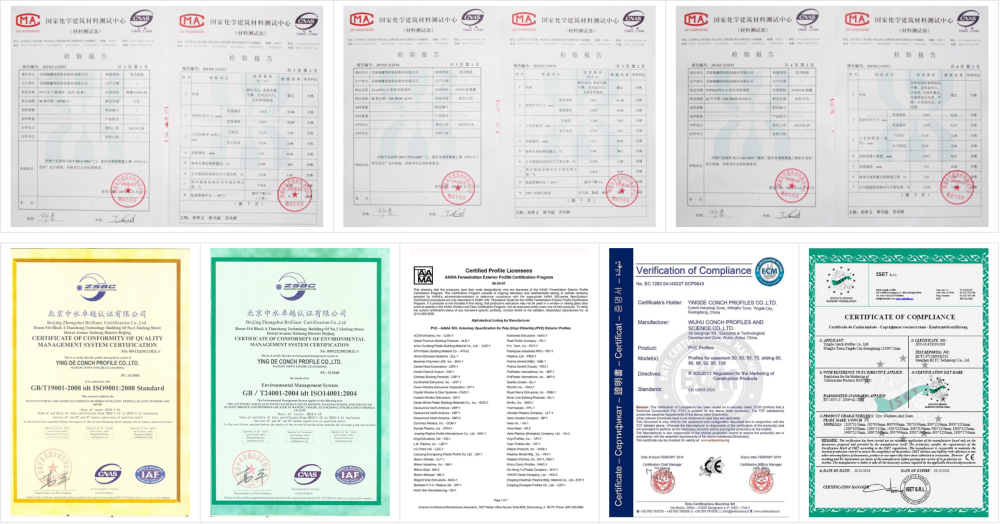
Haolv Building Materials Co., Ltd. has been making doors and windows for 19 years, with aluminum glass folding door systems from three to six leaves and the jamb load calculated before the order. Certification for the profiles and the glazing is available on request with the quotation. Minimum order is 10-20 units and lead time is 25-30 days.
Send the opening and the wall construction to kristin@haolvbuilding.com, or start from Haolv Building Materials Co., Ltd. and the leaf weight, the stack width and the anchor load come back with the quotation.
What this guide claims and what it does not: the 31 kg, the 155 kg and the 1,235 Nm are arithmetic on a stated leaf size, a stated glass build and a stated wind pressure, so they are calculated, not measured. They are design cases for hardware selection, not test results. The anchor load of a particular door is confirmed against its own wall construction, and the wind pressure against the project location.
References
- EN 14351-1:2006+A2:2016 — Windows and doors. Product standard. Performance characteristics.
- EN 12210:2016 — Windows and doors. Resistance to wind load. Classification.
- EN 12207:2017 — Windows and doors. Air permeability. Classification.
- EN 12208:2000 — Windows and doors. Watertightness. Classification.
- EN 1932:2013 — External blinds and shutters. Resistance to wind loads. Method of testing.
- EN 1991-1-4:2005+A1:2010 — Eurocode 1. Actions on structures. General actions. Wind actions.
Leaf weights and loads in this guide are calculated from the leaf geometry, glass at 2.5 kg per square metre per millimetre and a stated wind pressure. They are arithmetic, not measurements from an installed door, and the anchor design of any opening is confirmed against its own wall construction before fabrication.
Fast simple channel to send demands lock favorable price for building window door bulk purchases.