- English
- French
- German
- Portuguese
- Spanish
- Russian
- Japanese
- Korean
- Arabic
- Greek
- German
- Turkish
- Italian
- Danish
- Romanian
- Indonesian
- Czech
- Afrikaans
- Swedish
- Polish
- Basque
- Catalan
- Esperanto
- Hindi
- Lao
- Albanian
- Amharic
- Armenian
- Azerbaijani
- Belarusian
- Bengali
- Bosnian
- Bulgarian
- Cebuano
- Chichewa
- Corsican
- Croatian
- Dutch
- Estonian
- Filipino
- Finnish
- Frisian
- Galician
- Georgian
- Gujarati
- Haitian
- Hausa
- Hawaiian
- Hebrew
- Hmong
- Hungarian
- Icelandic
- Igbo
- Javanese
- Kannada
- Kazakh
- Khmer
- Kurdish
- Kyrgyz
- Latin
- Latvian
- Lithuanian
- Luxembou..
- Macedonian
- Malagasy
- Malay
- Malayalam
- Maltese
- Maori
- Marathi
- Mongolian
- Burmese
- Nepali
- Norwegian
- Pashto
- Persian
- Punjabi
- Serbian
- Sesotho
- Sinhala
- Slovak
- Slovenian
- Somali
- Samoan
- Scots Gaelic
- Shona
- Sindhi
- Sundanese
- Swahili
- Tajik
- Tamil
- Telugu
- Thai
- Ukrainian
- Urdu
- Uzbek
- Vietnamese
- Welsh
- Xhosa
- Yiddish
- Yoruba
- Zulu
Sourcing Inward Opening UPVC Windows for Acoustic Ratings That Survive Installation
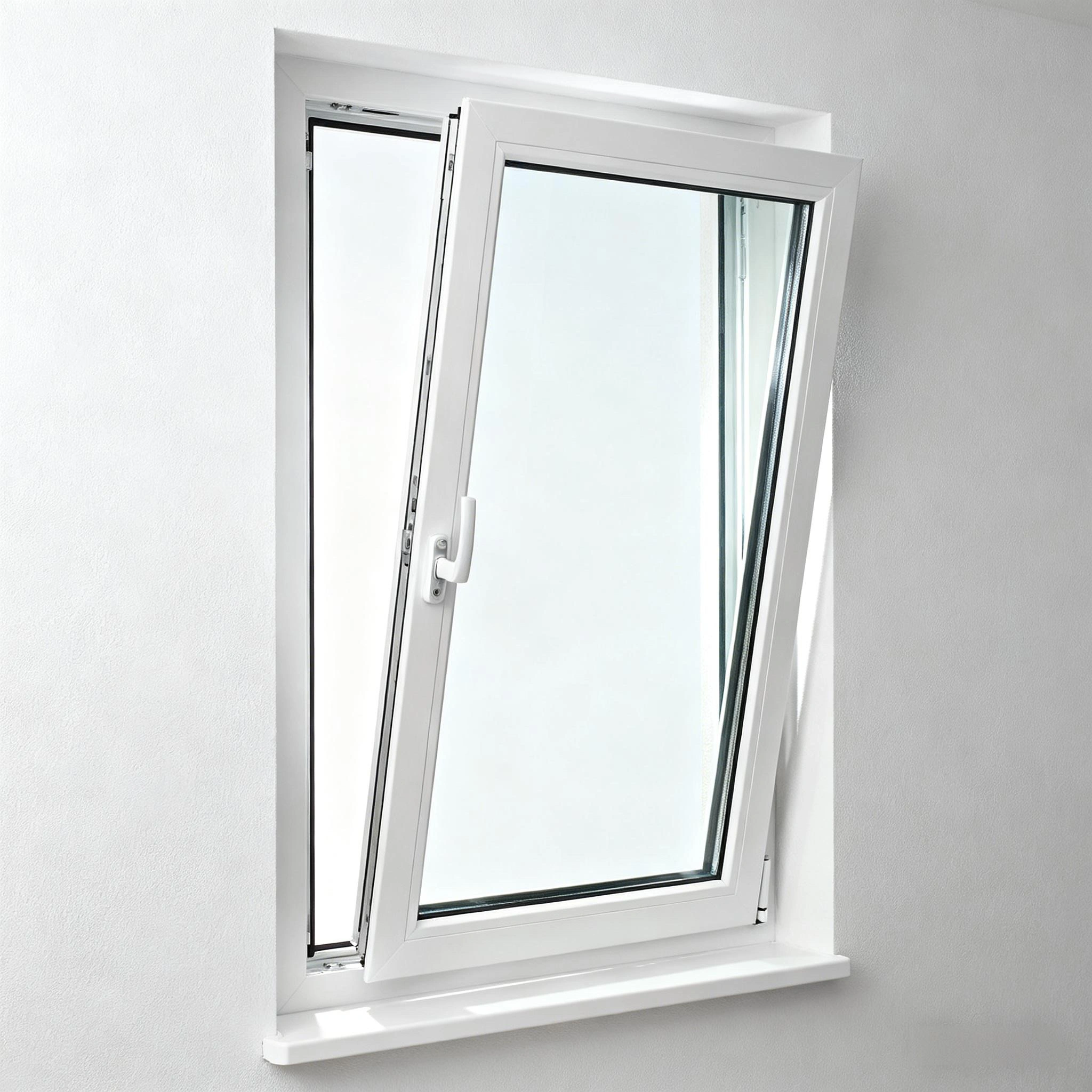
Inward opening UPVC windows rated at 32 dB deliver 29 dB behind a 1 mm joint and 26 dB behind a 3 mm one. The sash is hardly ever the weak point on an acoustic order. The joint is. Ask for the composite figure the assembled window reaches, and for the traffic spectrum term with it.
Where 6 dB goes
Glass at Rw 32 over 1.5 square metres has a transmission area of 0.00095 square metres. A 1 mm gap along 1 m adds 0.001 square metres of fully open path, which alone drops the assembly to 28.9 dB. Open the gap to 3 mm and the assembly reads 25.8 dB. On inward opening UPVC windows the gap is what the certificate never covers.
In this guide:
Which number does an acoustic order actually control?
An acoustic order for inward opening UPVC windows rests on one rating, and EN ISO 717-1 builds it from a measured spectrum, adding two adaptation terms: C for broadband noise and Ctr for traffic. Road and aircraft noise sit low in frequency, where a glazed unit is weakest, so the number that matters on an urban site is Rw + Ctr. A unit at Rw 32 with Ctr of minus 5 gives 27 dB(A) against a road, while a 4 mm single pane at Rw 30 with Ctr of minus 4 gives 26.
That gap of 1 dB explains a recurring surprise on inward opening UPVC windows orders: the specification says 32 dB, the sample reads 32, and the rooms facing the street still complain. The buy was a laboratory single number without the term that matches the source.
Why does a 16 mm cavity dip at 212 Hz?
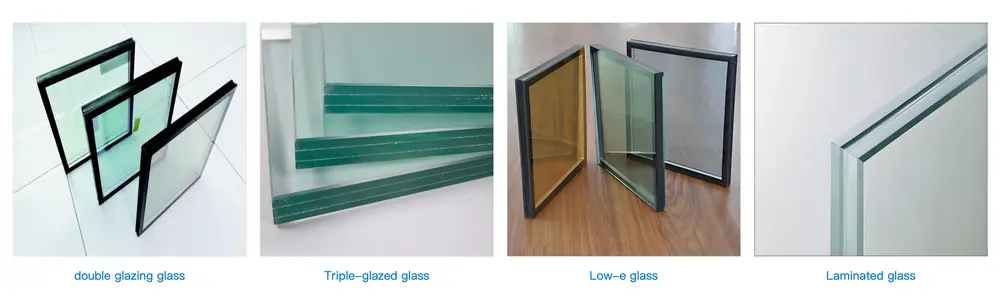
Two panes with air between them behave as a mass spring mass system, and on inward opening UPVC windows the cavity is the one dimension the profile fixes. The spring has a resonance. For panes of mass m1 and m2 in kilograms per square metre and a cavity d in metres, the resonance sits at 60 times the square root of (m1 + m2) divided by (m1 x m2 x d). With two 4 mm panes and a 16 mm cavity that is 212 Hz. Below it the two panes move together and the unit behaves as 20 kg per square metre; at it the cavity pumps and insulation collapses.
The same formula shows why a thicker cavity helps less than buyers expect, and why an asymmetric build helps more. At 6 mm the resonance is 346 Hz, at 12 mm 245 Hz, at 16 mm 212 Hz and at 20 mm 190 Hz. Moving from 16 to 20 mm shifts the dip by 22 Hz. Changing one pane from 4 to 6 mm moves the resonance to 190 Hz and, more usefully, breaks the symmetry that lets both panes vibrate in step.
Where only one pane can change, take the thicker pane to the room side. A 4 mm outer with a 6 mm inner leaves the outer pane light enough to stay stable in sun and the inner pane heavy enough to carry the low frequency. A unit from the flush casement UPVC range with the same 16 mm cavity responds the same way, so one pane schedule serves both casement types.
What does a 3 mm gap cost in decibels?
Sound leaks add by area, and inward opening UPVC windows are no exception, so the assembly figure is 10 times the log of the window area divided by the sum of transmission area times area for each path. A slit counts at close to full transmission, which makes it disproportionately expensive: 0.003 square metres of open path against 0.00095 of glass. On a 1.2 by 1.4 m window the perimeter is 5.2 m, so a 1 mm gap all round is 0.0052 square metres and the assembly tops out near 24 dB whatever the glass is.
| Path | Transmission area | Assembly Rw | Loss |
|---|---|---|---|
| Glass only, Rw 32, 1.5 sqm | 0.00095 sqm | 32.0 dB | reference |
| Plus a 1 mm gap, 1 m long | 0.00195 sqm | 28.9 dB | 3.1 dB |
| Plus a 3 mm gap, 1 m long | 0.00395 sqm | 25.8 dB | 6.2 dB |
| Plus a 5 mm gap, 1 m long | 0.00595 sqm | 24.0 dB | 8.0 dB |
| 1 mm gap around 5.2 m | 0.00615 sqm | 23.9 dB | 8.1 dB |
Assembly Rw = 10 log(A / sum of transmission area), A = 1.5 sqm glass. A slit is taken as fully transmitting, which is the conservative case. Every row is arithmetic on a stated area, calculated, not measured.
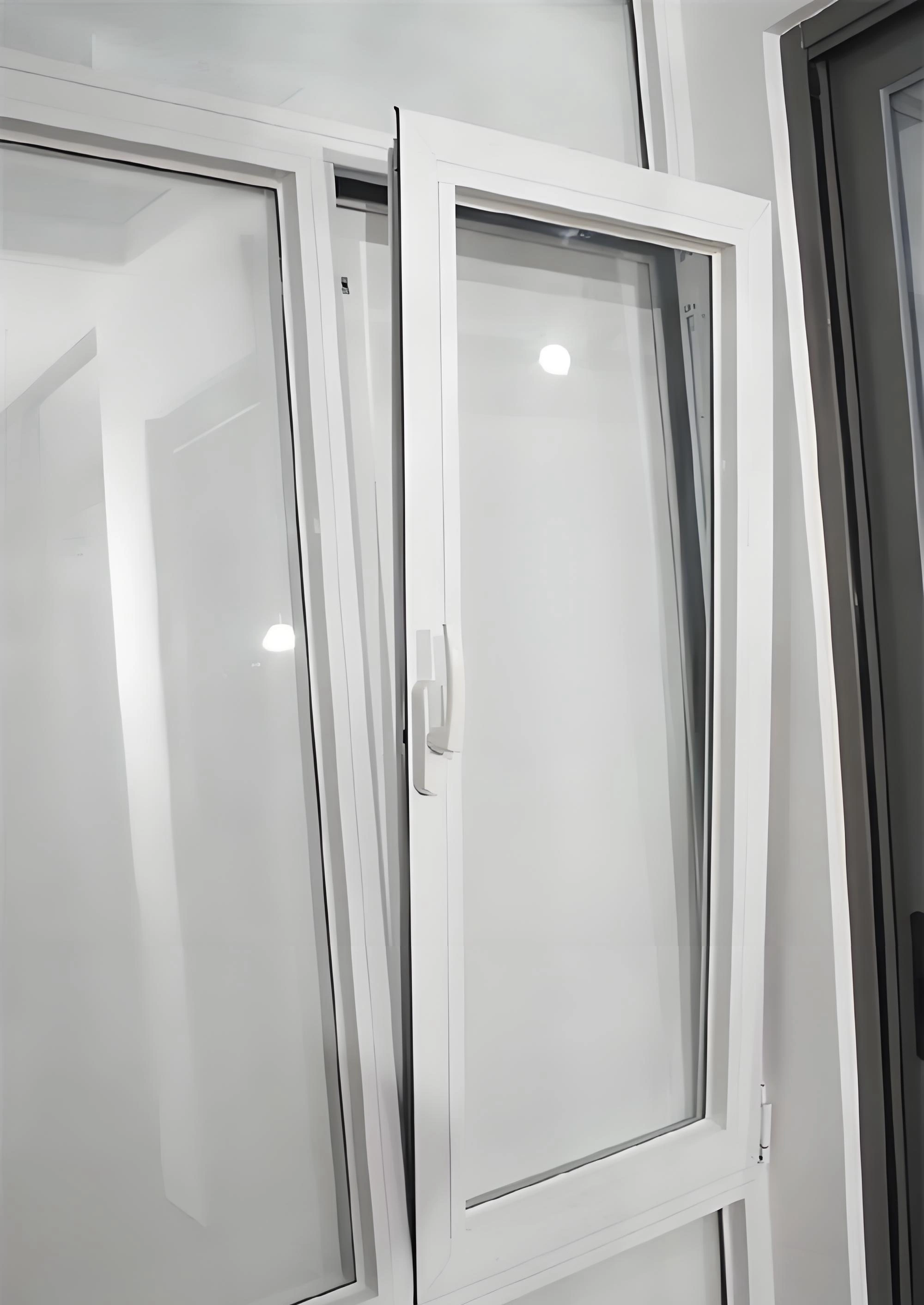
This is where an inward opening sash earns its place. The closing plane sits on the room side and the gasket is compressed against a rebate the wind cannot reach, so the joint that leaks is the outer one, and the inner leg keeps a dry, loaded seal. Windows that open outward lose that second line whenever the wind lifts the sash off its stop.
Why does an inward opening sash seal better in wind?
Wind pressure acts along one direction and either loads a seal or unloads it. On an inward opening sash the gust pushes the leaf onto its rebate, so the gasket compresses further as pressure rises: the seal is self energising up to the point where the sash bears on the frame. At 600 Pa over 1.5 square metres that is 900 N pressing the leaf inward, shared across the lock points and the hinges.
Two consequences follow for sourcing. The hinge side has to carry the same load as the lock side, so the steel reinforcement behind the hinges matters as much as the profile, and vinyl tilt turn units in the same family carry the load through a longer arm than a plain casement. The acoustic result is stable only while the sash stays in contact, which means the lock points have to be spaced for the pressure of the site, with the handle chosen afterwards.
How should an acoustic inward opening order be specified?
Six lines carry an order for inward opening UPVC windows: Rw with Ctr stated together, the glass build-up with pane thicknesses and cavity, the seal material on each of the four sides, the lock point count and spacing, the joint detail at the perimeter, and the test report the figures come from. The last line is the one that separates a specification from a claim, because Rw 35 means nothing until the report names the build-up it was measured on.
Where a site is dominated by low frequency noise from a road or a rail line, an asymmetric build with a laminated pane on the room side does more than any increase in cavity depth. Aluminium soundproofing casements follow the same logic, and the glazing schedule transfers between the two materials.
What does installation do to the tested rating?
Everything above assumes the perimeter joint is closed twice. A window set with a single bead on the outside has an open path around its full perimeter from the cavity to the room, and the 5.2 m figure applies: 24 dB. The detail that holds the rated number is a backer rod, a bead outside, and a bead inside, with the frame packed so the joint stays at its design width.
Send the site noise level, the facade area and the glass schedule to kristin@haolvbuilding.com, and the Rw with Ctr comes back for the build-up that was actually tested. Where a facade faces both a road and a quieter courtyard, urban soundproofing layouts usually mix two glazing builds on one elevation, and the schedule is easier to fix before the frames are ordered.
| Parameter | Typical value | Note |
|---|---|---|
| Product | inward opening UPVC windows | sash opens into the room, seal on the inner rebate |
| Profile | PVC-U multi chamber, steel reinforced | galvanised steel in the sash and the frame |
| Glass | double glazed 4-16-4, U-value 1.2 to 1.6 W/(sqm K) | triple glazed 0.8 to 1.2 |
| Acoustic | Rw 31 to 34 with Ctr of minus 5 on 4-16-4 | laminated build reaches Rw 37, Ctr minus 3 |
| Cavity resonance | 212 Hz at 16 mm, 190 Hz at 20 mm | asymmetric panes move it lower |
| Air permeability | EN 12207, class 4 available | 3 m3/(h sqm) at 100 Pa |
| Wind load | EN 12210, class stated per project | seal is self energising inward |
| Product standard | EN 14351-1 | declaration per order |
| Minimum order | 10-20 units | lead time 25-30 days |
Rw values are the range quoted for the build-up named in each row and are confirmed by the test report for that build-up. The assembly figures in this guide are arithmetic on a stated area, calculated, not measured.
Frequently asked questions
What do wholesale inward opening UPVC windows cost against a fixed window? The sash, the hinges and the lock set are the difference. A fixed light carries glass and a frame; an opening leaf adds a reinforced sash, two hinge sets and a locking bar. On an acoustic order the glazing usually dominates the price, so the sash premium is a smaller share than on a plain window.
Is Rw 35 enough for a house on a main road? Check the term. Rw 35 with Ctr of minus 5 gives 30 dB(A) against traffic, which suits a bedroom set back from a secondary road. A facade a few metres from a busy lane needs a laminated build and a joint detail that is closed twice.
What is the minimum order and lead time? Minimum order is 10-20 units and lead time is 25-30 days from an approved drawing. Windows sharing a glass build-up are glazed in one run, so mixing three acoustic builds on one order adds a glazing changeover for each.
Can the same frame take a different glazing later? Yes within the rebate depth the profile carries. A 24 mm unit and a 36 mm unit need different beads, and the sash weight changes with them, so a later upgrade involves new beads and new hinges. Certification is available on request with the quotation.
Ordering from Haolv
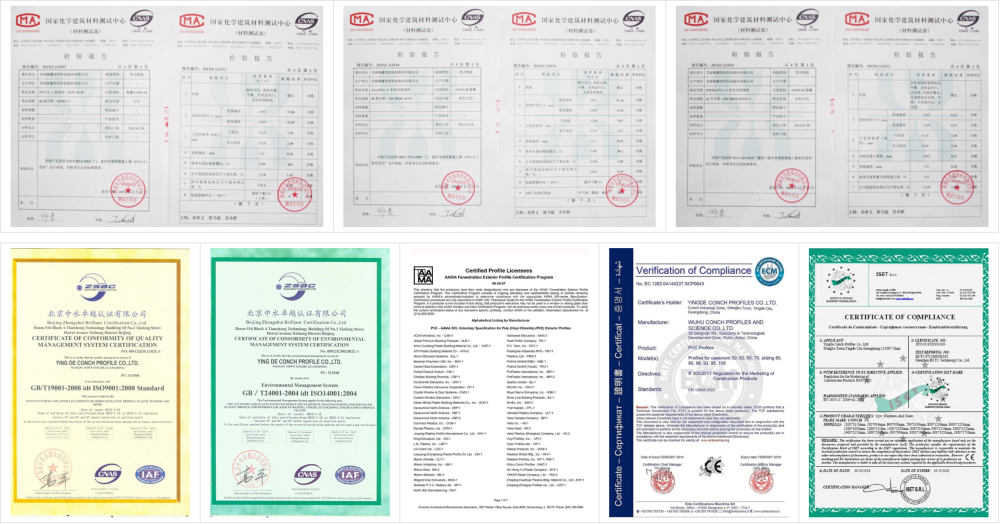
Haolv Building Materials Co., Ltd. has been making doors and windows for 19 years. Inward opening UPVC windows are built on multi chamber PVC-U sections with galvanised steel reinforcement, glazed to EN 14351-1 and supplied with the acoustic figures for the build-up that was tested. Certification is available on request with the quotation. Minimum order is 10-20 units and lead time is 25-30 days.
Send the facade schedule and the site noise level to kristin@haolvbuilding.com, and the glazing build-up, the Rw with Ctr and the joint detail come back per elevation. The full range is listed on the Haolv Building Materials Co., Ltd.
What this page calculates and what a report confirms: the 212 Hz resonance, the 28.9 and 25.8 dB assembly figures and the 900 N wind load are arithmetic on a stated pane mass, a stated cavity, a stated area and a stated pressure. They are calculated, not measured. The Rw and Ctr of a specific window come from the test report on that build-up, and the site noise level comes from a survey of the facade.
References
- EN ISO 717-1:2020 — Acoustics. Rating of sound insulation in buildings and of building elements. Airborne sound insulation.
- EN ISO 10140-2:2021 — Acoustics. Laboratory measurement of sound insulation of building elements. Measurement of airborne sound insulation.
- EN 14351-1:2006+A2:2021 — Windows and doors. Product standard, performance characteristics.
- EN 12207:2017 — Windows and doors. Air permeability. Classification.
- EN 12210:2016 — Windows and doors. Resistance to wind load. Classification.
- EN ISO 10077-1:2017 — Thermal performance of windows, doors and shutters. Calculation of thermal transmittance.
The resonance frequencies, assembly figures and wind loads in this guide are arithmetic on a stated pane mass, a stated cavity depth, a stated window area and a stated pressure, with a slit taken as fully transmitting. They are calculated, not measured. The rated values of a specific window come from the laboratory report on that build-up, and the installed result depends on the perimeter joint.
Fast simple channel to send demands lock favorable price for building window door bulk purchases.