- English
- French
- German
- Portuguese
- Spanish
- Russian
- Japanese
- Korean
- Arabic
- Greek
- German
- Turkish
- Italian
- Danish
- Romanian
- Indonesian
- Czech
- Afrikaans
- Swedish
- Polish
- Basque
- Catalan
- Esperanto
- Hindi
- Lao
- Albanian
- Amharic
- Armenian
- Azerbaijani
- Belarusian
- Bengali
- Bosnian
- Bulgarian
- Cebuano
- Chichewa
- Corsican
- Croatian
- Dutch
- Estonian
- Filipino
- Finnish
- Frisian
- Galician
- Georgian
- Gujarati
- Haitian
- Hausa
- Hawaiian
- Hebrew
- Hmong
- Hungarian
- Icelandic
- Igbo
- Javanese
- Kannada
- Kazakh
- Khmer
- Kurdish
- Kyrgyz
- Latin
- Latvian
- Lithuanian
- Luxembou..
- Macedonian
- Malagasy
- Malay
- Malayalam
- Maltese
- Maori
- Marathi
- Mongolian
- Burmese
- Nepali
- Norwegian
- Pashto
- Persian
- Punjabi
- Serbian
- Sesotho
- Sinhala
- Slovak
- Slovenian
- Somali
- Samoan
- Scots Gaelic
- Shona
- Sindhi
- Sundanese
- Swahili
- Tajik
- Tamil
- Telugu
- Thai
- Ukrainian
- Urdu
- Uzbek
- Vietnamese
- Welsh
- Xhosa
- Yiddish
- Yoruba
- Zulu
Vinyl French Casement Windows Factory Checklist for Paired Sash Orders
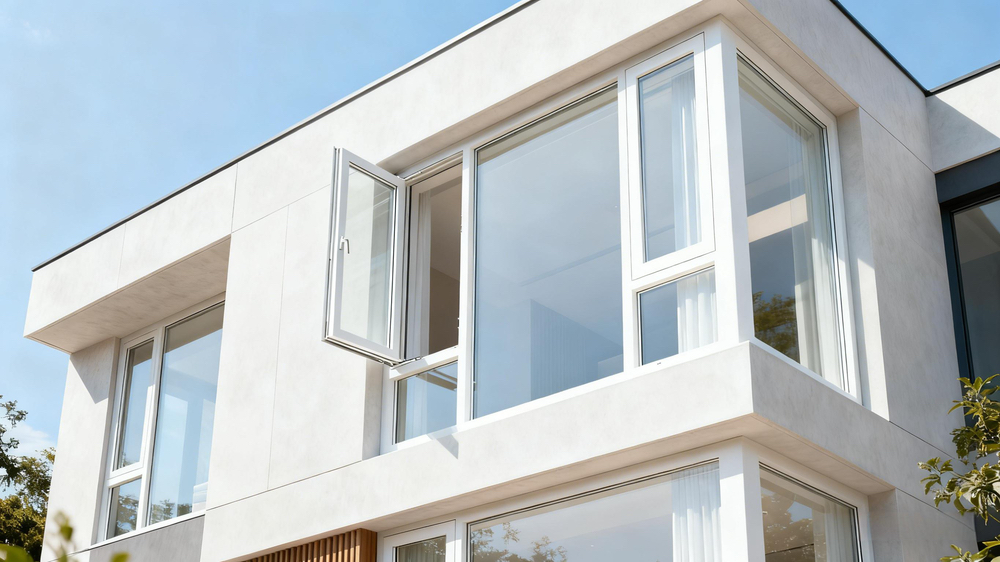
Vinyl french casement windows are a two-leaf system, 1,200 mm plus 1,200 mm, and the meeting stile between the leaves is the only joint with no frame behind it. At 2,000 Pa the gap at mid height opens 1.6 mm, which a 3 mm seal absorbs; the limit arrives near 1,640 mm of sash height.
Four numbers decide the pair
Sash height, wind pressure, the stiffness of the reinforced stile and the compression left in the seal. Take a 1,400 mm sash at 2,000 Pa: half the leaf load is 1,680 N along the stile, which is 1.2 N per mm on a section with EI = 3.8 x 10^10 N mm2, and 5 x 1.2 x 1400^4 / (384 x 3.8e10) gives 1.6 mm of opening.
In this guide:
What changes when two sashes meet with no frame between them?
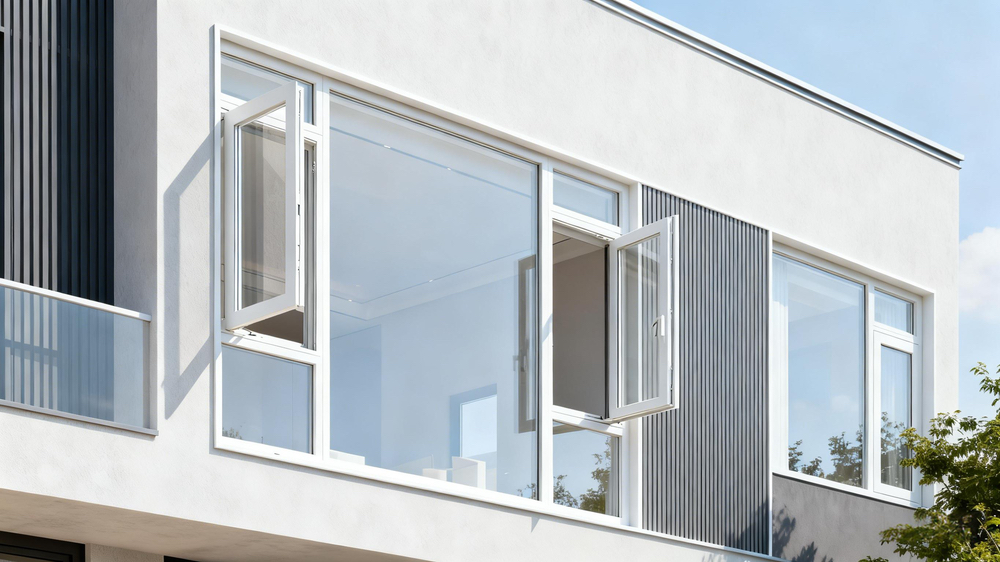
Every outer side of a casement lands on a frame with a drainage chamber behind it, and on vinyl french casement windows the middle joint has nothing behind it at all. A pair keeps the four outer sides and adds a fifth joint down the middle, where one sash presses against the other through a 12 mm overlap and a bulb seal. There is no chamber at that joint, so water and air meet a two-part seal and nothing else.
The layout is worth knowing before the order is placed because it decides the hardware. One leaf carries the handle and the lock, the other carries flush bolts at head and sill and nothing in between. That second leaf is held at two points over its full height, and everything this page calculates follows from those two points. The five casement opening styles differ in exactly this respect: how many points hold the moving leaf.
How far does the meeting joint open under wind load?
Treat the reinforced meeting stile as a beam spanning the two flush bolts. A 1,200 by 1,400 mm leaf has 1.68 square metres, so at 2,000 Pa it carries 3,360 N. Roughly half of that resolves along the meeting stile, which is 1,680 N over 1,400 mm, or w = 1.2 N per mm.
A 60 by 70 mm PVC-U stile with a 1.5 mm steel liner has a second moment of area of about 175,000 mm4 in the liner alone, which at 210,000 N/mm2 gives EI = 3.8 x 10^10 N mm2 with the PVC-U wall added. Then delta = 5wL^4 / (384EI) = 5 x 1.2 x 1400^4 / (384 x 3.8e10) = 1.6 mm. A 3 mm bulb seal still has 1.4 mm of compression left at that point.
Where does the height limit of a pair come from?
The constraint is the seal. On vinyl french casement windows deflection goes as the fourth power of the span, so the same stile at different heights opens very differently: 1,200 mm gives 0.9 mm, 1,400 mm gives 1.6 mm, 1,700 mm gives 3.4 mm and 2,000 mm gives 6.6 mm. The 3 mm compression in the bulb is used up between 1,600 and 1,700 mm.
| Sash height | Opening at 2,000 Pa | Seal left | Third lock point at mid height | Opening with it |
|---|---|---|---|---|
| 1,200 mm | 0.9 mm | 2.1 mm | not needed | n/a |
| 1,400 mm | 1.6 mm | 1.4 mm | optional | 0.10 mm |
| 1,600 mm | 2.7 mm | 0.3 mm | recommended | 0.17 mm |
| 1,700 mm | 3.4 mm | none | required | 0.21 mm |
| 2,000 mm | 6.6 mm | none | required, plus a stronger liner | 0.41 mm |
1,200 mm wide leaf, 1.2 N per mm along the meeting stile, EI = 3.8 x 10^10 N mm2, delta = 5wL^4/(384EI). Halving the span cuts deflection by 16. Every figure is arithmetic on a stated section and a stated pressure, calculated, not measured.
What does the extra joint cost in air permeability?
Count the joint length on a pair of vinyl french casement windows. Two leaves of 1,200 by 1,400 mm have 5.2 m of perimeter each, so 10.4 m of leaf seal, plus 2 x 1.4 = 2.8 m down the meeting stile. Two single casements filling the same opening with a 120 mm mullion between them have 10.4 m and no middle joint. The pair saves the mullion and pays 2.8 m of seal, which is 27 percent more joint on the same opening.
Now put the class beside the length. EN 12207 class 4 allows 3 cubic metres an hour per square metre at 100 Pa, which on a 2.4 by 1.4 m opening is 10.1 cubic metres an hour. Spread over 13.2 m of joint that is 0.76 cubic metres an hour per metre. That is a two-seal budget, and it is the reason a paired leaf gets a bulb seal plus an inner lip while a fixed light gets one gasket.
Rain at that joint is handled by a cover profile on the outer face and by the overlap itself. The detail is the one place a pair differs from a single leaf in water performance, and it is worth reading casement installation guidance on how the frame is packed before the leaves go in, because a frame that twists by 2 mm opens the middle joint before the wind does.
Why must a pair be matched in height and handed?
The two leaves are welded separately, so each carries its own tolerance. At plus or minus 1 mm per leaf the pair can meet with a 2 mm step, and a 12 mm overlap with a 3 mm bulb leaves 1 mm of margin on the worst side. A step that size shows as a shadow line down the middle of the window and as a wet line in driving rain.
Thermal movement works against the same tolerance. PVC-U moves about 7 x 10^-5 per kelvin, so a 1,200 mm leaf crosses 3.4 mm over a 40 K swing, and the lock seats have to absorb that between them. A seat with plus or minus 1.5 mm of adjustment covers a 3 mm range, which is less than the movement, so the middle joint needs slotted screw holes so the seat can travel. Handing is the other half: the lock and the flush bolts sit on opposite leaves, and a pair built the wrong way round cannot be rehung in the frame.
How should a paired vinyl french casement order be specified?
A vinyl french casement windows order runs on five lines, and the first two are the ones that cause claims: leaf height and width written as a pair with the handing, and the lock point count per leaf with the height it was checked against. Then the seal schedule per side, the glass build-up with its U-value, and the wind pressure the stile deflection was calculated at. A pair ordered at 1,700 mm without a third lock point will still be built, and it will whistle at the middle on a windy night.
Where the opening is wider than about 2,600 mm a pair stops being the efficient answer and vinyl casement windows with a fixed centre light work out cheaper per square metre, since the fixed light carries no hardware and no middle joint.
On a tall narrow opening, flush casement UPVC windows keep the same leaf geometry and move the seal line into the frame plane. Send the opening list with heights and handing and the lock point count comes back per pair, checked against the design wind pressure for the site.
| Parameter | Typical value | Note |
|---|---|---|
| Product | vinyl french casement windows | two equal leaves, handed pair |
| Profile | PVC-U multi-chamber, steel liner 1.5 mm | liner is a structural part on tall leaves |
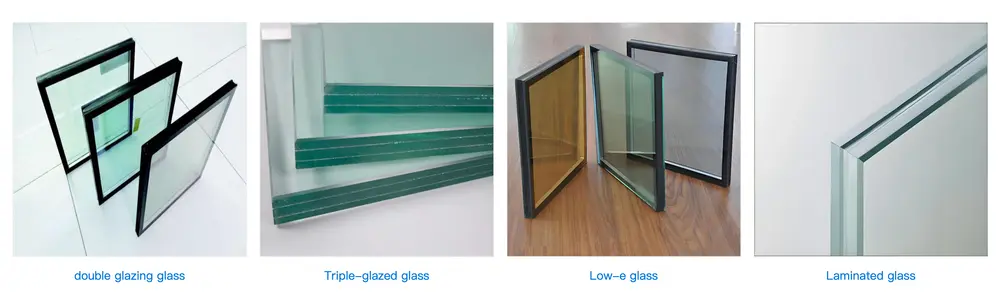
| Glass | double glazed 4-16-4, U-value 1.2 to 1.6 W/(sqm K) | low-e and argon for cold climates |
| Meeting joint | 12 mm overlap, bulb seal plus lip | no drainage chamber behind it |
| Lock points | two up to 1,600 mm, three above | third point at mid height |
| Air permeability | EN 12207, class 4 available | 2.4 by 1.4 m pair budgets 0.76 m3/(h m) of joint |
| Wind load | EN 12210, class stated per project | deflection checked at the design pressure |
| Product standard | EN 14351-1 | profile to EN 12608-1 |
| Minimum order | 10-20 units | lead time 25-30 days |
Lock point counts and liner thickness are set per leaf height and design wind pressure. The deflections in this guide are beam arithmetic on a stated section, calculated, not measured.
Frequently asked questions
What is the MOQ for wholesale vinyl french casement windows? Minimum order is 10-20 units and lead time is 25-30 days from an approved drawing. Leaf heights that need a third lock point are priced with the extra hardware, so mixing heights in one order splits the hardware line.
How tall can a pair be before a third lock point is needed? Above about 1,600 mm. At 1,400 mm the meeting stile opens 1.6 mm at 2,000 Pa and the bulb seal keeps 1.4 mm; at 1,700 mm the opening is 3.4 mm and the seal has nothing left.
Which supplier figure should be checked first? On vinyl french casement windows, the seal schedule at the meeting stile, then the lock point count. A quotation that lists a bulb seal without saying whether the middle joint has an inner lip has not specified the one joint that separates a pair from a single leaf.
Can the two leaves differ in width? Not on a true pair, because the meeting stiles have to land on each other. Unequal leaves need a fixed mullion in the middle, which is a different product and a different price per square metre.
Ordering from Haolv
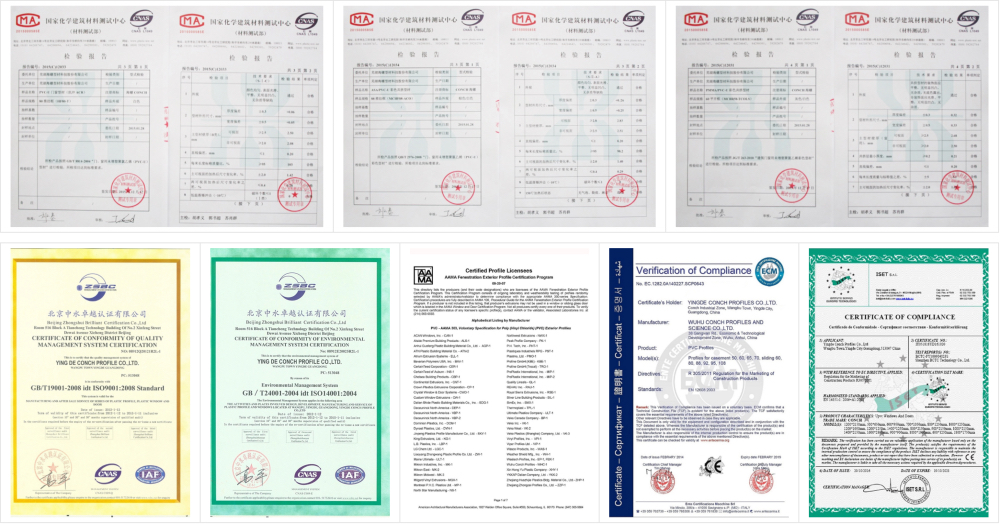
Haolv Building Materials Co., Ltd. has been making doors and windows for 19 years. Vinyl french casement windows are built on multi-chamber PVC-U profiles, glazed to EN 14351-1 and supplied as a matched pair with the lock point count and the seal schedule on the drawing. Certification is available on request with the quotation. Minimum order is 10-20 units and lead time is 25-30 days.
Send the opening list with heights, handing and the design wind pressure to kristin@haolvbuilding.com, or start from Haolv Building Materials Co., Ltd. and the pair schedule comes back per opening.
What this page calculates and what a project confirms: the 1.6 mm opening, the 0.9, 2.7, 3.4 and 6.6 mm figures, the 1,640 mm limit, the 13.2 m joint length and the 3.4 mm thermal movement are arithmetic on a stated section, a stated pressure and a stated temperature swing. They are calculated, not measured. The section of a specific profile, the compression set of a specific seal and the design wind pressure of a specific site come from the profile data sheet, the seal supplier and the structural drawings.
References
- EN 14351-1:2006+A2:2021 — Windows and doors. Product standard, performance characteristics.
- EN 12207:2017 — Windows and doors. Air permeability. Classification.
- EN 12210:2016 — Windows and doors. Resistance to wind load. Classification.
- EN 12208:2000 — Windows and doors. Watertightness. Classification.
- EN 12608-1:2016 — Unplasticized polyvinylchloride (PVC-U) profiles for the fabrication of windows and doors. Classification, requirements and test methods.
- EN ISO 10077-1:2017 — Thermal performance of windows, doors and shutters. Calculation of thermal transmittance.
The deflections, joint lengths and thermal movements in this guide are beam arithmetic and expansion arithmetic on a stated stile section, a stated wind pressure and a stated temperature swing. They are calculated, not measured. Actual figures depend on the reinforcement in the profile supplied, the seal fitted and the design wind pressure of the site.
Fast simple channel to send demands lock favorable price for building window door bulk purchases.