- English
- French
- German
- Portuguese
- Spanish
- Russian
- Japanese
- Korean
- Arabic
- Greek
- German
- Turkish
- Italian
- Danish
- Romanian
- Indonesian
- Czech
- Afrikaans
- Swedish
- Polish
- Basque
- Catalan
- Esperanto
- Hindi
- Lao
- Albanian
- Amharic
- Armenian
- Azerbaijani
- Belarusian
- Bengali
- Bosnian
- Bulgarian
- Cebuano
- Chichewa
- Corsican
- Croatian
- Dutch
- Estonian
- Filipino
- Finnish
- Frisian
- Galician
- Georgian
- Gujarati
- Haitian
- Hausa
- Hawaiian
- Hebrew
- Hmong
- Hungarian
- Icelandic
- Igbo
- Javanese
- Kannada
- Kazakh
- Khmer
- Kurdish
- Kyrgyz
- Latin
- Latvian
- Lithuanian
- Luxembou..
- Macedonian
- Malagasy
- Malay
- Malayalam
- Maltese
- Maori
- Marathi
- Mongolian
- Burmese
- Nepali
- Norwegian
- Pashto
- Persian
- Punjabi
- Serbian
- Sesotho
- Sinhala
- Slovak
- Slovenian
- Somali
- Samoan
- Scots Gaelic
- Shona
- Sindhi
- Sundanese
- Swahili
- Tajik
- Tamil
- Telugu
- Thai
- Ukrainian
- Urdu
- Uzbek
- Vietnamese
- Welsh
- Xhosa
- Yiddish
- Yoruba
- Zulu
Bulk Thermal Break Casement Windows for Ventilation Led Residential Projects
Thermal break casement windows pass 1.77 square metres of free air on a 1,500 by 1,400 mm opening, against 0.85 for the same opening in sliding and 0.076 for a tilt only setting. A 14 square metre room needs 0.56 of that area to pass a natural ventilation check.
Three numbers decide the answer
Free area on the opening, demand from the floor area, and the air change a purge setting has to reach. On a 1,500 by 1,400 mm opening the three are 1.77 square metres, 0.56 square metres and 84 air changes an hour. A window that fails the third number still passes the first two.

In this guide:
How much of a casement window actually opens when the sash swings out?
More than any other opening type, and the arithmetic is simple. Free area is the clear opening left once the sash has swung clear, less the sash member on the closing side and the frame rebate. On thermal break casement windows with 60 mm members that band is 60 mm on the hinge side of the clear width and 120 mm top and bottom, so a 750 by 1,400 mm sash passes 690 by 1,280 mm.
That is 0.883 square metres per sash, and two sashes on a 1,500 by 1,400 mm opening give 1.77 square metres, which is 84 percent of the wall hole. A sliding leaf on the same opening has to slide behind its partner, so the interlock and the jamb engagement take 90 mm off the width: 660 by 1,280 mm, or 0.845 square metres, 40 percent of the hole.
| Opening on 1,500 by 1,400 mm | Free area | Share of hole | Verdict for a 14 sqm room |
|---|---|---|---|
| two side hung sashes, both open | 1.77 sqm | 84% | passes 4% and 5% with margin |
| one sliding leaf | 0.845 sqm | 40% | passes 4%, tight at 5% |
| tilt only, 110 mm gap | 0.076 sqm | 3.6% | fails both, background only |
| side hung with 100 mm restrictor | 0.069 sqm | 3.3% | fails both, safety wins |
| top hung sash open 45 degrees | 0.59 sqm | 28% | passes 4% on its own |
Free area is the clear opening with the sash fully open, less 60 mm of sash member on the closing side and 120 mm top and bottom, and 90 mm of interlock and jamb engagement on a sliding leaf. These are arithmetic on a stated opening, calculated and not measured on a delivered window.
The bottom row is the one that trips up mixed elevations. A top hung sash does open wide, and at 45 degrees it still gives 0.59 square metres, but that sash is 700 mm tall on a 1,400 mm opening, so half the hole is fixed. A manual awning window of the same glass area will always beat a casement on rain protection and always lose on free area.
How much free area does a room need before the window passes?
Most codes set a natural ventilation line at 4 percent of the floor area, and purge or rapid ventilation at 5 percent. A 4.0 by 3.5 metre bedroom is 14 square metres, so the two lines are 0.56 and 0.70 square metres of free area. The room volume at 2.7 metres is 37.8 cubic metres, and that is the figure the air change rate divides into.
Turning area into air needs one more number, the velocity through the opening. On thermal break casement windows at 0.5 metres a second, a normal cross draught, 1.77 square metres passes 0.885 cubic metres a second, or 3,186 cubic metres an hour, which is 84 air changes on a 37.8 cubic metre room. At 0.1 metres a second in still air the same window still gives 637 cubic metres an hour and 17 air changes.
That is why a casement on a hot elevation is worth more than a better U-value. A frame carries heat by conduction at a rate measured in watts; an open sash carries it out with the air at a rate measured in kilowatts. The sliding and casement comparison changes completely once the question becomes how many air changes an hour.
Why does a tilt only setting fail a purge calculation?
Because the opening is a slot, not a hole. A tilt setting on a 750 mm sash leaves about 110 mm of gap at the top, so the free area is 0.076 square metres on a 2.10 square metre opening, 3.6 percent of the hole and far below the 0.56 the bedroom needs. In air terms that is 82 cubic metres an hour at 0.3 metres a second.
Eighty two cubic metres an hour is not a failure. Eight litres a second per person for two people is 57.6 cubic metres an hour, so a tilt setting covers background ventilation comfortably with the room locked. It simply cannot clear a room that has been shut all afternoon.
The setting that resolves both is one tilt turn plus one casement in the same room. In practice that pairing is what the four opening styles come down to on a real elevation, because the two functions sit on two sashes.
The tilt and turn casement window carries the background line at 82 cubic metres an hour with the room locked, and the purge comes from the casement beside it at 3,186. That split costs one extra sash and removes the whole argument about whether the room is ventilated.
What does an open sash meet in wind, and what holds it?
A 750 by 1,400 mm sash is 1.05 square metres of sail. At 800 Pa, the pressure a 36 metre a second gust produces, the pull on the stays is 840 newtons, so two friction stays carry 420 newtons each. A stay rated at 300 newtons will hold the sash closed and lose it open, which is the failure mode seen on upper floors.
The number is worth carrying into the order because it is not on any datasheet. Wind load class on thermal break casement windows is stated to EN 12210 and tested closed; the open sash is a separate mechanical problem, and the stay rating is the only figure that covers it. Ask for the stay load with the quotation.

Which frame and glass figures still matter once the opening is solved?
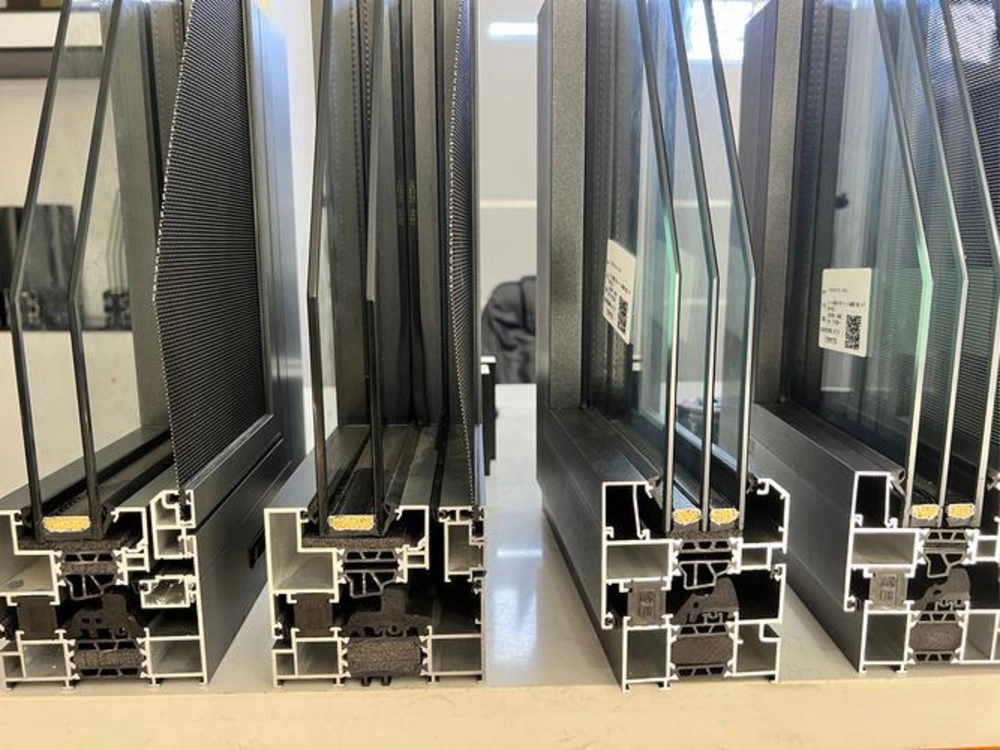
The thermal break carries the winter. A polyamide strip at roughly 0.3 watts per metre kelvin sits between two aluminium chambers at 160 to 200, and a 24 mm strip takes frame U-value to about 4.0, a 34 mm strip to 3.5. Whole window values on thermal break casement windows run 2.0 to 2.7 with a double glazed unit.
The glass carries the rest: low-e and argon take a 4-16-4 unit to 1.2 to 1.6 watts per square metre kelvin, and a triple unit to 0.8 to 1.2. Those are the figures a buyer should see in writing, because the opening arithmetic above is fixed by geometry while the U-value is where a cheap quote trims.
| Parameter | Typical value | Note |
|---|---|---|
| Product | thermal break casement windows | 6063-T5, PA66 GF25 strip |
| Opening | 1,500 by 1,400 mm | two sashes, 750 mm each |
| Free area, both open | 1.77 sqm | calculated, not measured |
| Free area, tilt only | 0.076 sqm | 110 mm gap at the head |
| Frame U-value | 3.5 to 4.0 W per sqm kelvin | 24 mm and 34 mm strips |
| Whole window U-value | 2.0 to 2.7 W per sqm kelvin | double glazed, low-e and argon |
| Glazing | 4-16-4 to triple | 1.2 to 1.6, triple 0.8 to 1.2 |
| Wind load | EN 12210, class by project | stay load stated separately |
| Air permeability | EN 12207 class 3 to 4 | tested closed, gasket dependent |
| Minimum order | 10-20 units | lead time 25-30 days from approved drawing |
Free areas are arithmetic on the stated opening and member widths. U-values are standard ranges for the stated build ups. Wind load and air permeability classes are confirmed per order against the test report for that specification.
Which numbers should the enquiry carry so the quote is comparable?
Four: the opening size, the floor area of the room behind it, the free area the local code asks for, and the wind load or storey height for thermal break casement windows on that elevation. Send those and the sash split, the free area and the stay load come back together, so two quotes can be read against the same line. kristin@haolvbuilding.com takes drawings in any format.
How is the drawing checked before the order is placed?
Three checks, all of them arithmetic on the drawing for thermal break casement windows. Multiply the clear sash width by the clear height and compare it with 4 percent of the floor area. Confirm the sash split, because two 750 mm sashes and one 1,500 mm sash open the same area while only one of them can be built. And read the stay rating against the wind pressure for the storey, which is the figure most drawings leave out.
A casement that clears the free area line and the stay load is a window that works in year one and year fifteen. The free area never changes; the stay is the part that wears, and it is the cheapest line on the order to get right.
Frequently asked questions
What is the minimum order for bulk thermal break casement windows? Minimum order is 10-20 units and lead time is 25-30 days from an approved drawing. Orders that mix two sash splits in one elevation are priced per split, because the cutting list changes with it.
Is the wholesale price quoted per square metre or per unit? Per unit, with the opening size and the sash count on the line for each set of thermal break casement windows. A per square metre rate hides the sash split, and the sash split is what decides the free area the client is paying for.
Can the restrictor and the ventilation line both be met? On one window, no. A 100 mm restrictor takes the free area to 0.069 square metres whatever the sash size, so the usual answer is a restricted casement for safety beside a tilt turn that carries the air.
Which supplier figure is worth checking first? The stay rating, then the sash member width. Member width sets the free area directly, and a 70 mm member on the same opening costs about 3 percent of it, which on a house with thirty windows is most of one window of air.
Ordering from Haolv
Haolv Building Materials Co., Ltd. has been making doors and windows for 19 years. Thermal break casement windows are cut from 6063-T5 billet, assembled with PA66 GF25 strips and friction stays, and glazed to EN 12150-1 on the same line as the sliding range. Certification is available on request with the quotation. Minimum order is 10-20 units and lead time is 25-30 days.
Send the opening sizes, the floor areas and the storey heights to kristin@haolvbuilding.com, or start from Haolv Building Materials Co., Ltd. and the free area per room comes back with the price, sash split by sash split.
What this page calculates and what it leaves to the order: the 1.77, the 0.845, the 0.076 and the 84 air changes are arithmetic on a stated 1,500 by 1,400 mm opening, 60 mm members and a 2.7 metre ceiling. They are calculated, not measured. The code line for a project is the figure the local authority accepts, and the wind and air classes of any window come from its test report.

References
- EN 12207:2017 — Windows and doors. Air permeability. Classification.
- EN 12208:1999 — Windows and doors. Watertightness. Classification.
- EN 12210:2016 — Windows and doors. Resistance to wind load. Classification.
- EN 14351-1:2006+A2:2016 — Windows and doors. Product standard. Performance characteristics.
- EN ISO 10077-1:2017 — Thermal performance of windows, doors and shutters. Calculation of thermal transmittance.
- EN 12150-1:2015 — Glass in building. Thermally toughened soda lime silicate safety glass.
Free areas, air change rates, stay loads and U-values in this guide are arithmetic on a stated opening, stated member widths and a stated room. They are calculations from a drawing, not measurements of a delivered window, and the classes of any set are taken from the test report for that specification.
Fast simple channel to send demands lock favorable price for building window door bulk purchases.