- English
- French
- German
- Portuguese
- Spanish
- Russian
- Japanese
- Korean
- Arabic
- Greek
- German
- Turkish
- Italian
- Danish
- Romanian
- Indonesian
- Czech
- Afrikaans
- Swedish
- Polish
- Basque
- Catalan
- Esperanto
- Hindi
- Lao
- Albanian
- Amharic
- Armenian
- Azerbaijani
- Belarusian
- Bengali
- Bosnian
- Bulgarian
- Cebuano
- Chichewa
- Corsican
- Croatian
- Dutch
- Estonian
- Filipino
- Finnish
- Frisian
- Galician
- Georgian
- Gujarati
- Haitian
- Hausa
- Hawaiian
- Hebrew
- Hmong
- Hungarian
- Icelandic
- Igbo
- Javanese
- Kannada
- Kazakh
- Khmer
- Kurdish
- Kyrgyz
- Latin
- Latvian
- Lithuanian
- Luxembou..
- Macedonian
- Malagasy
- Malay
- Malayalam
- Maltese
- Maori
- Marathi
- Mongolian
- Burmese
- Nepali
- Norwegian
- Pashto
- Persian
- Punjabi
- Serbian
- Sesotho
- Sinhala
- Slovak
- Slovenian
- Somali
- Samoan
- Scots Gaelic
- Shona
- Sindhi
- Sundanese
- Swahili
- Tajik
- Tamil
- Telugu
- Thai
- Ukrainian
- Urdu
- Uzbek
- Vietnamese
- Welsh
- Xhosa
- Yiddish
- Yoruba
- Zulu
Wholesale Two Track UPVC Sliding Windows for Ten Year Air Tightness Budgets
Two track UPVC sliding windows lose their air class through one part: the bead. A 6 mm gasket pressed to 30 percent gives 1.8 mm of seal, the class 4 budget on a 1.5 by 1.2 metre window is 5.4 cubic metres an hour, and a 0.2 mm gap around 5.4 metres of perimeter passes about 50.
One bead, three numbers
Squeeze 1.8 mm, a set that eats 0.45 to 0.90 of it, and a 1.0 mm contact line below which the seal stops being a seal. The first two are design, the third is ten years of weather, and only the third is missing from a quotation.

In this guide:
What actually holds the seal on a two track sliding window?
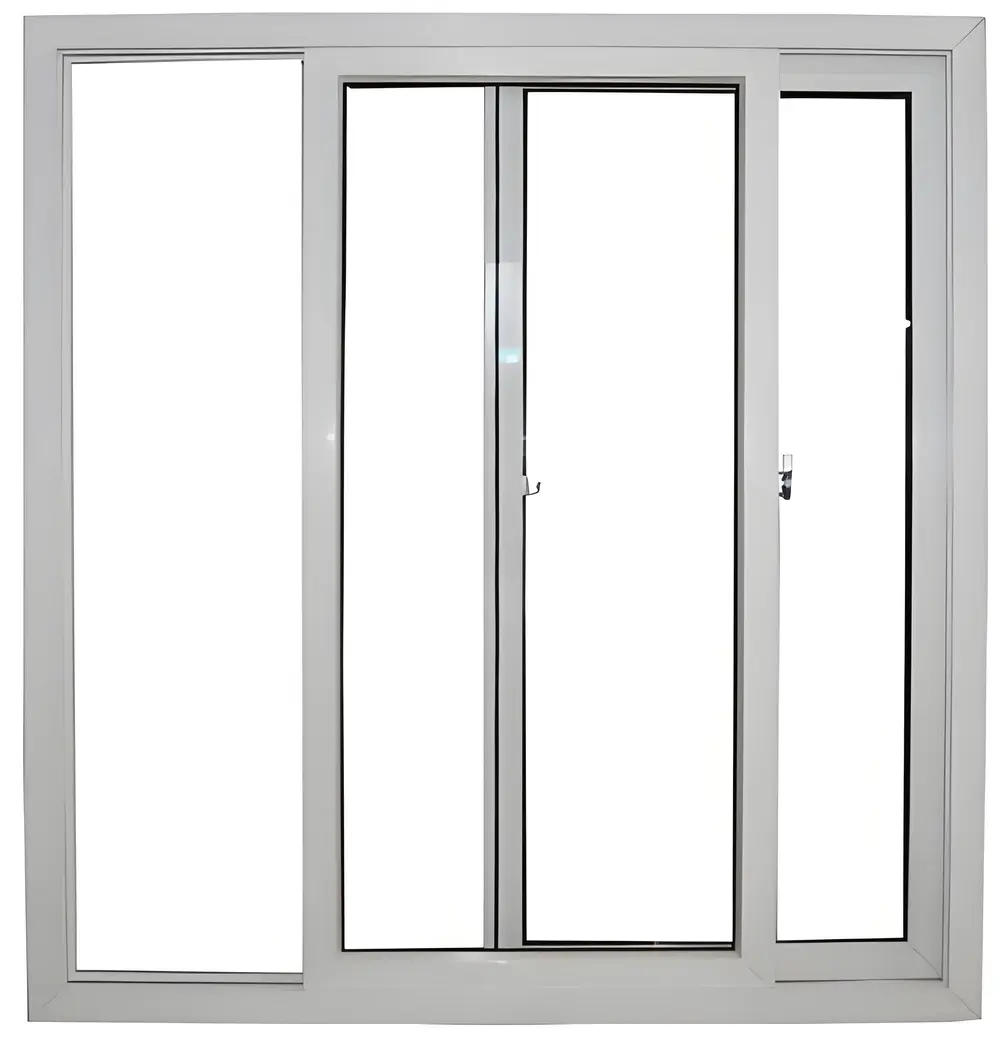
Three things in series: the interlock, the bead and the closing pressure. On two track upvc sliding windows the interlock carries two brush lines where a casement has one compression bead, and a brush is a restrictor, not a seal. It cuts the opening to a labyrinth and leaves the air class to the compressible parts at the jambs, the head and the sill.
That is why the bead does all the work and gets none of the attention. A two track window has one moving plane per leaf and one interlock between them, so the total sealing line on a 1,500 by 1,200 mm window is 5.4 metres of perimeter plus twice the height at the interlock, about 7.8 metres, against 16.8 metres on a casement of the same size where every sash edge needs its own bead.
A shorter line sounds like an easier job. It is the opposite, because the same 0.2 mm of failure on 7.8 metres is concentrated on fewer, longer paths that run the full height of the window. A single hardened bead at one jamb is enough to move a whole elevation down a class.
How much compression is designed in, and how much is left in year ten?
On two track upvc sliding windows a 6 mm hollow bead is set to compress 30 percent at the closing stop, which is 1.8 mm. The closing stop is machined so that the leaf bottoms with 1.8 mm of squeeze and no more, because over compressing a hollow bead buckles it and opens a line along the fold.
Compression set is what is left after the squeeze is released. Measured to ISO 815-1 at 70 hours and 70 degrees, a good EPDM returns to within 25 percent of its compressed thickness, so 1.8 mm becomes 1.35 mm of live seal. Thermoplastic elastomer sits at 30 to 40 percent and plasticised PVC at 40 to 50 percent, which leaves 0.90 mm.
| Gasket | Set after 10 years | Live seal left | Verdict against 1.0 mm |
|---|---|---|---|
| EPDM, welded corner | 20 to 25% | 1.35 to 1.44 mm | holds class 4 with margin |
| TPE, welded corner | 30 to 40% | 1.08 to 1.26 mm | holds class 3, class 4 on test |
| plasticised PVC | 40 to 50% | 0.90 to 1.08 mm | drops under the contact line |
| EPDM, mitred and glued | 25% at the bead | joint is the leak | class decided by the corner |
Set values are typical ranges for the material families under ISO 815-1 at 70 hours and 70 degrees, applied to a 1.8 mm squeeze on a 6 mm bead. The 1.0 mm contact line is a working threshold for a hollow bead, and the class that results is confirmed on the test report for the actual gasket.
The reason this matters on a hot elevation is that the set is reached in service, not in the factory. A white profile at 70 degrees on a west wall runs the bead at close to its test temperature for months, so the thirty year figure is really a ten year figure on that elevation and a twenty year figure on a shaded one.
What does a 0.2 mm gap around the perimeter cost in air?
More than the whole budget. A uniform 0.2 mm line around 5.4 metres is 0.00108 square metres. At 100 Pa the velocity through an orifice works out at 12.9 metres a second from the square root of twice the pressure over air density, so the flow is 0.0139 cubic metres a second, or 50 cubic metres an hour.
On two track upvc sliding windows EN 12207 class 4 allows 3 cubic metres an hour per square metre at 100 Pa, which on a 1.8 square metre window is 5.4 cubic metres an hour. A discharge coefficient of 0.6 brings the 50 down to 30, and 30 is still five times the budget. Working backwards, class 4 on this window tolerates an average gap of 0.02 mm.
Two conclusions follow. A contact seal is the only thing that works, because no gap small enough to pass is buildable. And the class is decided by the worst 100 mm of the perimeter, which is why a sample window that reads well on the bench can fail on site after one season of sun. The high rise window guide makes the same point from the pressure side.
Which gasket material keeps its set on a hot wall?
EPDM, and on two track upvc sliding windows the reason is the absence of plasticiser. A plasticised PVC bead starts soft and ends hard, because the plasticiser migrates into the profile and out of the bead, and the bead that was 65 Shore A becomes 85. Hard beads do not compress, they sit on the surface and let air past the fold.
The second variable is the corner, and it is where a good material loses. TPE welds, so a corner is a continuous ring with no joint. EPDM is glued at a mitre, and a glued mitre on a hollow bead leaves a joint that opens and closes with every cycle. On two track upvc sliding windows the frame corners are welded and the bead corners are often not, which is the quietest defect on the whole window.
On a flush casement the bead runs in a groove that holds it in place, so a joint that opens is contained. A flush casement UPVC window therefore tolerates a glued corner better than a slider does, which is the opposite of what the price list suggests.
Where does the frame movement go if the bead is already compressed?
PVC-U moves 7 times 10 to the minus 5 per kelvin, so a 1,500 mm frame sees 4.2 mm over a 40 K swing. That number is larger than the 1.8 mm of squeeze the bead was designed for, and it is why the frame has to be fixed so the movement goes into the joint between frame and wall, with packers at the fixing points and a compressible foam backer behind the bead line.
Two tracks change this arithmetic, because the second plane adds stiffness in the direction the frame wants to bow. A three track UPVC sliding window adds a third plane and 42 mm of depth, so its 3,000 mm frame bows less across the middle and the bead at the head keeps its squeeze on a wider opening.
Which gasket lines belong in the purchase order?
Three lines for two track upvc sliding windows: the material with the compression set figure, the corner method, and the replacement part number. Those three decide whether the window still passes class 4 in year eight, and none of them appears on a price per square metre. Send the elevation and the required class to kristin@haolvbuilding.com and the bead spec comes back with the price.
How is a sample window checked, and which figures go into the specification?
Four checks that need no rig. Squeeze test: close the leaf on a strip of paper at four points, and a strip that pulls out without drag marks the leak. Corner check: bend the bead at the mitre and look for a gap that opens. Set check: press the bead with a thumbnail at the head and at the sill, and a bead that stays dented has already taken a set. Sight line: a straight edge along the closing face shows a leaf that is out of wind and sealing on one corner only.
A window that passes all four is a window whose class holds through its first decade. The range of UPVC window types all use the same bead logic, so the check travels across the whole order.

| Parameter | Typical value | Note |
|---|---|---|
| Product | two track upvc sliding windows | PVC-U multi chamber, steel liner |
| Opening | 1,500 by 1,200 mm | perimeter 5.4 m |
| Gasket | EPDM, 6 mm hollow bead | squeeze 1.8 mm at 30 percent |
| Set allowance | 25 percent over 10 years | leaves 1.35 mm live seal |
| Air permeability | EN 12207 class 3 to 4 | 5.4 cubic metres an hour budget |
| Tolerance on average gap | 0.02 mm for class 4 | calculated, not measured |
| Watertightness | EN 12208, project pressure | sill slots and brush line |
| Frame movement | 4.2 mm over 40 K | 7 times 10 to the minus 5 per kelvin |
| Glazing | 4-16-4 to triple | low-e and argon, U-value 1.2 to 1.6 |
| Minimum order | 10-20 units | lead time 25-30 days from approved drawing |
Squeeze, set allowance, live seal and the 0.02 mm tolerance are arithmetic on a stated bead, a stated squeeze and the orifice equation. They are calculated, not measured on a delivered window. Air and water classes are confirmed per order against the test report for that specification.
Frequently asked questions
What is the minimum order for wholesale two track UPVC sliding windows? Minimum order is 10-20 units and lead time is 25-30 days from an approved drawing. Orders that specify an EPDM welded bead are cut from the same profile and add nothing to the schedule.
Can the bead be replaced on site? Yes, on two track upvc sliding windows with a groove held bead, with a part number and about 1.2 metres per sash side. On a bonded bead the profile comes out with it, which is the one detail worth settling before a project with a ten year maintenance plan goes ahead.
Does a higher price per unit buy a better gasket? Not by itself. The bead is a small share of the unit price, and the two upgrades that matter are EPDM in place of plasticised PVC and a welded corner. Both are specified lines, so they should be asked for by name.
Which supplier document proves the gasket? A material declaration naming the compound family and a compression set figure to ISO 815-1. A certificate for the window as a whole says nothing about the bead, and the bead is what changes first.
Ordering from Haolv
Haolv Building Materials Co., Ltd. has been making doors and windows for 19 years. Two track UPVC sliding windows are extruded from lead free PVC-U with a galvanised steel liner, welded at the corners and fitted with EPDM gaskets to EN 12365-1, glazed to EN 12150-1. Certification is available on request with the quotation. Minimum order is 10-20 units and lead time is 25-30 days.
Send the elevation, the required air class and the maintenance plan to kristin@haolvbuilding.com, or start from Haolv Building Materials Co., Ltd. and the bead spec, the corner method and the replacement part number come back with the price.
What this page calculates and what it leaves to the order: the 1.8 mm, the 1.35 mm, the 0.90 mm, the 50 cubic metres an hour and the 0.02 mm are arithmetic on a stated 6 mm bead, a 30 percent squeeze, a 1.5 by 1.2 metre window and the orifice equation at 100 Pa. They are calculated, not measured. Set figures are typical ranges for the material families, and the class of any window comes from its test report.

References
- EN 12207:2017 — Windows and doors. Air permeability. Classification.
- EN 12208:1999 — Windows and doors. Watertightness. Classification.
- EN 12365-1:2003 — Building hardware. Gaskets and weatherstripping for doors, windows, shutters and curtain walling.
- EN 14351-1:2006+A2:2016 — Windows and doors. Product standard. Performance characteristics.
- EN ISO 10077-2:2017 — Thermal performance of windows, doors and shutters. Numerical method for frames.
- EN 12150-1:2015 — Glass in building. Thermally toughened soda lime silicate safety glass.
Squeeze, compression set, live seal, leakage and tolerance figures in this guide are arithmetic on a stated bead profile, a stated squeeze and the orifice equation. They are calculations from a specification, not measurements of a delivered window, and the classes of any set are taken from the test report for that specification.
Fast simple channel to send demands lock favorable price for building window door bulk purchases.