- English
- French
- German
- Portuguese
- Spanish
- Russian
- Japanese
- Korean
- Arabic
- Greek
- German
- Turkish
- Italian
- Danish
- Romanian
- Indonesian
- Czech
- Afrikaans
- Swedish
- Polish
- Basque
- Catalan
- Esperanto
- Hindi
- Lao
- Albanian
- Amharic
- Armenian
- Azerbaijani
- Belarusian
- Bengali
- Bosnian
- Bulgarian
- Cebuano
- Chichewa
- Corsican
- Croatian
- Dutch
- Estonian
- Filipino
- Finnish
- Frisian
- Galician
- Georgian
- Gujarati
- Haitian
- Hausa
- Hawaiian
- Hebrew
- Hmong
- Hungarian
- Icelandic
- Igbo
- Javanese
- Kannada
- Kazakh
- Khmer
- Kurdish
- Kyrgyz
- Latin
- Latvian
- Lithuanian
- Luxembou..
- Macedonian
- Malagasy
- Malay
- Malayalam
- Maltese
- Maori
- Marathi
- Mongolian
- Burmese
- Nepali
- Norwegian
- Pashto
- Persian
- Punjabi
- Serbian
- Sesotho
- Sinhala
- Slovak
- Slovenian
- Somali
- Samoan
- Scots Gaelic
- Shona
- Sindhi
- Sundanese
- Swahili
- Tajik
- Tamil
- Telugu
- Thai
- Ukrainian
- Urdu
- Uzbek
- Vietnamese
- Welsh
- Xhosa
- Yiddish
- Yoruba
- Zulu
Double Slider Shower Door Supplier Comparison for Hotel Bathroom Buyers
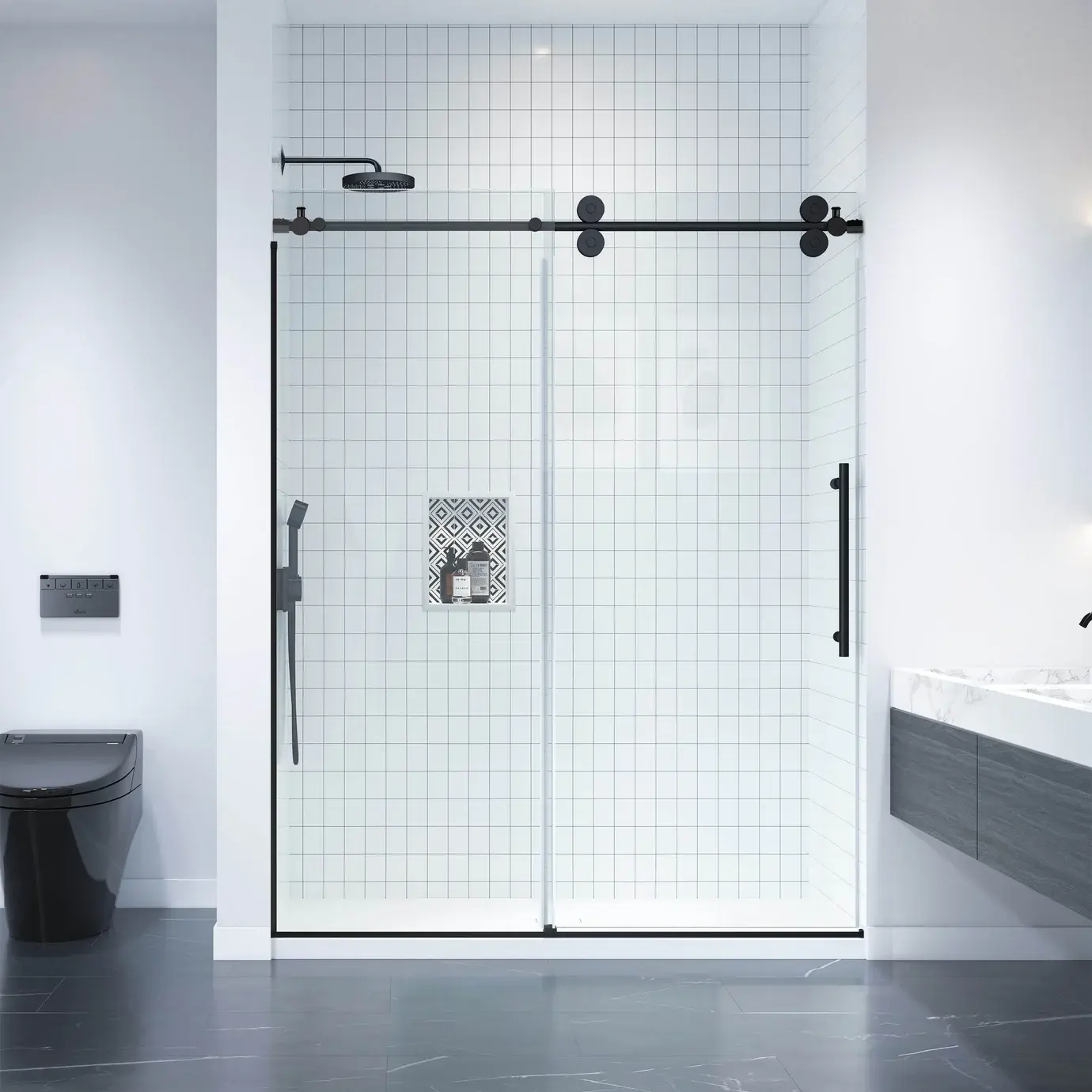
A double slider shower door on a 1,200 by 1,900 mm opening carries 46.8 kg of 8 mm glass on four rollers, and its bottom channel passes 0.0028 litres a second against 0.025 running down the glass. Water is held by the 30 mm overlap, and the channel only guides it back.
Two panels, three numbers
A 30 mm overlap, 23.4 kg per panel, and a channel that passes one ninth of the water reaching it. The overlap is the seal, the panel weight is the roller class, and the channel is a detail that decides whether the tray floods at the ends.
In this guide:
How wide are the two panels on a 1,200 mm opening?
Panel width is the opening plus the overlap, divided by two. On a double slider shower door with a 30 mm overlap and a 1,200 mm opening each panel is 615 mm, and the pair travels on two tracks so that one panel passes behind the other. Take the overlap to 20 mm and the panel grows 5 mm, which buys nothing and costs 10 mm of sealing face.
The overlap is where the water is stopped, so it is the one dimension worth arguing about. Thirty millimetres gives a magnetic or flexible seal a face to sit on and enough tolerance for a tray that is 3 mm out of level. Below 20 mm the seal sits on the edge of the glass and the first panel that sags opens a line down the middle.
Single and double slide are not the same product with one panel removed. The single and dual slide comparison comes down to access width: on a 1,200 mm opening a single slide passes 585 mm and a double passes the full 1,200, which is the difference between a shower a guest steps into and one they turn sideways into.
How much does the glass weigh, and what does it do to the rollers?
Glass is 2.5 kg per square metre per millimetre, so 8 mm is 20 kg a square metre. A 615 by 1,900 mm panel is 1.169 square metres and 23.4 kg, and the pair on a double slider shower door is 46.8 kg before hardware. Two rollers per panel carry 11.7 kg each when the door is still.
Static load is the wrong number to buy on. A guest who lets the panel run into the stop delivers roughly twice the static load for a fraction of a second, so the roller sees about 23 kg and the class that survives a hotel decade is 30 kg, not 15. The difference in price between a 15 kg and a 30 kg roller is a few dollars a set.
| Glass thickness | Mass per panel | Static load per roller | Panel width that works |
|---|---|---|---|
| 6 mm | 17.5 kg | 8.8 kg | up to 700 mm, light duty |
| 8 mm | 23.4 kg | 11.7 kg | 700 to 1,000 mm, hotel standard |
| 10 mm | 29.3 kg | 14.6 kg | 900 to 1,200 mm, heavy traffic |
| 8 mm laminated | 23.4 kg | 11.7 kg | same mass, holds if it breaks |
Masses are arithmetic on a 615 by 1,900 mm panel at 2.5 kg per square metre per millimetre, with two rollers per panel. They are calculated, not measured on a delivered set, and the roller class for a project is confirmed against the hardware schedule.
Can the bottom channel carry the water that reaches it?
No, and it is not supposed to. A 10 mm wide channel with 3 mm of head passes 0.0028 litres a second by the weir formula. A shower head runs 10 litres a minute, so 0.167 litres a second leaves the rose, and roughly 15 percent of it reaches the glass as a film, which is 0.025 litres a second at the channel.
That leaves nine times too much water for the channel, which is the arithmetic behind a simple rule: the channel is a guide, the seal is the barrier. Any quotation that sells a deep channel as the water defence is selling the wrong part of the assembly.
What the channel does do is stop the film from running sideways along the bottom rail and out under the end of the panel. That is why the channel has to run the full width and turn up at both ends, and why a tray with a 20 mm upstand tolerates a shallow channel while a level access tray needs the full detail.
Why does a gap of a fraction of a millimetre pull water upward?
Capillarity, and on a double slider shower door it is the whole reason the seal has to touch. Rise is twice the surface tension divided by density, gravity and the gap radius. Water at 0.0728 newtons a metre in a 0.3 mm slot rises 99 mm; halve the slot to 0.15 mm and it rises 198 mm. Both are taller than the height of a bottom rail.
This is the single strongest argument for a contact seal on a double slider shower door. A seal that touches closes the capillary path completely. A seal that leaves 0.3 mm of clearance looks neat on a drawing and delivers water to the dry side at 99 mm above the tray, quietly, along the whole height of the panel.

Which glass thickness belongs on a hotel job?
Eight millimetres for most bathrooms, ten for double slider shower door panels wider than 900 mm. Stiffness goes with the cube of thickness, so 10 mm is 1.95 times stiffer than 8 mm and 4.6 times stiffer than 6 mm, and the extra mass lands on the rollers as 5.9 kg a panel.
Toughened glass for a shower is specified to EN 12150-1, and the enclosure as a whole to EN 14428. Where the panel is fixed beside the sliding one, a frameless swing glass shower door carries its mass on two hinges, and the hinge rating becomes the equivalent of the roller class.
Which lines should the quotation separate?
Five: glass thickness and tempering standard, panel width with the overlap, roller or hinge class, bottom channel profile with the end upstands, and the seal type at the vertical edge. Send the tray size and the guest room count to kristin@haolvbuilding.com and those five come back priced separately for each room type.
Separating them matters on a hotel because room types repeat. A 900 mm tray in 120 rooms is 120 identical sets, and a 5 mm change in overlap or a 2 kg change in roller class multiplies by 120. On a single bathroom the same differences are invisible, which is why the layout guide reads differently for a house and for a hotel floor.
How is it installed so the seal still works in year five?
Three things: the tray level within 2 mm across 1,200 mm, the vertical frame plumb, and the channel set so water drains toward the tray. A tray 3 mm out of level over 1,200 mm is a 0.25 percent fall, and that is enough to send the film to one end of the channel where the upstand is doing all the work.
For a fixed panel beside the sliding one, a single sliding frameless shower door uses the same tray and channel detail with one panel, so the installer detail sheet is the same document. That is worth having, because the commonest failure on a hotel floor is not the product, it is the silicone line along the tray.
| Parameter | Typical value | Note |
|---|---|---|
| Product | double slider shower door | 6063-T5 frame, EN 14428 |
| Opening | 1,200 by 1,900 mm | two panels, 615 mm each |
| Overlap | 30 mm | seal face, 20 mm is the floor |
| Glass | 8 mm toughened, EN 12150-1 | 23.4 kg per panel |
| Rollers | two per panel, 30 kg class | 11.7 kg static, 23.4 kg on a slam |
| Bottom channel | 10 mm wide, 3 mm head | 0.0028 litres a second by weir |
| Vertical seal | contact seal or magnetic strip | capillary path closed |
| Tray detail | 20 mm upstand or level access | channel turned up at both ends |
| Minimum order | 10-20 units | lead time 25-30 days from approved drawing |
Panel width, panel mass, roller load and channel flow are arithmetic on a stated 1,200 by 1,900 mm opening, 8 mm glass at 2.5 kg per square metre per millimetre and the weir equation. They are calculated, not measured on a delivered set, and the enclosure performance of a project is confirmed against the test report.
Two practical numbers for the site sheet: silicone bead 6 mm wide and 3 mm deep, and the seal checked with a paper strip along the full height after the first week of use, when the panels have settled.
Frequently asked questions
What is the minimum order for bulk double slider shower doors? Minimum order is 10-20 units and lead time is 25-30 days from an approved drawing. A hotel schedule with one drawing repeated across room types is priced per set, with the glass and the hardware on separate lines.
Is a wholesale price per set comparable between suppliers? Only if the glass thickness, the roller class and the channel profile are on the line. Those three move the cost more than the frame finish, and they are the three that a per set price usually leaves out.
Do the panels need a bottom guide as well as rollers? Yes. With 23.4 kg of glass on a top hung carriage the bottom guide is what stops the panel swinging, and a set that leaves it out shows the movement in the first month. On a bottom rolling track the guide sits in the rail and the same rule applies.
Which supplier document settles the glass question? A mill certificate to EN 10204 for the batch and a tempering declaration to EN 12150-1, plus the panel drawing with the thickness on it. A generic catalogue page does not settle it, and glass thickness is the line most often changed quietly between quotation and delivery.
Ordering from Haolv
Haolv Building Materials Co., Ltd. has been making doors and windows for 19 years. Double slider shower doors are built on 6063-T5 aluminium profiles with stainless steel rollers to EN 1670 class 4 and toughened glass to EN 12150-1, and the frames are checked against EN 14428 for the enclosure function. Certification is available on request with the quotation. Minimum order is 10-20 units and lead time is 25-30 days.
Send the tray sizes, the room count and the glass thickness you want to kristin@haolvbuilding.com, or start from Haolv Building Materials Co., Ltd. and the panel width, the roller class and the channel profile come back with the price, room type by room type.
What this page calculates and what it leaves to the order: the 615 mm, the 23.4 kg, the 0.0028 litres a second and the 99 mm are arithmetic on a stated 1,200 by 1,900 mm opening, 8 mm glass at 2.5 kg per square metre per millimetre, and the weir and capillary equations. They are calculated, not measured. The enclosure performance of any set comes from its test report, and the tray detail from the site drawing.

References
- EN 14428:2015+A1:2018 — Shower enclosures. Functional requirements and test methods.
- EN 12150-1:2015 — Glass in building. Thermally toughened soda lime silicate safety glass.
- EN 10088-2:2014 — Stainless steels. Technical delivery conditions for sheet, plate and strip.
- EN 1670:2007 — Building hardware. Corrosion resistance. Requirements and test methods.
- EN 10204:2004 — Metallic products. Types of inspection documents.
- EN 1999-1-1:2007+A1:2014 — Eurocode 9. Design of aluminium structures. General structural rules.
Panel widths, glass masses, roller loads, channel flow and capillary rise in this guide are arithmetic on a stated opening, a stated glass build and the weir and capillary equations. They are calculations from a drawing, not measurements of a delivered set, and the performance of any enclosure is taken from the test report for that specification.
Fast simple channel to send demands lock favorable price for building window door bulk purchases.