- English
- French
- German
- Portuguese
- Spanish
- Russian
- Japanese
- Korean
- Arabic
- Greek
- German
- Turkish
- Italian
- Danish
- Romanian
- Indonesian
- Czech
- Afrikaans
- Swedish
- Polish
- Basque
- Catalan
- Esperanto
- Hindi
- Lao
- Albanian
- Amharic
- Armenian
- Azerbaijani
- Belarusian
- Bengali
- Bosnian
- Bulgarian
- Cebuano
- Chichewa
- Corsican
- Croatian
- Dutch
- Estonian
- Filipino
- Finnish
- Frisian
- Galician
- Georgian
- Gujarati
- Haitian
- Hausa
- Hawaiian
- Hebrew
- Hmong
- Hungarian
- Icelandic
- Igbo
- Javanese
- Kannada
- Kazakh
- Khmer
- Kurdish
- Kyrgyz
- Latin
- Latvian
- Lithuanian
- Luxembou..
- Macedonian
- Malagasy
- Malay
- Malayalam
- Maltese
- Maori
- Marathi
- Mongolian
- Burmese
- Nepali
- Norwegian
- Pashto
- Persian
- Punjabi
- Serbian
- Sesotho
- Sinhala
- Slovak
- Slovenian
- Somali
- Samoan
- Scots Gaelic
- Shona
- Sindhi
- Sundanese
- Swahili
- Tajik
- Tamil
- Telugu
- Thai
- Ukrainian
- Urdu
- Uzbek
- Vietnamese
- Welsh
- Xhosa
- Yiddish
- Yoruba
- Zulu
Custom Aluminum Pivot Hinged Door for Hotel and Office Entrances Options MOQ and Lead Times
Buyers sourcing customized aluminum pivot-hinged door suppliers usually arrive with two questions that a catalogue cannot answer: what the pivot-hinged door can carry once the glass is chosen, and how long the order takes from drawing approval to the container. An Aluminum Pivot-Hinged Door is a leaf that rotates on a floor and head pivot set instead of hanging from a stile, which removes the vertical frame member that limits every hinged entrance and lets a panel run from floor to ceiling without a visible jamb. For a hotel lobby, a corporate reception or a villa hall the appeal is the sightline; for the procurement team the appeal is that the frame, glass, pivot and lock arrive as one tested assembly with a stated lead time. The notes below are written for importers, distributors and fitout contractors placing a first or second bulk order.
In this guide:
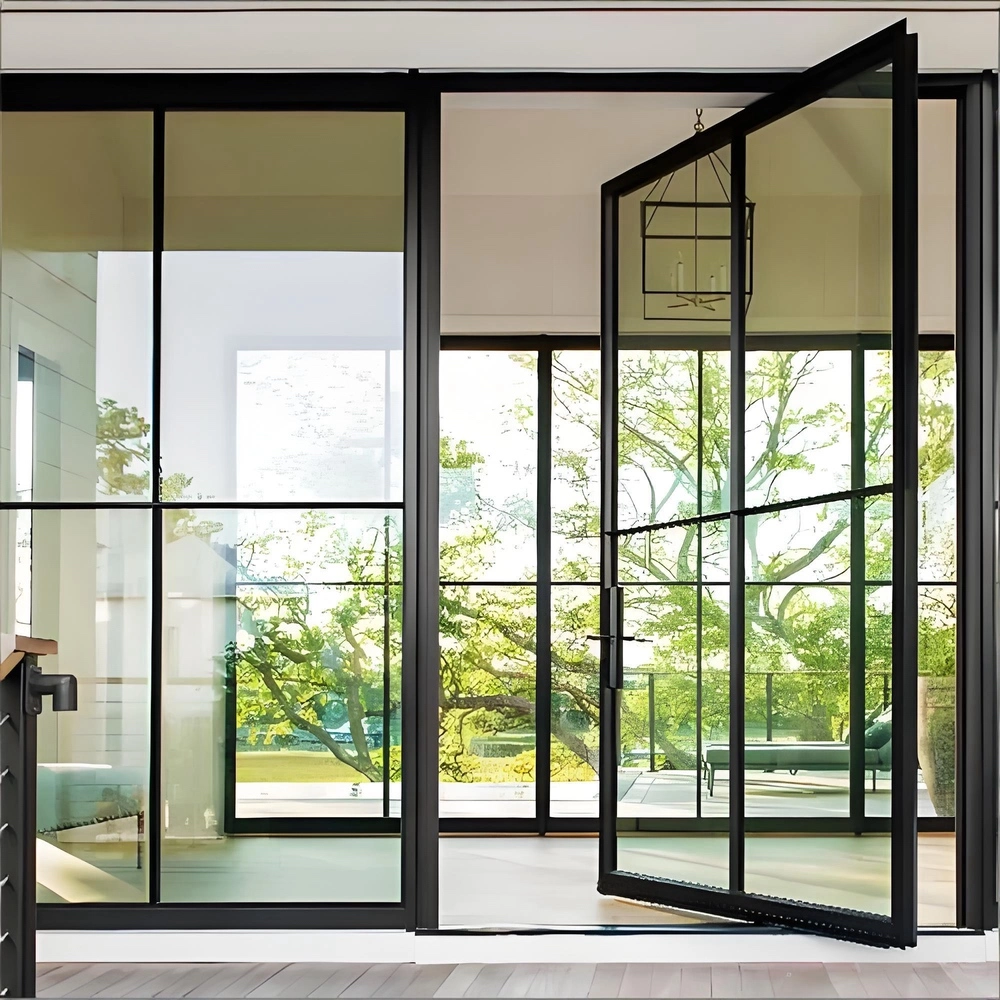
Short answer: a customized aluminum pivot-hinged door order is set by four numbers: the pivot rating, normally 100 to 150 kg per leaf, the glass build between 10 and 28 mm, the 120 or 140 series frame, and the door count, with production starting at 10 to 20 units and shipment 25 to 30 days after drawing approval.
| Parameter | Typical value | Note |
|---|---|---|
| Pivot hinge rating | 100 to 150 kg per leaf | Decides the maximum glass area, not the frame |
| Frame series | 120 or 140 mm pivot system | 140 series for tall or double leaves |
| Glass build | 10 to 28 mm tempered, laminated or double | Thickness drives leaf weight |
| Alloy and wall | 6063-T5, 1.4 to 2.0 mm wall | Confirmed against the extrusion drawing |
| Sound reduction | 35 to 50 dB for the assembly | Follows glass build and the EPDM seal |
| Finish | Powder coating, anodising or RAL | A custom RAL colour starts its own batch |
Pivot Hinge Capacity Glass Build and Lock Set on a Custom Pivot Entrance Door
How the Pivot Rating Caps the Leaf Size
A pivot-hinged door carries the leaf at two points, top and bottom, and the rating on the data sheet is a weight limit rather than a size limit. That distinction matters because two leaves of the same height can differ by forty kilograms once the glass changes, and the pivot is the first item to fail when the weight creeps past its rating. A 120 series system with a standard pivot set is normally rated to about 100 kg per leaf; a 140 series with a heavy duty pivot set reaches 150 kg and is the specification to ask for when the design calls for a single leaf wider than about 1.2 metres.
The workable sequence for a pivot-hinged door at enquiry stage is to fix the leaf size and the glass build first, then let the supplier confirm the pivot. Asking for a pivot rating before the glass is chosen usually produces a quotation that has to be revised, and on a bulk order a revised pivot means revised floor preparation because the bottom pivot pocket depth differs between hardware sets. Buyers who send a sketch with leaf width, leaf height, glass build and estimated weight get a usable number in one round.
Glass Build and What It Adds to the Leaf
Pivot-hinged doors in this range take glass from 10 to 28 mm, and the practical split is simple: 10 to 12 mm laminated for a single leaf on a sheltered elevation, 20 to 28 mm double or triple for a lobby that has to hold a U-value target, and tempered laminated where the leaf faces a public footway. Laminated glass is the safer default on an entrance people walk through because it stays in the frame when it breaks; tempered glass is stronger against a single impact but releases completely once it fails. That is a specification decision, not a price negotiation.
On a pivot-hinged door, thickness is also where quotations diverge without anyone noticing. Two offers for the same pivot-hinged design can sit twenty per cent apart purely because one prices an 11.5 mm laminated unit and the other a 24 mm double unit, and both call it double glazing on the schedule. Demand the glass make-up written out as thickness plus interlayer or cavity, and the comparison becomes honest.
Lock Set and the Anti Lift Detail
A pivot-hinged door leaf has no hinge stile to hide a lock in, so the locking is done through the pivot axis and the head. A multi point lock with an anti lift pin engages the head frame and the bottom rail, which is what stops the leaf being levered upward out of its pivot. On a public entrance that detail matters more than the cylinder grade, because a lift attack does not need a key.
On a pivot-hinged door the lock should be described by function rather than by model: points of engagement, anti lift, panic or escape function if the entrance is on an escape route, and whether the cylinder is master keyable. On a hotel with a building management system the last item decides whether the front desk can issue a single key for the entrance, and it cannot be added after the leaf is fabricated.
Wind Load Drainage and U-value Targets That Decide the Pivot Door Envelope
Wind Pressure and the Head Pivot
A pivot-hinged door entrance is a large unbraced panel, and the head pivot takes the horizontal load that a hinged leaf would share with its stiles. On an exposed elevation the design wind pressure has to be checked before the leaf area is finalised, and above roughly eight storeys the EN 12210 class should be written into the tender instead of assumed from a typical project. A leaf that passes the static test can still whistle under gust load if the head seal is a single blade rather than a double EPDM gasket.
The second wind issue on a pivot-hinged door is the swing arc. A pivot-hinged door leaf rotates inside the opening rather than outside it, so on a corner entrance the leaf can foul an adjacent wall or a reception desk unless the clearance is drawn. Sending a plan detail with the arc marked is the cheapest way to avoid a site change order, and it costs nothing at enquiry stage.
Rain Path and the Floor Pocket
Water on a pivot-hinged door arrives at the bottom pivot, because that is the only place where the leaf meets the floor. A low threshold keeps the pocket shallow and the transition accessible; a flush floor integration gives the cleanest line and needs a drained recess in the structural slab with the pocket set below the finished floor. On a pivot-hinged door the flush version is a builder cost that appears after the door has been bought, which is why it should be settled with the main contractor before the order is placed.
Where the entrance is unsheltered, the workable detail is a low threshold with a double brush seal, a recessed mat line inside and a canopy above, so rainwater never reaches the door at the angle the watertightness test assumes. Specifying a flush pocket on an open elevation is the most common source of post handover complaints on pivot entrances, and it is decided on the drawing rather than at the factory.
Thermal Targets and the Thermal Break
The pivot-hinged door frame carries a polyamide thermal barrier, normally PA66 GF25, between the inner and outer aluminium. The barrier matters because aluminium conducts at roughly 160 to 200 W/(m K) while the polyamide sits near 0.3, and without it the frame becomes the coldest surface in a conditioned lobby. A thermally broken pivot assembly on a double glazed leaf typically lands between 2.0 and 2.7 W/m2K for the whole door, which is enough for most hotel and office envelopes but should be checked against the project target rather than quoted as a promise.
For a conditioned pivot-hinged door the three items that move the U-value are the barrier width, the cavity and the spacer bar. A warm edge spacer and an argon fill are the cheapest upgrades on the schedule and the easiest to verify in a glass certificate. If the project has a modelled energy target, ask for the glass certificate and the frame Uf value together, because a whole door figure without both is an estimate.

Pivot Against Hinged and Sliding Leafs on a Hotel or Office Entrance
What a Pivot Buys and What It Costs
A pivot-hinged door buys an uninterrupted glass face and a leaf that can be taller than a hinged leaf of the same weight, because the load goes into the floor instead of into a stile. The cost is in the floor: the bottom pivot needs a structural support, the pocket needs a drain on an exposed elevation, and the hardware set is heavier than a butt hinge arrangement. On a hotel lobby where the entrance is the first thing a guest sees, that trade is usually worth taking; on a service door it never is.
A pivot-hinged door is not the right answer for a service door, where a hinged leaf stays the cheaper and more serviceable answer for a secondary entrance, and a double leaf arrangement with a fixed side panel is still the standard way to get a wide clear opening with a sealed frame. Where the project mixes both, a double aluminum swing doors on the main elevation and a hinged pair on the side entrance keeps the hardware range to two families instead of four.
Why Sliding Loses on a Sealed Lobby
A sliding entrance clears a wide opening with a small stack of panels and needs no swing clearance, which is why it dominates shopfronts. It also compresses its seal in one direction only, so at the same frame depth it leaks more air and more water than a leaf that closes onto a compression gasket all round. On a lobby with an air tightness target or a pressure relationship to maintain, that difference decides the type before price is discussed.
The practical way to settle the type is to fix the traffic pattern, the egress width and the sealing target in that order. A swing glass door selection made on those three criteria rarely needs to be revisited; one made on the rendering usually does.
Matching the Pivot to the Rest of the Elevation
A lobby rarely has one entrance only. Where the same elevation needs a pair of double leaves with a fixed side panel, a aluminum French casement door gives the wide clear opening without going to a tall pivot, and keeps the hardware family the same as the main door. Buying both from one supplier is usually worth more than the per unit saving on a second source, because the finish batch and the delivery slot can be combined.
The same logic applies to the glass. Where the entrance is the only piece of glazing on the elevation, one glass make-up across the pivot and the side lights keeps the exterior consistent and simplifies the approval drawing, which is the document that actually protects the delivery date.
MOQ Approval Drawings and the 25 to 30 Day Delivery Window
What the MOQ Covers
Production starts at 10 to 20 units, and on a pivot entrance that quantity is usually enough for a hotel entrance plus two side doors or a corporate reception with a service pair. The minimum applies to the order as a whole rather than to each size, so mixed leaf widths and mixed swing directions can load together provided the drawings are released as one set. What cannot be mixed freely is the finish: a custom RAL colour starts its own coating batch, which carries its own minimum.
On a pivot-hinged door order two colours is the practical limit for a first bulk order. Beyond that the extrusion is split across pretreatment batches, the schedule stretches, and the saving on the unit price is eaten by the extra freight handling. If the project needs a signature colour, put it on the main entrance only and keep the secondary doors in the standard palette.
The Approval Set That Protects the Date
Orders ship within 25 to 30 days of confirmation, and that window assumes four things are approved before production starts: the opening sizes and the swing arcs, the glass make-up per leaf, the pivot and lock set, and the finish. Each of those has a different lead time at the factory, and the last one approved sets the shipping date. Buyers who release all four with the deposit rarely see the date move; buyers who leave the finish open usually do.
Ask for a signed approval drawing per opening reference before the deposit is released. The drawing should carry the leaf size, the pivot pocket dimensions, the glass make-up, the handing and the lock function. A single wrong handing on a pivot leaf cannot be corrected on site the way a hinged leaf can be rehung, because the pivot pockets are machined into the floor and the head.
Packing and Site Handover
Pivot-hinged doors travel standing in a braced stillage with the pivot pockets protected and the glass under a peelable film that comes off within a month of arrival. Label every leaf to its opening reference and ship the pivot sets in a separate marked crate, because a missing bottom pivot stops the whole entrance while a missing handle stops one door. On a multi building project, one spare pivot set per twenty leaves is a realistic insurance line.
Handover of a pivot-hinged door should include the pivot adjustment procedure, the closer or floor spring settings if one is fitted, the lock function schedule and the glass certificates. A short review of the door types on site at handover, using a aluminium glass door types as a reference, saves the service calls that come from a leaf that is simply out of adjustment.
What Changes After the First Year of Service
The Three Wear Points
On a pivot-hinged door the parts that wear are the bottom pivot bearing, the head pivot guide and the perimeter gasket. All three are replaceable without removing the glass, which is the reason to insist on a standard pivot pattern rather than a proprietary one. Ask for the replacement part numbers with the quotation, not with the maintenance manual.
A pivot-hinged door leaf that starts to drag on the floor at month eighteen is usually a bottom bearing rather than a structural problem, and a leaf that whistles at month twelve is usually a flattened gasket rather than a wind issue. Both are cheap fixes when identified early and expensive when left until the floor spring or the pivot housing has taken the load.
Scheduled Inspection
A single visit four weeks after handover is enough for a pivot-hinged door and then twice a year is enough for most entrances: check the pivot for lateral play, check that the leaf still closes against the gasket without a nudge, and check the head seal for flattening. Record the results against the leaf reference so a trend is visible before it becomes a failure.
Actual performance depends on the specified glass build, the pivot and lock set, the exposure of the elevation and the installation detail on site. Values quoted here describe typical configurations in this product range and are not a guarantee for a specific opening.
Conclusion
A buyer comparing customized aluminum pivot-hinged door suppliers should ask for four numbers before asking for a price: pivot rating per leaf, glass make-up in millimetres, frame series and door count against the 10 to 20 unit minimum. Those four decide whether the entrance can be built at all, and they are also the four that appear on the approval drawing the site will work from. Get them in writing at enquiry, and the 25 to 30 day delivery window becomes a commitment rather than a hope.
FAQ
Q1: What is the MOQ for a custom aluminum pivot-hinged door order?
A: Production starts at 10 to 20 units, counted across the whole order rather than per size. Mixed leaf widths and handings load together when the approval drawings are released as one set. A custom RAL colour carries its own coating batch minimum on top of the door count.
Q2: How much glass weight can a pivot entrance leaf carry?
A: A standard 120 series pivot set carries about 100 kg per leaf and a heavy duty 140 series set reaches 150 kg. The limit is on the pivot hardware, so the leaf size, the glass build and the pivot rating have to be confirmed together before the floor pocket is set out.
Q3: What lead time should a bulk pivot door importer plan for?
A: Shipment follows 25 to 30 days after confirmation, provided the opening sizes, glass make-up, pivot and lock set and finish are all approved with the deposit. A custom RAL colour is the item most likely to move the date, so it should be frozen first.
Q4: Which frame series should a hotel lobby entrance use?
A: A 120 series suits a single leaf up to about 1.2 metres wide with a double glazed unit. Step up to a 140 series when the leaf is taller than 2.4 metres, when it is a double pivot pair, or when the glass build passes 24 mm.
Partner with Haolv Building Materials for Aluminum Pivot-Hinged Door Supply
Haolv Building Materials Co., Ltd. has been manufacturing windows and doors for 19 years and builds pivot, hinged, sliding and folding door systems in aluminium and vinyl. Frames, glass, pivot hardware and thresholds come from one supplier, orders ship within 25 to 30 days, and production starts from 10 to 20 units. Certification documents are available on request. Email us at kristin@haolvwindows.com with the opening schedule, the glass build and the target market, and we will return a line by line quotation against your drawings.
This guide is maintained by Haolv's engineering team and reviewed against EN 14351-1 and EN 12207 as standards change.

References
1. European Committee for Standardization. (2016). EN 14351-1: Windows and doors - Product standard, performance characteristics.
2. European Committee for Standardization. (2000). EN 12207: Windows and doors - Air permeability - Classification.
3. European Committee for Standardization. (2003). EN 12208: Windows and doors - Watertightness - Classification.
4. European Committee for Standardization. (2003). EN 12210: Windows and doors - Resistance to wind load - Classification.
5. American Architectural Manufacturers Association. (2021). AAMA/WDMA/CSA 101/I.S.2/A440: North American fenestration standard.
6. International Organization for Standardization. (2015). ISO 9001: Quality management systems - Requirements.
Fast simple channel to send demands lock favorable price for building window door bulk purchases.