- English
- French
- German
- Portuguese
- Spanish
- Russian
- Japanese
- Korean
- Arabic
- Greek
- German
- Turkish
- Italian
- Danish
- Romanian
- Indonesian
- Czech
- Afrikaans
- Swedish
- Polish
- Basque
- Catalan
- Esperanto
- Hindi
- Lao
- Albanian
- Amharic
- Armenian
- Azerbaijani
- Belarusian
- Bengali
- Bosnian
- Bulgarian
- Cebuano
- Chichewa
- Corsican
- Croatian
- Dutch
- Estonian
- Filipino
- Finnish
- Frisian
- Galician
- Georgian
- Gujarati
- Haitian
- Hausa
- Hawaiian
- Hebrew
- Hmong
- Hungarian
- Icelandic
- Igbo
- Javanese
- Kannada
- Kazakh
- Khmer
- Kurdish
- Kyrgyz
- Latin
- Latvian
- Lithuanian
- Luxembou..
- Macedonian
- Malagasy
- Malay
- Malayalam
- Maltese
- Maori
- Marathi
- Mongolian
- Burmese
- Nepali
- Norwegian
- Pashto
- Persian
- Punjabi
- Serbian
- Sesotho
- Sinhala
- Slovak
- Slovenian
- Somali
- Samoan
- Scots Gaelic
- Shona
- Sindhi
- Sundanese
- Swahili
- Tajik
- Tamil
- Telugu
- Thai
- Ukrainian
- Urdu
- Uzbek
- Vietnamese
- Welsh
- Xhosa
- Yiddish
- Yoruba
- Zulu
Opening Tilt And Turn Windows Price Factors for High Rise Residential Buyers
Leaf mass, not leaf area, sets the price of opening tilt and turn windows: the same 1.2 m2 sash weighs 29 kg in double glazing and 60 kg in triple, and that doubling crosses a hardware class. Buyers who compare quotes per square metre never see the step.
Leaf mass in one line
Glass mass = glazed area x thickness in millimetres x 2.5 kg/m2. A 1,200 x 1,000 mm sash carries 1.2 m2, so 8 mm double glazing gives 24 kg of glass and 18 mm triple gives 54 kg. Sash framing adds about 5 to 6 kg on either build. The hole in the wall is identical; the leaf is not.
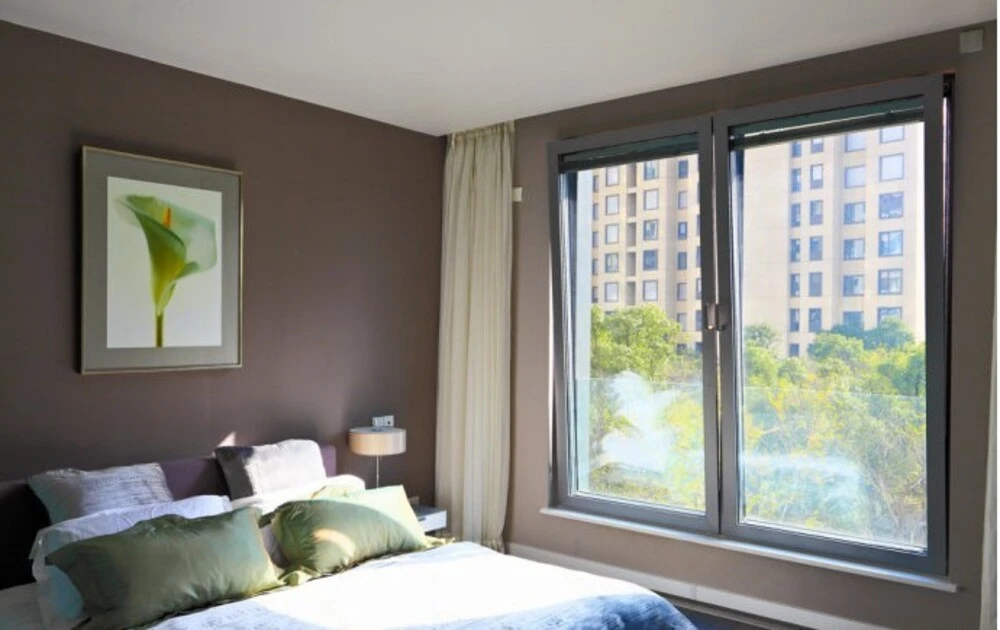
In this guide:
Why does the same window opening weigh twice as much in one quote as another?
Take two quotations for a 1,200 x 1,000 mm inward opening sash. One is glazed 4+16A+4 with argon and a low-e coating, the other 6+12A+6+12A+6. The frame, the hardware and the labour are close to identical. The glass total moves from 8 mm to 18 mm, and because mass scales linearly with thickness, the leaf moves from 29 kg to 60 kg. That single line is the whole difference in the envelope of the order.
The sash framing is not the variable. A 1,200 x 1,000 mm sash has a 4.4 m perimeter, and at roughly 1.2 kg per metre of aluminium sash profile that is 5.3 kg in both cases. Perimeter is set by the opening, not by the glass, so the only lever the buyer actually holds is the glazing build.
This is why a quotation that lists one unit price per square metre and nothing else is not comparable. The same supplier can quote two lines that look alike and behave completely differently, and the difference only appears when the sash is hung, adjusted and packed. A thinner tilt and turn sash windows line and a heavier one are different products at the same nominal size.
Where does a sash cross into the next hardware class?
Tilt and turn hardware is sold by maximum leaf mass and maximum sash width, not by window size. The common classes for this product are around 80 kg and 130 kg. A rating is a limit, not a target: most suppliers apply a margin of roughly 1.3, so an 80 kg class is comfortable to about 61 kg of leaf. On opening tilt and turn windows the class therefore follows the glass build, and the glass build has to be fixed before the hardware is chosen. That margin is where the price step hides.
Read the two variables apart and the pattern is clean. Size alone does not move the class: a 1.5 m2 double glazed sash is 37 kg and stays on standard hardware. Glass alone does: a 1.2 m2 triple glazed sash at 59 kg sits at the edge of the same class, and the moment it grows to 1.5 m2 the leaf passes 74 kg and the hinge set, the stay arm and the corner gearing all change at once.
| Sash size | Glass build | Leaf mass | Hardware class | What moves in the quotation |
|---|---|---|---|---|
| 1,200 x 1,000 mm | 4+16A+4 (8 mm) | 29 kg | 80 kg class, full margin | Baseline: standard hinges, standard stay, standard packing |
| 1,200 x 1,000 mm | 6+12A+6+12A+6 (18 mm) | 60 kg | 80 kg class at its practical limit | Heavier stay, reinforced corner drive, extra packing per unit |
| 1,500 x 1,000 mm | 4+16A+4 (8 mm) | 37 kg | 80 kg class, unchanged | Nothing in the hardware line despite the larger opening |
| 1,500 x 1,000 mm | 6+12A+6+12A+6 (18 mm) | 74 kg | 130 kg class | New hinge set, longer stay arm, deeper section, more mass per unit |
Leaf mass = glazed area x thickness x 2.5 kg/m2 plus 5 to 7 kg of sash framing. Calculated from the glass weight constant, not measured on a sample. A specific order is confirmed against its own schedule.
The thermal argument for the third pane is real and it sits on the same axis. Whole unit U-values run about 1.2 to 1.6 W/m2K for a PVC-U or thermally broken aluminium frame with double glazing, and about 0.8 to 1.2 with triple. On a high rise facade the third pane often pays for itself in heating load long before it pays for itself in hardware cost, which is why tilt and turn windows benefits should be read together with the hardware step rather than on their own.
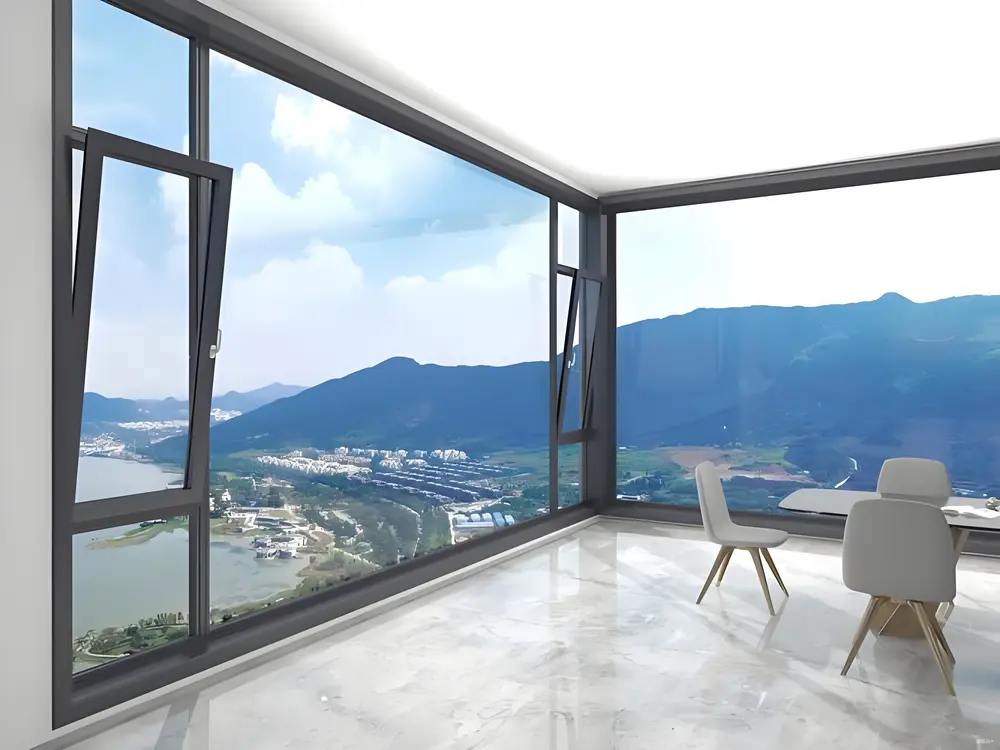
What does each bottom bearing carry once the sash is opened in the tilt position?
In the tilt position the leaf hangs from two bottom corner bearings and is restrained at the top corner by the stay. The dead load splits between them, so each bearing takes half the leaf: 143 N at 29 kg, 294 N at 60 kg, 363 N at 74 kg. Those are the numbers a bearing is asked to hold for years, not for a demonstration.
Wind adds a second component. At 25 m/s the velocity pressure is 391 Pa, and on a 1.2 m2 sash that is 469 N pushing on the glazed area. In the tilt position the stay carries most of it, which is why the stay is rated in newtons and not described as heavy duty. Ask for the rated force and the arm length, then check that the arm length matches the sash width the schedule actually calls for.
Bearings are the first wear item on this product and the cheapest thing to get wrong at order stage. A bearing is a part number, not a description: ask for it, and ask how many cycles it is rated for. Two operations a day for ten years is 7,300 cycles, which is a small fraction of a properly rated component and a large fraction of a cheap one replaced without telling anyone.
Which glass build earns the weight it adds?
Not all performance costs mass. A low-e coating adds nothing measurable. Argon filling adds about 0.02 kg per square metre. A laminated inner pane replaces one glass sheet with two thinner ones plus an interlayer, so the total is close to the same 2.5 kg per square metre per millimetre. The third pane is different: it adds a full 6 mm sheet and a second spacer, which is 15 kg per square metre of extra leaf. On opening tilt and turn windows that is the largest single jump in leaf mass available to a buyer.
So the sequence of decisions matters. Coating and gas first, because they are free in mass terms and move the U-value. Laminated glass second, if the project needs a safety or acoustic class. The third pane last, and only after the hardware class has been checked against the new leaf mass. Doing it the other way round produces the worst outcome: a triple glazed unit on hardware sized for the double glazed version.
For a high rise residential programme the practical pairing is a 1.2 m2 sash with 6+12A+6, laminated where the facade sits above a walkway, plus argon. That lands near 44 kg, inside the 80 kg class margin, and still delivers a whole unit U-value around 1.1 to 1.3 W/m2K. Where a german style tilt turn profile is specified for its hardware platform, the same arithmetic applies to the same opening.
| Parameter | Typical value | Note |
|---|---|---|
| Configuration | Inward opening tilt and turn windows, single or double sash | Tilt for ventilation, turn for cleaning |
| Profile alloy | 6063-T5, thermally broken | PA66 GF25 barrier strip, conductivity about 0.3 W/(m.K) |
| Wall thickness | 1.4-2.0 mm residential, 2.5-3.0 mm commercial | Confirm against wind class, not price |
| Glass mass constant | 2.5 kg per m2 per mm of thickness | The number that drives leaf mass |
| Typical leaf mass | 29-44 kg double, 59-90 kg triple | Check against the hardware rating before quoting |
| Hardware classes | About 80 kg and 130 kg leaf mass | Rating is a limit; ask the applied margin |
| Whole unit U-value | 1.2-1.6 W/m2K double, 0.8-1.2 triple | Frame material moves the lower bound |
| Air permeability | EN 12207 class per contract | Class 4 is 3 m3/(h.m2) at 100 Pa or better |
| Lead time and MOQ | 25-30 days, 10-20 units | Applies to standard glass builds |
Values describe the common export range for inward opening tilt and turn windows. A specific order is confirmed against its own specification sheet and hardware datasheet.

How should a price comparison be laid out so the hardware step is visible?
Three columns do the work: leaf mass per line, hardware class per line, and the glass build written as a total thickness. With those three present, a cheap line and an expensive line explain themselves. Without them, the buyer is comparing a 29 kg unit against a 60 kg unit and calling the difference a factory margin.
If the opening schedule and the target U-value are already fixed, send it over and the leaf mass and hardware class can be returned line by line against the real sash sizes before any profile is cut. Changing the hardware class at that point costs nothing; changing it after the order is released costs the difference plus the schedule.
One more discipline: compare the same glass build across every line. A comparison that mixes a double glazed line with a triple glazed line is not a price comparison, it is two different products with one number attached. Fix the glass build, then let the hardware class be the only variable that moves.
What belongs in a wholesale order for opening tilt and turn windows?
Five clauses carry the weight discussion into a wholesale order for opening tilt and turn windows: hardware class expressed as maximum leaf mass, hinge and stay part numbers with the stay rated force in newtons, the glass build as a total thickness with each pane named, the whole unit U-value target, and packing that blocks the sash instead of letting it rest on the sill. Items left out are the ones that arrive different from the sample.
Mass also reaches the freight line before anything else does. At 2.5 kg per square metre per millimetre, a third pane adds about 30 kg to a 1.2 m2 unit, and that accumulates across a full order ahead of the volume limit. It is arithmetic about a packed order, not a loading record, and the loading plan for the actual specification is what confirms it.
Where the same elevation mixes tilt and turn units with fixed lights, keep one hardware family so the maintenance team carries one set of spares. On projects that lean commercial, the same arithmetic decides whether commercial tilt turn windows can stay on standard hardware or step up a class.
Frequently asked questions
What is the minimum order for bulk opening tilt and turn windows?
Minimum order is 10-20 units and lead time is 25-30 days for standard glass builds. A hardware class change is confirmed at quotation stage, before the order is released, because it changes the hinge set on every unit rather than on a sample.
Can the hardware class be quoted separately from the window price?
Yes, and it should be. Ask for the leaf mass and the hardware class as two columns beside the unit price. A supplier who cannot state the leaf mass for a given glass build is quoting a size, not a product. Ask any supplier of opening tilt and turn windows for the leaf mass column before the price column.
Does triple glazing always push the order into heavier hardware?
Not always. A 1.2 m2 triple glazed sash at 60 kg sits at the practical limit of an 80 kg class rather than past it. The step usually arrives when a triple glazed sash also grows: 1.5 m2 at 18 mm passes 74 kg and moves the whole hardware line.
Which U-value can be reached without leaving the light hardware class?
With a 1.2 m2 sash, 6+12A+6, argon and a low-e coating, the leaf lands near 44 kg and the whole unit near 1.1 to 1.3 W/m2K. Reaching 0.8 normally needs the third pane, and that is the point where the mass arithmetic has to be run again rather than assumed.
Ordering from Haolv
Haolv Building Materials Co., Ltd. has been making windows and doors for 19 years, including opening tilt and turn windows for high rise residential facades. Aluminium profiles, glazing and hardware are assembled in one plant, so the glass build, the leaf mass and the hardware class are decided by the same team that cuts the profile. Certification documents are available on request. Minimum order is 10-20 units and lead time is 25-30 days.
Send the opening schedule, the target U-value and the hardware class already specified on the project to kristin@haolvbuilding.com, and the quotation comes back with leaf mass stated per line rather than one blended price per square metre.
Leaf masses in this guide are calculated, not measured: glazed area times glass thickness times 2.5 kg per square metre per millimetre, plus 5 to 7 kg of sash framing. Power and pressure figures use the velocity pressure relation p = 0.625 v squared. No shipment data and no test report is used, and no sample was weighed for this article. Hardware ratings, spacer widths and U-values are confirmed against the datasheets and the specification of the actual order.

References
- EN 14351-1:2006+A2:2016 — Windows and doors. Product standard, characteristics and performance.
- EN 12207:2017 — Windows and doors. Air permeability. Classification.
- EN 12210:2016 — Windows and doors. Resistance to wind load. Classification.
- EN 673:2011 — Glass in building. Determination of thermal transmittance. Calculation method.
- EN 1279-2:2018 — Glass in building. Insulating glass units. Long term test method for moisture penetration.
- ISO 9001:2015 — Quality management systems. Requirements.
Fast simple channel to send demands lock favorable price for building window door bulk purchases.