- English
- French
- German
- Portuguese
- Spanish
- Russian
- Japanese
- Korean
- Arabic
- Greek
- German
- Turkish
- Italian
- Danish
- Romanian
- Indonesian
- Czech
- Afrikaans
- Swedish
- Polish
- Basque
- Catalan
- Esperanto
- Hindi
- Lao
- Albanian
- Amharic
- Armenian
- Azerbaijani
- Belarusian
- Bengali
- Bosnian
- Bulgarian
- Cebuano
- Chichewa
- Corsican
- Croatian
- Dutch
- Estonian
- Filipino
- Finnish
- Frisian
- Galician
- Georgian
- Gujarati
- Haitian
- Hausa
- Hawaiian
- Hebrew
- Hmong
- Hungarian
- Icelandic
- Igbo
- Javanese
- Kannada
- Kazakh
- Khmer
- Kurdish
- Kyrgyz
- Latin
- Latvian
- Lithuanian
- Luxembou..
- Macedonian
- Malagasy
- Malay
- Malayalam
- Maltese
- Maori
- Marathi
- Mongolian
- Burmese
- Nepali
- Norwegian
- Pashto
- Persian
- Punjabi
- Serbian
- Sesotho
- Sinhala
- Slovak
- Slovenian
- Somali
- Samoan
- Scots Gaelic
- Shona
- Sindhi
- Sundanese
- Swahili
- Tajik
- Tamil
- Telugu
- Thai
- Ukrainian
- Urdu
- Uzbek
- Vietnamese
- Welsh
- Xhosa
- Yiddish
- Yoruba
- Zulu
UPVC Swing Doors Factory Checklist for Residential Entrance Procurement
At 25 m/s a 1.89 m2 leaf of UPVC swing doors takes 739 N of wind, more than twice its own weight, and a checklist built on leaf mass never asks whether the hinge stile can carry that sideways. Wind, not weight, decides the hinge count.
Two loads on one stile
Dead load: a 35 kg leaf pushes down with 343 N, split over three hinges at 114 N each. Wind at 25 m/s: 391 Pa x 1.89 m2 = 739 N sideways at mid height, which is 776 Nm about the bottom hinge, so each of two hinges 1.8 m apart takes 431 N horizontally. The two numbers differ by a factor of 3.8, and only one of them appears in a door catalogue.
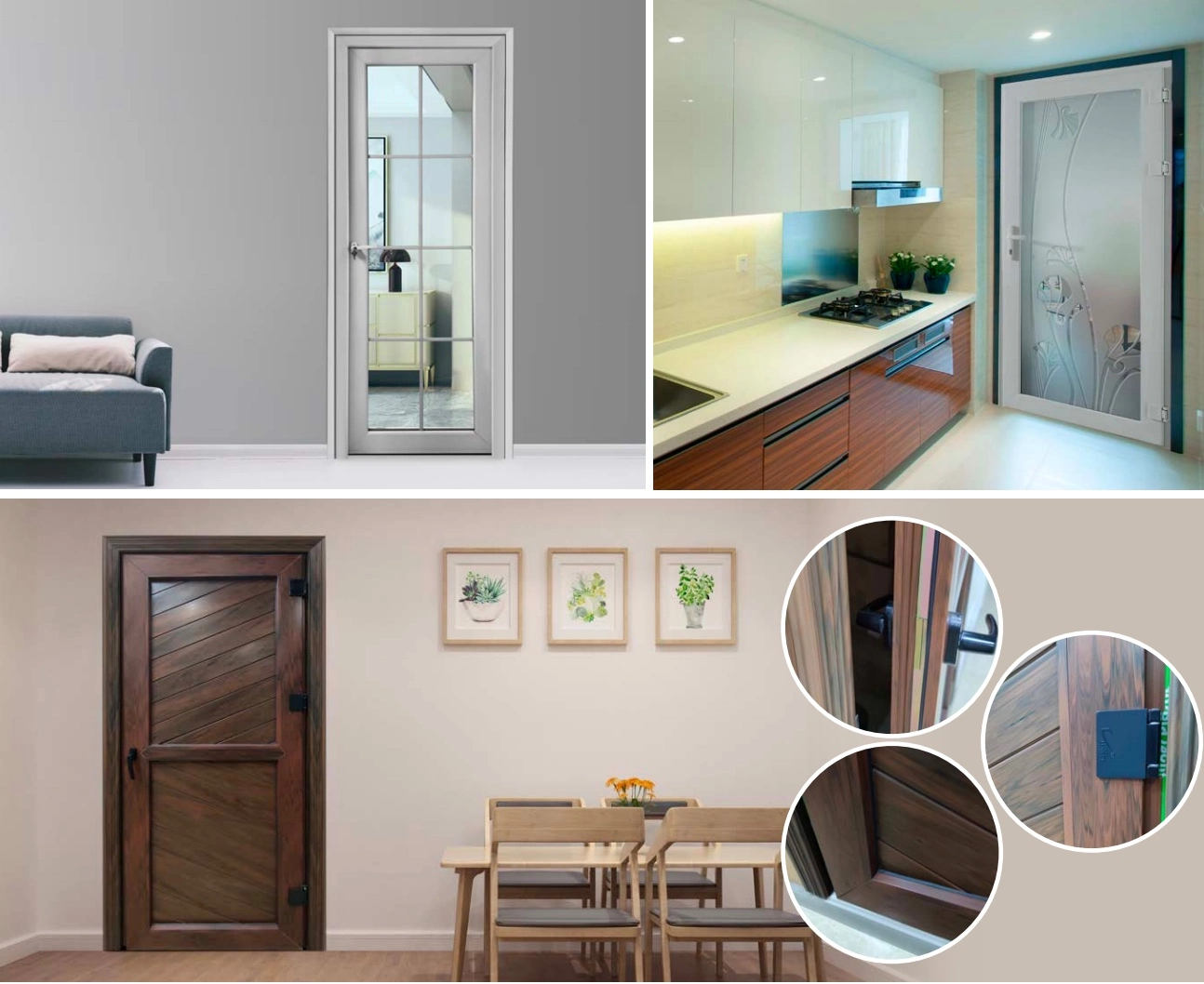
In this guide:
Why does a gust load a UPVC door leaf harder than its own weight?
Pressure follows p = 0.625 v squared, with v in metres per second. At 25 m/s that is 391 Pa. A 900 x 2,100 mm leaf is 1.89 m2, so the force is 391 x 1.89 = 739 N, against a dead load of 343 N for the same leaf at 35 kg. At 35 m/s the pressure is 766 Pa and the force is 1,448 N, four times the weight of the door.
A door is worse placed than a window of the same area. The leaf is 2.1 m tall, so the wind acts about 1.05 m above the bottom hinge, and a single leaf carries one lock point instead of a full perimeter of locking cams. The load enters the wall through three hinges on one side and a keep on the other, which is a much shorter path than a window frame provides. That is why UPVC swing doors need a different checklist from a window of the same size.
Coastal and exposed sites make this the deciding variable rather than the profile. Where a project sits within a kilometre of open water, the same leaf can see 35 m/s design gusts, and the specification that survives it is a different door from the one that survives 25. On UPVC swing doors used on an exposed elevation the hinge count is a specification item, not a detail. UPVC doors for coastal work reads differently once the force is known rather than described.
How many hinges does a 1.89 m2 leaf actually need?
The answer comes from the moment, not from the mass. Two hinges 1.8 m apart resist the 776 Nm bending moment as a couple, so each takes 776 / 1.8 = 431 N horizontally in opposite directions. Under 35 m/s the same couple is 1,448 x 1.05 = 1,520 Nm, which is 845 N per hinge. That is the number the fixing has to survive, and it is the number a catalogue never prints. On UPVC swing doors the same arithmetic runs for every leaf size in the schedule.
A third hinge does not add strength so much as shorten the span. Moving the hinge spacing from 1.8 m to two gaps of 0.9 m raises the couple reaction to 776 / 0.9 = 862 N at the top and bottom pair, which sounds worse until you note that each hinge now shares with two others and the leaf cannot drop out of plane if one fixing creeps. That is the real reason to specify three.
| Wind speed | Pressure | Force on a 1.89 m2 leaf | Hinge and fixing requirement |
|---|---|---|---|
| 20 m/s (72 km/h) | 250 Pa | 473 N | Two hinges acceptable, 1.5 mm steel insert at the hinge stile, 8 mm anchors |
| 25 m/s (90 km/h) | 391 Pa | 739 N | Three hinges, insert spanning both fixing zones, check anchor pull-out |
| 35 m/s (126 km/h) | 766 Pa | 1,448 N | Three hinges plus a mid rail lock; verify the anchor into the reveal, not the frame |
| 45 m/s (162 km/h) | 1,266 Pa | 2,393 N | A single 900 mm PVC-U leaf is out of scope; two leaves, or a commercial system |
Pressures are calculated from p = 0.625 v squared and forces from leaf area. These are arithmetic on design gust speeds, not measurements from a test rig or a shipment.
What does the steel insert in the hinge stile have to carry?
PVC-U is a wall of 2.8 to 3.0 mm. A screw threaded straight into that wall holds by friction against a material that creeps under sustained load, so 431 N applied for months at a time will elongate the hole. A galvanised steel insert changes the fixing from screw-in-plastic to screw-in-steel, and that is the whole point of it. An insert under 1.2 mm thick does not do the job.
Four details decide whether the insert is real. Thickness, 1.2 mm minimum and 1.5 mm on an entrance door. Length, which must span both hinge fixing zones plus 100 mm beyond each, otherwise the load transfers into unreinforced profile. Screw count and size per hinge, since two screws into 1.5 mm steel behave very differently from four. And continuity at the corners, because a hinge stile insert that stops 50 mm short of the welded corner leaves the top hinge working on plastic alone.
The check that settles it takes ten minutes. Hang the leaf on the sample, put a dial gauge on the lock side, and load the leaf at mid height with 500 N for an hour. A door with a proper insert returns to within a millimetre. A door without one keeps a permanent set, and the same set appears on site as a door that drags at the top of the lock side after the first hot season.
| Parameter | Typical value | Note |
|---|---|---|
| Configuration | Single or double leaf UPVC swing doors, inward or outward | Opening direction and threshold follow the elevation |
| Profile | PVC-U, multi chamber | Class per EN 12608-1 as specified for the project |
| Wall thickness | 2.8-3.0 mm | Measured on the visible wall, not across the weld |
| Steel insert | 1.2 mm minimum, 1.5 mm on entrance leaves | Must span both hinge fixing zones plus 100 mm |
| Glazing | 4+16A+4 double, laminated where a safety class applies | 2.5 kg per m2 per mm drives leaf mass |
| Leaf mass | 30-40 kg at 900 x 2,100 mm | Weigh a sample before fixing the hinge count |
| Hinges | 2 or 3 per leaf, sized on wind moment not mass alone | Ask for screw size and anchor type |
| Whole unit U-value | 1.2-1.6 W/m2K double glazed | Frame and spacer move the lower bound |
| Air permeability | EN 12207 class per contract | Tested on the closed and locked unit |
| Lead time and MOQ | 25-30 days, 10-20 units | Standard glass builds |
Values describe the common export range for PVC-U swing doors. A specific order is confirmed against its own specification sheet, the hardware datasheet and the wall design.
Which part of a PVC-U door fails first on a site visit?
In order: hinge fixing first, then gasket compression set at the lock side, then a blocked threshold drain, then the lock keep losing alignment. All four trace back to the same cause. The leaf moves because the fixing allowed it to move, and every later symptom is the leaf arriving somewhere it was not designed to be.
Gasket set is measurable and worth writing into the contract. A compression of 25 to 30 percent is what an EPDM or TPE seal is designed for; pushed to 50 percent it takes a set within two seasons and stops recovering, and the door starts whistling at the lock side on a windy night. If the same profile is offered as a window and as a door, the door needs the deeper gasket, not the same one.
The profile itself rarely fails. Where a leaf has cracked at a hinge screw, the crack starts at the hole and runs to the edge, which is a fixing problem showing up as a profile problem. That distinction matters at claim time: a supplier who blames the profile will replace a leaf, and the replacement fails the same way. Notes on types of UPVC windows and how they are built apply directly to the door leaf, because the two are made on the same line.

What should a factory checklist test before a bulk order ships?
Five items on UPVC swing doors, all cheap, all recorded: hinge pull-out with a stated torque or force, leaf squareness measured diagonally, gasket continuity around the full perimeter including the bottom rail, threshold drainage with a pour test, and glazing bead retention on the outside face. A checklist that only records appearance and dimensions tests nothing that fails in service.
If the door schedule and the design gust speed for the site are already fixed, send it over and the hinge count, insert thickness and anchor type can be returned against the real leaf sizes before the profile is cut. That is the cheap moment to change a fixing detail.
Packing belongs on the same checklist. A leaf strapped flat for three weeks arrives with the gasket flattened on one edge and the insert loaded in a direction it was never designed for. Doors ship upright, braced at the hinge stile, with the lock side free. Ask for the packing drawing, not a photo of the last container.
Which clauses belong in a wholesale contract for UPVC swing doors?
Six clauses: leaf mass, insert thickness and length, hinge count with screw size and anchor type, the design gust speed the door is specified to, the glazing build, and the drainage detail at the threshold. Each one is a number, not an adjective. Anything written as heavy duty, reinforced or tropical grade is a promise that cannot be checked on arrival.
Where the door also has to hold a thermal target, the glazing choice moves the mass again, and the hinge arithmetic has to be rerun. A double glazed 900 x 2,100 mm leaf at 8 mm glass carries about 24 kg of glass; stepping to 12 mm adds 12 kg, which is a third more dead load on the same three hinges. An energy efficient UPVC door and a standard one are not interchangeable on the same fixing schedule.
For entrances that pair a swing leaf with a glazed side panel, or with a second leaf on a French pair, keep the insert and hinge specification identical on both leaves. A UPVC french doors pair where only the active leaf is reinforced fails at the inactive leaf first, which is the one nobody inspects.
Frequently asked questions
What is the minimum order and lead time for wholesale UPVC swing doors?
Minimum order is 10-20 units and lead time is 25-30 days for standard glass builds. A change of insert thickness or hinge count is confirmed at quotation stage, because both change the fabrication of every leaf rather than a sample.
How do I check the steel insert without cutting a sample open?
Ask for the insert drawing with thickness and length dimensioned, then run the load test: hang the leaf, load 500 N at mid height for an hour and measure the permanent set with a dial gauge on the lock side. A leaf with a proper insert returns to within a millimetre.
Does a heavier door always need more hinges?
Not for weight alone. A 35 kg leaf is comfortable on three hinges. What forces a fourth hinge or a shorter spacing is the wind moment on a tall leaf, or a leaf wider than 1,000 mm where the lock side is far from the hinge line. Both are common on UPVC swing doors used as balcony and entrance leaves.
Which wind speed should be written into the order?
The design gust speed for the site, not the highest number available. A sheltered inland entrance and a coastal one at the same size are different doors internally even when the profile and the colour match. Ask for the force the door is specified to carry, in newtons, and check the anchor type against the wall it goes into.
Ordering from Haolv
Haolv Building Materials Co., Ltd. has been making windows and doors for 19 years, including UPVC swing doors for residential entrances. PVC-U profiles, steel reinforcement, glazing and hardware are assembled in one plant, so the insert, the hinge set and the drainage detail are decided where the leaf is welded. Certification documents are available on request. Minimum order is 10-20 units and lead time is 25-30 days.
Send the door schedule, the wall build up and the design gust speed for the site to kristin@haolvbuilding.com, and the reply comes back with hinge count, insert thickness and anchor type stated per leaf rather than as a general promise of strength.
Every force and reaction in this guide is calculated, not measured. Pressure uses p = 0.625 v squared; force is pressure times leaf area; the hinge reaction is the bending moment divided by hinge spacing. No test rig result, no shipment record and no site measurement is used here. Insert thickness, screw size, anchor capacity and U-values are confirmed against the hardware datasheet, the wall design and the specification of the actual order.

References
- EN 14351-1:2006+A2:2016 — Windows and doors. Product standard, characteristics and performance.
- EN 12207:2017 — Windows and doors. Air permeability. Classification.
- EN 12208:1999 — Windows and doors. Watertightness. Classification.
- EN 12210:2016 — Windows and doors. Resistance to wind load. Classification.
- EN 12608-1:2016 — Unplasticized polyvinylchloride profiles for windows and doors. Classification and requirements.
- ISO 9001:2015 — Quality management systems. Requirements.
Fast simple channel to send demands lock favorable price for building window door bulk purchases.