- English
- French
- German
- Portuguese
- Spanish
- Russian
- Japanese
- Korean
- Arabic
- Greek
- German
- Turkish
- Italian
- Danish
- Romanian
- Indonesian
- Czech
- Afrikaans
- Swedish
- Polish
- Basque
- Catalan
- Esperanto
- Hindi
- Lao
- Albanian
- Amharic
- Armenian
- Azerbaijani
- Belarusian
- Bengali
- Bosnian
- Bulgarian
- Cebuano
- Chichewa
- Corsican
- Croatian
- Dutch
- Estonian
- Filipino
- Finnish
- Frisian
- Galician
- Georgian
- Gujarati
- Haitian
- Hausa
- Hawaiian
- Hebrew
- Hmong
- Hungarian
- Icelandic
- Igbo
- Javanese
- Kannada
- Kazakh
- Khmer
- Kurdish
- Kyrgyz
- Latin
- Latvian
- Lithuanian
- Luxembou..
- Macedonian
- Malagasy
- Malay
- Malayalam
- Maltese
- Maori
- Marathi
- Mongolian
- Burmese
- Nepali
- Norwegian
- Pashto
- Persian
- Punjabi
- Serbian
- Sesotho
- Sinhala
- Slovak
- Slovenian
- Somali
- Samoan
- Scots Gaelic
- Shona
- Sindhi
- Sundanese
- Swahili
- Tajik
- Tamil
- Telugu
- Thai
- Ukrainian
- Urdu
- Uzbek
- Vietnamese
- Welsh
- Xhosa
- Yiddish
- Yoruba
- Zulu
Special Shape UPVC Windows Factory Checklist for Arch and Round Openings
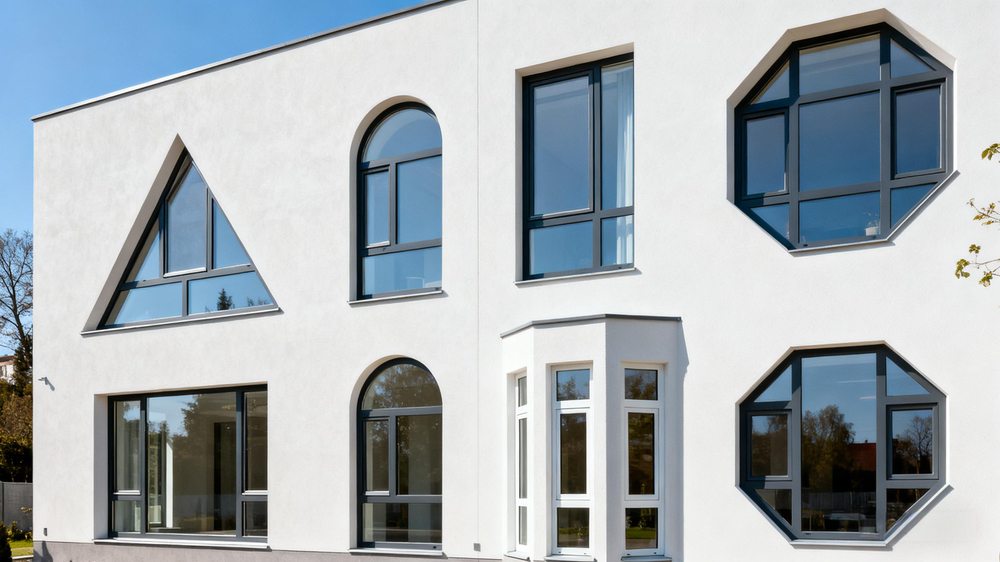
A shaped window is not priced by area. On a 1000 mm opening a semicircular head yields 78.5 per cent of the rectangle it is cut from but needs 157 per cent of the frame length, and a curved head can never be an opening sash. Special shape UPVC windows quoted per square metre cannot be compared between factories, because shape, not size, sets the work.
Three numbers decide what a shaped unit really costs
- Head yield — the glazed area of the curve divided by the rectangle it was cut from: 69.9 per cent for a segmental head, 78.5 per cent for a semicircular one.
- Frame length — the arch runs 1.16 to 1.57 times the straight head it replaces, and every metre carries profile, reinforcement, welding, bead and gasket.
- Fixed share — the curved head cannot be an opening sash, so the fixed part of a 2000 mm unit is about 21 per cent of the glazed area.
In this guide:
- How much glazed area does a shaped head actually deliver?
- Why is a shaped window quoted per unit and not per square metre?
- Where does the rain go on an arched head?
- Which part of a shaped window can actually open?
- What do wholesale buyers get wrong on shaped orders?
- How should you brief a factory before a shaped order?
How Much Glazed Area Does a Shaped Head Actually Deliver?
A shaped head is cut from a rectangular blank, so the first number that matters is how much of that blank ends up as glass. It is pure geometry, and it can be worked out from the width and the rise alone.
| Head form, 1000 mm wide | Rise | Glazed area | Bounding rectangle | Yield | Frame length | Vs straight head |
|---|---|---|---|---|---|---|
| Straight head | 250 mm | 0.250 m² | 0.250 m² | 100% | 1.00 m | 1.00× |
| Segmental arch | 250 mm | 0.175 m² | 0.250 m² | 69.9% | 1.16 m | 1.16× |
| Semicircular arch | 500 mm | 0.393 m² | 0.500 m² | 78.5% | 1.57 m | 1.57× |
Segment area = R² × acos((R − h) / R) − (R − h) × √(2Rh − h²), with R = (W²/4 + h²) / 2h. Arc length = 2R × acos((R − h) / R). Calculated from geometry, not taken from a supplier drawing.
Two things follow from that table, and the second is the one buyers miss. The first is that a segmental head at the same rise yields less than a semicircular one, because a shallow curve cuts away more of the blank relative to the glass it leaves. The second is that the frame length moves in the opposite direction to the yield: the semicircular head keeps more glass but needs 57 per cent more frame than the straight head it replaces.
For a round window the same arithmetic runs on the whole perimeter. A 1000 mm diameter circle holds 0.785 m² inside a 1.0 m² square, which is the same 78.5 per cent yield, but its frame is 3.14 m against 4.0 m for the square. Round units therefore lose on glass and win on frame, which is the opposite of an arch head, and is why the two cannot share a rate. Material changes the rate again, as this comparison of UPVC versus aluminium sets out for the same arch shape.
Why Is a Shaped Window Quoted per Unit and Not per Square Metre?
Because the area barely explains the work. Run the numbers on a 1000 mm wide unit with 1500 mm to the springing line and a 500 mm semicircular head: the glazed area is 1.89 m² and the frame runs 5.57 m, which is 2.94 m of frame per square metre. A plain 1000 x 2000 mm rectangle at the same overall height is 2.0 m² on 6.0 m of frame, or 3.00 m per square metre. The shaped unit has less frame per square metre than the rectangle.
So geometry is not where the extra cost sits. What changes is everything that happens before the frame exists: the profile has to be bent or cut into segments and welded on a curve, the glazing has to be templated rather than ordered at a nominal size, and each shape is a one-off drawing rather than a repeat of the same item. On a container order of twenty identical arches the drawing cost is small; on an order of twenty different shapes it dominates.
The practical consequence is that a per square metre rate on special shape UPVC windows is only meaningful within one shape at one quantity. Comparing two factories on a rate per square metre for a mixed shaped schedule compares two different amounts of work. What should be compared is the per unit price with the width, the rise and the springing height fixed, because those three dimensions are the whole specification of the shape.
A supplier who quotes a shaped unit from a photo has guessed the radius. A radius is not a dimension that can be measured from an image, and the difference between a 250 mm rise and a 300 mm rise on a 1000 mm opening changes both the glass area and the frame length. Profiles and reinforcement for these units follow the same logic as arch top UPVC windows in straight runs, with the curve added at the head.
Where Does the Rain Go on an Arched Head?
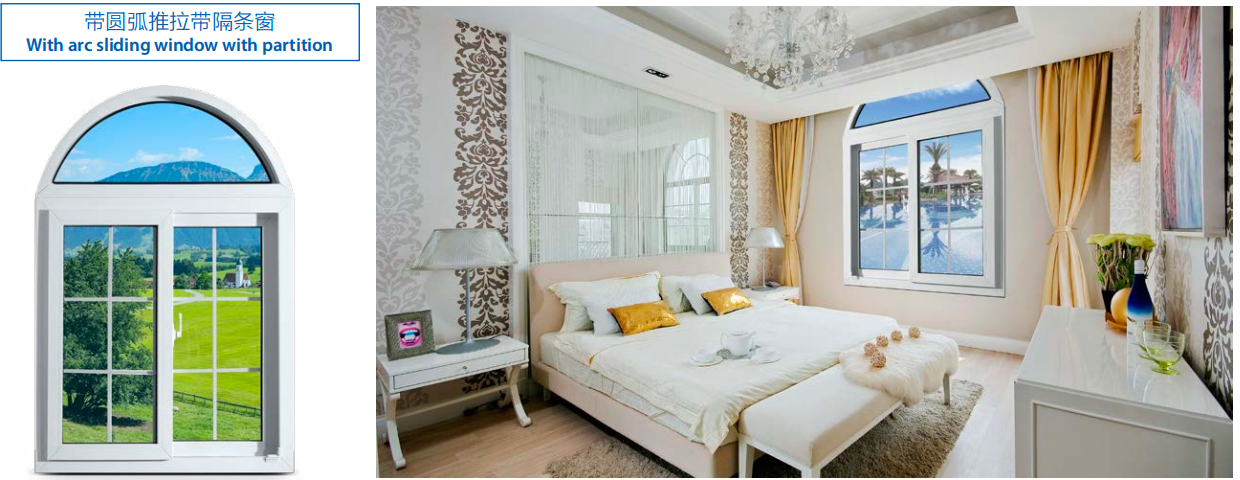
A shaped head changes the path water takes, and the change is predictable from the geometry. On an arch the highest point is the apex, so water runs away from the apex along both curved members and arrives at the two springing points, where the arch meets the vertical jambs.
| Rainfall intensity | Water on the arch head (1000 mm, 500 mm rise) | Per springing point | Where it must drain |
|---|---|---|---|
| 50 mm/h | 19.6 L/h | 9.8 L/h | Slots at both springing points plus the sill |
| 100 mm/h | 39.3 L/h | 19.6 L/h | Same, and the sill slots carry the run-off from the jambs |
| 150 mm/h | 59.0 L/h | 29.5 L/h | Same, with the sill checked for capacity |
Rainfall of 1 mm/h delivers 1 L per square metre per hour. Arch head area 0.393 m² at 1000 mm wide and 500 mm rise, assumed to shed to the two springing points only. Calculated, not measured on a test facade.
Two design rules follow. Drainage slots belong at the springing points and the sill, not at the apex, because at the apex there is no lower point for the water to reach within the frame. And the two springing joints, where the curve meets the straight, carry both the water and the highest bending moment in the head, so they are the first place to inspect on a shaped unit that leaks.
The same reasoning explains why shaped windows fail at the joints rather than in the middle of the curve. The arc itself is a stiff shape — it carries load in compression — but the two transitions from curve to straight are welded or mechanically jointed corners in a section that was designed to run straight.
Watertightness for the assembled unit is classified under EN 12208 and air permeability under EN 12207, both tested on the complete unit rather than on a sample of profile. A special shape UPVC window is tested as a shaped unit, which is why the test should be requested per shape family rather than assumed from a straight window report.
Which Part of a Shaped Window Can Actually Open?
An opening sash needs parallel sides for its hinges, its locking hardware and its weather seal. On a special shape UPVC window a curve does not provide them, so the curved head is fixed and the operable part is the rectangle below the springing line. That is a construction fact rather than a design preference.
It has a measurable cost. On the 1000 mm wide unit with 1500 mm to the springing line and a 500 mm semicircular head, the glazed area is 1.89 m² and the fixed head accounts for 0.393 m², or 20.8 per cent. One fifth of the glass in a shaped window is glass that no one can open, clean from inside, or use for purge ventilation.
| Parameter | Typical value | Note |
|---|---|---|
| Profile | PVC-U multi-chamber, steel reinforced | Reinforcement required in every load-bearing member |
| Frame depth | 60 to 70 mm | Confirmed against the profile system ordered |
| Glazing | Double or triple sealed unit, 24 to 44 mm | Shaped units need a bent spacer and a template |
| Air permeability | EN 12207, up to Class 4 | Tested on the assembled unit, not on profile samples |
| Watertightness | EN 12208, up to Class 9A | Springing joints are the critical points on an arch |
| Wind load | EN 12210, Class 4 to 5 | Confirmed against the design wind speed and unit size |
| Thermal transmittance | U-value 1.2 to 1.6 W/m²K double glazed | Frame value to EN ISO 10077-1 |
| Finish | White, laminated or co-extruded colour | Dark colours need the expansion allowance checked |
Typical ranges for PVC-U shaped units. Values are confirmed per order against the selected profile system and glass build.
The fixed share matters most where ventilation is the reason for the window. A shaped unit used as the only opening in a room delivers less operable area than its glazed area suggests, and the deficit has to be made up somewhere else in the room. Specifiers who add an arch head for appearance usually keep the rectangular opening below it as the functional window, which is the arrangement that works.
It also decides how the unit is made. A fixed head and an opening sash are separate frames with a transom between them, not one sash bent around a curve, so the springing line is a real structural member with its own welded corners. Round windows follow the same rule and are almost always fixed, which is worth knowing before comparing a round unit with a UPVC bow windows that projects and does open.
What Do Wholesale Buyers Get Wrong on Shaped Orders?
Four errors account for most of the rework, and all four are settled before the drawing is approved.
- Sending a photograph instead of a rise. The shape is defined by the width, the rise and the springing height. A photo defines none of them, and a factory that accepts a photo will guess the radius.
- Confusing rise with radius. A 1000 mm opening with a 250 mm rise has a radius of 625 mm. Quoting a radius as a rise produces a head twice as deep as intended, and neither the glass nor the frame will match the elevation.
- Pricing a mixed schedule of special shape UPVC windows per square metre. Twenty different shapes at one rate per square metre means twenty different amounts of drawing, bending and templating work for the same money.
- Forgetting the template and the packing. Shaped units are templated rather than ordered at a nominal size, and they stack badly. A container loaded on the assumption of rectangular units will either lose crate space or arrive with damaged corners.
The second item is the one that produces the most expensive mistakes, because the error is invisible until the unit arrives: a head that is half a metre deep instead of a quarter looks plausible on a drawing and wrong on a wall. If the elevations are already drawn, send them over and the rise, springing height and fixed share can be read back against each shape before anything is cut.
How Should You Brief a Factory Before a Shaped Order?
Six items define a special shape UPVC window completely. With all six, a factory can price per unit instead of guessing rather than pricing against an assumption.
- Opening width, and the springing height measured from the sill to where the curve starts.
- Rise of the head, measured vertically from the springing line to the apex, in millimetres.
- Which part opens: fixed head with an opening sash below, or fully fixed, and the sash count if there is more than one.
- Glass build, since a shaped sealed unit needs a bent spacer and a template rather than a nominal size.
- Finish and colour, with the expansion allowance confirmed for dark colours on wide units.
- Quantity per shape, listed shape by shape rather than as a total, because the price depends on the mix.
With those six, the price stops being an area calculation and becomes a per unit figure that can be compared between factories. The same discipline applies to importing: what a buyer is really comparing between suppliers is covered in this note on arch top UPVC suppliers, which sets out the documents and drawing controls that sit around the unit itself.
Questions Buyers Ask Before Ordering
What is the wholesale MOQ for special shape UPVC windows?
Production starts from 10 to 20 units per order when the shapes repeat, and from a smaller quantity per shape when several shapes are ordered together. Lead time is 25 to 30 days from drawing approval.
How is a shaped window priced?
A special shape UPVC window is priced per unit, with the width, rise and springing height fixed. Area alone does not describe the work: a semicircular head yields 78.5 per cent of its blank but needs 57 per cent more frame than a straight head.
Can a round window be made to open?
Rarely. An opening sash needs parallel sides for hinges and hardware, so round and arched units are normally fixed, with a rectangular opening sash below the springing line where ventilation is required.
Which factory can supply arch top UPVC windows in bulk?
Compare the per unit price with the rise and springing height stated, the reinforcement in the curved members, and whether the glazing is templated. A rate per square metre hides all three.
What glass is used in shaped units?
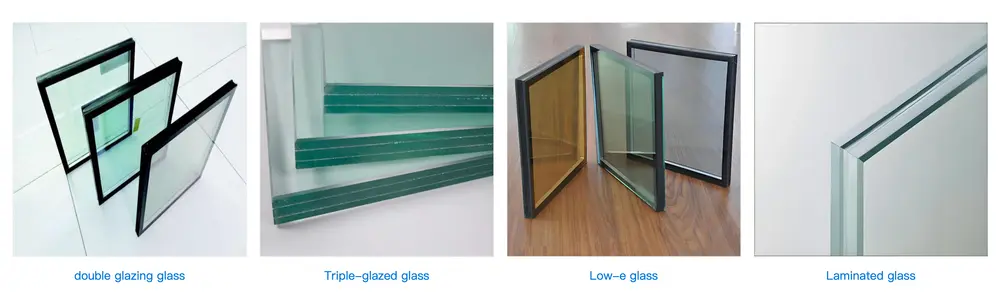
Double or triple sealed units, 24 to 44 mm, with a bent spacer and a template. Low-e coatings and argon fill apply as they would in a rectangular unit.
Ordering from Haolv
Haolv Building Materials Co., Ltd. has been manufacturing aluminium and UPVC windows and doors for 19 years, covering special shape UPVC windows, arch top, casement, sliding and bow systems. Frames, glass and hardware are supplied together, orders ship in 25 to 30 days, and production starts from 10 to 20 units. Certification documents are available on request. Any question on the rise, yield or fixed share above can be sent to kristin@haolvwindows.com.
The figures in this guide are calculated from the geometry of the shapes described and the standard glass weight of 2.5 kg per square metre per millimetre. They are arithmetic on nominal dimensions, not measurements from a specific installation. Rise, radius and profile depth vary by system, so the calculated areas and frame lengths are confirmed against the approved shop drawing before an order is placed.

References
- EN 14351-1:2006+A2:2016 — Windows and doors, product standard, performance characteristics
- EN 12207:2016 — Windows and doors, air permeability, classification
- EN 12208:1999 — Windows and doors, watertightness, classification
- EN 12210:2016 — Windows and doors, resistance to wind load, classification
- EN 673:2011 — Glass in building, determination of thermal transmittance, calculation method
- EN ISO 10077-1:2017 — Thermal performance of windows, doors and shutters, calculation of thermal transmittance
Areas, frame lengths and water volumes in this guide are calculated from nominal geometry and stated rainfall intensity, and are not test results for a specific unit. Curved profile limits, reinforcement and glazing templates differ between systems and should be confirmed against the approved drawing for the actual order.
Fast simple channel to send demands lock favorable price for building window door bulk purchases.