- English
- French
- German
- Portuguese
- Spanish
- Russian
- Japanese
- Korean
- Arabic
- Greek
- German
- Turkish
- Italian
- Danish
- Romanian
- Indonesian
- Czech
- Afrikaans
- Swedish
- Polish
- Basque
- Catalan
- Esperanto
- Hindi
- Lao
- Albanian
- Amharic
- Armenian
- Azerbaijani
- Belarusian
- Bengali
- Bosnian
- Bulgarian
- Cebuano
- Chichewa
- Corsican
- Croatian
- Dutch
- Estonian
- Filipino
- Finnish
- Frisian
- Galician
- Georgian
- Gujarati
- Haitian
- Hausa
- Hawaiian
- Hebrew
- Hmong
- Hungarian
- Icelandic
- Igbo
- Javanese
- Kannada
- Kazakh
- Khmer
- Kurdish
- Kyrgyz
- Latin
- Latvian
- Lithuanian
- Luxembou..
- Macedonian
- Malagasy
- Malay
- Malayalam
- Maltese
- Maori
- Marathi
- Mongolian
- Burmese
- Nepali
- Norwegian
- Pashto
- Persian
- Punjabi
- Serbian
- Sesotho
- Sinhala
- Slovak
- Slovenian
- Somali
- Samoan
- Scots Gaelic
- Shona
- Sindhi
- Sundanese
- Swahili
- Tajik
- Tamil
- Telugu
- Thai
- Ukrainian
- Urdu
- Uzbek
- Vietnamese
- Welsh
- Xhosa
- Yiddish
- Yoruba
- Zulu
Vinyl French Casement Windows Factory Checklist for Coastal Housing Procurement
A wholesale vinyl French casement windows factory is asked for two contradictory things at once: a pair of leaves that swing inward like timber French windows, and a frame that survives salt air, driving rain and a housing estate budget. Both are achievable, but only if the reinforcement, the gasket line and the hardware schedule are settled before the quotation is signed. A Vinyl French Casement Windows is a side hung UPVC casement with a French window elevation and usually a pair of opening leaves, so the frame has to carry two sashes plus an active and a passive leaf detail, which is a heavier duty than a single casement of the same width. For procurement teams buying for coastal housing, the checklist below is the one that decides whether the ninth block of units matches the first.
In this guide:
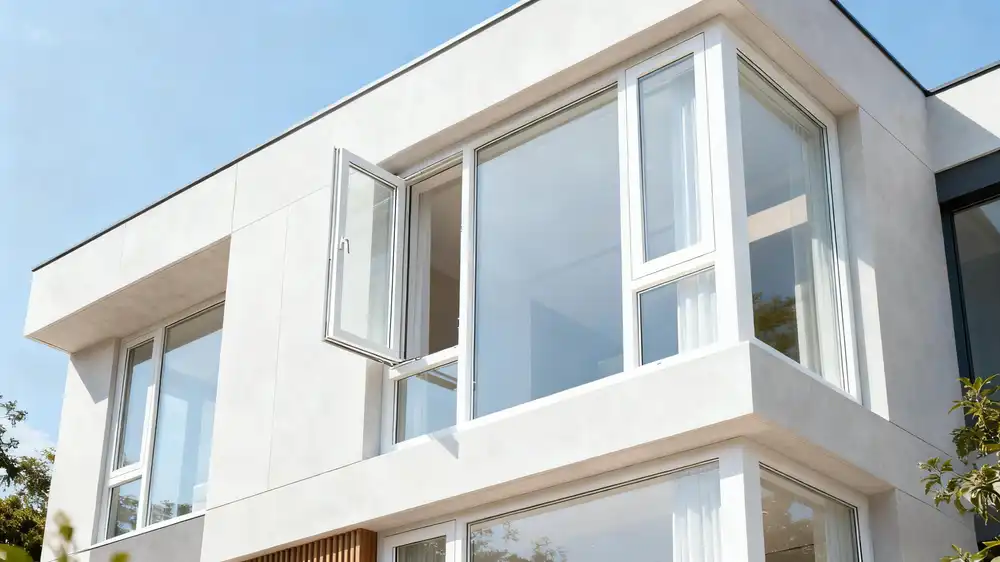
Short answer: a wholesale vinyl French casement windows factory should be checked on five points: galvanised steel reinforcement of 1.4 to 2.0 mm in every opening leaf, welded corners dressed rather than filled, a triple EPDM gasket line, multi-point locking on both leaves, and a documented water test result before the container is loaded.
| Parameter | Typical value | Note |
|---|---|---|
| System depth | 60 / 70 mm UPVC casement series | Deeper system allows a wider sash and a heavier glass build |
| Reinforcement | Galvanised steel, 1.4 to 2.0 mm | PVC-U expands more than aluminium, so long leaves need it |
| Glazing | Double or triple, Low-E optional | U-value quoted as low as 1.4 W/m2K with triple glazing |
| Sealing | Triple EPDM weatherstripping | Quoted sound reduction of up to 35 dB |
| Performance | GB/T 7106 air Class 8, water Class 6 at 350 Pa, wind load 5 kPa | Coastal sites should be checked against design pressure |
Inside the Profile of a Vinyl French Casement Window
Why Reinforcement Decides the Life of the Leaf
PVC-U moves more than aluminium under the same temperature swing, and a French casement leaf is tall and narrow, which is the worst shape for that movement. Galvanised steel reinforcement of 1.4 to 2.0 mm inside the profile is what keeps the leaf straight through a summer facade and a winter one. A factory that quotes a lower figure, or that leaves the reinforcement out of the opening leaves to save weight, is selling a window that will drop on its hinges inside two seasons.
On a vinyl French casement window, reinforcement is also a welding question. The steel has to stop short of the welded corner so the two profiles can fuse, and that gap is where a badly built window shows itself: a corner that is filled with sealant rather than welded, or a weld that has been dressed so heavily that the wall around it is thinner than the drawing allows. Ask how the corner is welded and how it is cleaned, not whether it is welded.
Chambers, Drainage and the Gasket Line
On a vinyl French casement window a multi-chamber profile is not a marketing term; the chambers are what let water drain away from the inner face and what slow heat transfer through the frame. On a French casement the drainage path has to serve two leaves and a meeting stile, so the factory needs to show where the weep slots sit, how the meeting stile is drained, and whether the sill has a slope built in or relies on site sealing. A window that drains onto its own inner face is a leak with a two year delay.
The gasket line on a vinyl French casement window does the rest. Triple EPDM weatherstripping gives a rain screen, an air seal and an inner barrier, and on a pair of inward opening leaves each one has to keep compression across the meeting stile where the two sashes meet. That junction is the weakest line in any French window, vinyl or timber, and it is worth asking for a section drawing of it before the order is placed.
Hardware on a Pair of Leaves
Two leaves mean one active and one passive leaf, and the passive leaf usually closes on flush bolts top and bottom while the active leaf carries the multi-point lock and the handle. The hardware has to be European standard multi-point locking with stainless steel hinges, and the hinge specification has to be matched to the leaf weight rather than to the frame width. On a coastal project specify stainless throughout, including the flush bolts, because a plated component will fail before the profile does.
Handles are the part buyers change most often, and colour matching is the usual reason. Confirm early whether the handle finish is stocked in white, silver or a custom match, and confirm that the spindle length suits the sash thickness, because a handle ordered separately after the container arrives rarely matches the original order.
Why Coastal Housing Needs a Different Vinyl French Casement Window Specification
Salt Air, UV and the Finish
Salt air attacks the hardware on a vinyl French casement window first and the profile second. Stainless steel hinges, lock keeps and flush bolts are the difference between a window that is still working in year eight and one that has seized. Ultraviolet is the second load: a UPVC profile stabilised with titanium dioxide and finished with a co-extruded cap layer holds its colour far better than a thin printed film, and on a sea facing elevation the difference is visible within three summers.
Colour is a specification decision on the coast for a practical reason as well. A dark foil or paint finish runs hotter in direct sun, and a hot surface expands further, which puts more strain on the welds and on the reinforcement. Where a project wants an anthracite or a dark grey elevation, ask what the finish system is rated for and whether the same colour is available as a co-extruded skin rather than a painted surface.
Wind Load and Water Tightness on an Exposed Elevation
The vinyl French casement window range is quoted with air tightness to GB/T 7106 Class 8, water tightness to Class 6 at 350 Pa and wind load resistance to 5 kPa. On a coastal block those figures need reading against the design pressure for the specific elevation, because a sheltered courtyard facade and a tenth floor sea facing one do not load the same window equally, even when the drawing shows an identical unit.
Water tightness is where a French casement earns or loses its reputation, because the meeting stile gives water a route that a single casement does not have. Ask for the test report that covers the paired leaf configuration, not a report for a single casement from the same family. A test on a different configuration is evidence of the factory, not evidence of the window you are buying.
Thermal Targets in a Warm Humid Market
A vinyl French casement window is quoted at a U-value as low as 1.4 W/m2K with triple glazing, and that figure is a useful target in a temperate market. In a hot humid market the same window is often better sold with a double unit and a solar control coating, because cooling load responds to SHGC more than to U-value. Specify both numbers against the orientation, and let the glazing follow the climate rather than the catalogue.
Condensation risk on the interior face is the other half of the thermal argument. In a cooled room in a humid climate the inner surface of the frame can sit below dew point, and a multi-chamber profile with a warm edge spacer moves that risk away from the frame and into the glass, where it can be managed by ventilation rather than by a callback.
The Ordering Sequence That Keeps a Wholesale Programme Repeatable
Fix the Elevation Before the Schedule
Vinyl French casement windows are bought as an elevation, not as a list of sizes. Which units are paired, which are single, where the fixed lights sit and whether the pair opens inward or outward have to be settled on a drawing before a schedule is issued, because the answer changes the frame, the reinforcement and the hardware. A schedule produced from a room list rather than from an elevation is the most common source of a mismatch on site.
Where the same elevation also carries doors, compare the wholesale vinyl French doors for matched elevations against the window units before the order is split, since a matching sightline across a window and a door usually means one profile family rather than two purchases. Splitting the order between a window supplier and a door supplier is how a facade ends up with two slightly different whites.
Quantities, Sampling and the First Container
Initial orders of 10 to 20 units are accepted with neutral packaging or OEM branding, and standard production runs on a 25 to 30 days lead time from order confirmation. For a housing programme that is enough to build and inspect a show unit before the volume order, which is the cheapest quality step available: approve the corner weld, the gasket compression and the handle finish on one window rather than arguing about them across a container.
On a vinyl French casement window, colour and glazing should be locked by number rather than by name. A RAL reference, a glass build written as 4+16Ar+4 with the coating named, and a gasket compound named in the order prevent the substitution that otherwise appears in the second batch. Where the programme runs across several blocks, keep the same reference for every release, including the packaging label, so that site staff can match a crate to a block without opening it.
What Customisation Is Worth Paying For
Useful customisation on a vinyl French casement window is dimensional and mechanical: sizes cut to the opening, RAL colour matching, single or paired leaves, colonial or diamond grille patterns, a friction stay for controlled ventilation, and a choice of tempered or laminated glass on ground floor units. Decorative options that change the profile shape are rarely worth the tooling cost on a housing programme, because they add a lead time item without improving performance.
OEM and ODM work is available for distributors who want their own label, and the sample route lets a buyer approve the elevation and the finish before volume. A practical reference for that approval step is the comparison of vinyl French doors for residential building projects, which sets out how paired leaves are usually configured and where the hardware differs between a door and a window.
Factory Checks and Shipment Paperwork Before a Coastal Delivery
What to Ask the Factory to Show
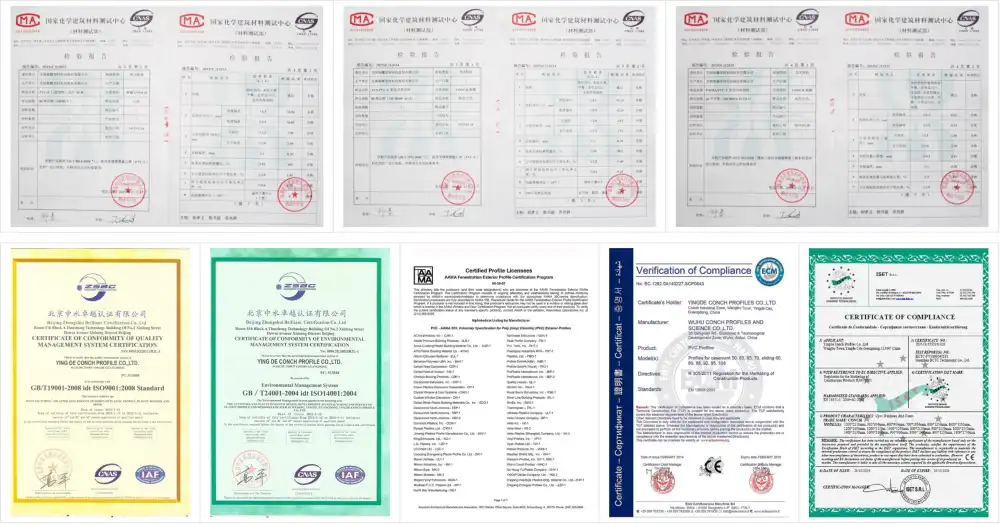
Ask for the certification documentation that applies to the product family, the test reports behind the air, water and wind figures, and the profile datasheet that states the reinforcement thickness and the chamber layout. Then ask for a section drawing of the meeting stile and of the sill drainage, because those two details decide the service life of a paired leaf and they are almost never on a quotation.
If the programme is large enough to justify it, ask for a pre shipment inspection on a sample of units rather than on one. The usual findings are a corner weld that has been over dressed, a gasket that is short at the meeting stile, and a handle fitted with the wrong spindle length; all three are cheap to fix before loading and expensive to fix on site. Reviewing how UPVC flush casement windows are specified for energy efficiency is useful here, because the same sealing logic applies and the vocabulary is shared with the factory.
Packing, Loading and the Handover File
A vinyl French casement window frame is light and stiff, which makes them easy to load badly. Ask whether frames ship assembled with the glass glazed or separately, how the corners are protected, and whether the leaves are braced in the crate. On a coastal delivery the container itself matters: a long sea route with a container that breathes badly will leave condensation on the profiles, and a factory that packs with a desiccant and a moisture barrier avoids the white bloom that appears on delivery.
The handover file should contain the installation instructions, the recommended sealant, the drainage drawing and the hardware reference list. Without the hardware reference a replacement hinge ordered a year later will not match the screw positions, and the site will solve it by drilling new holes into a welded frame.
Service Life and Maintenance in Salt Air
A Short Routine That Actually Matters
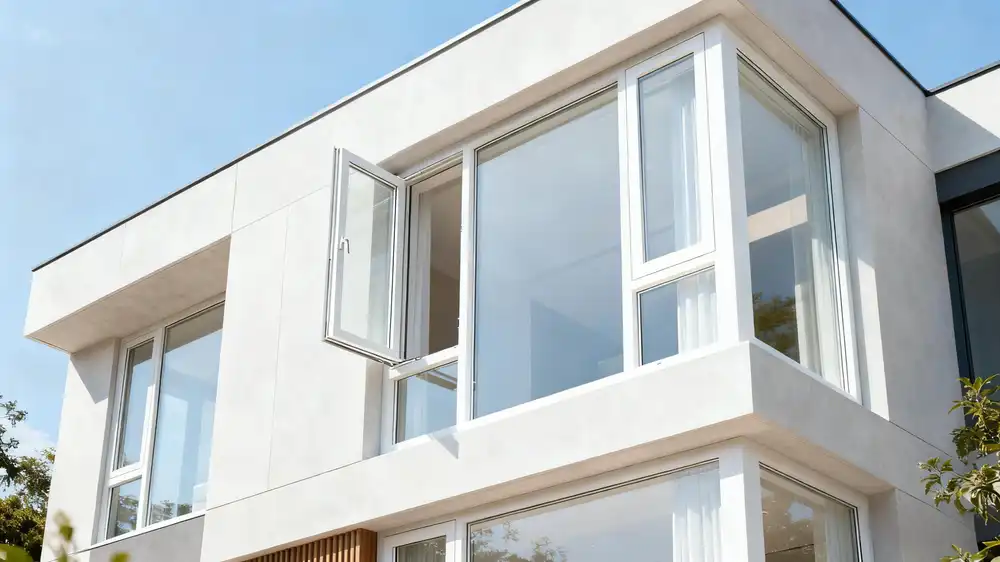
Wash the vinyl French casement window frame with fresh water and a mild detergent rather than a solvent, rinse the hardware on a coastal site every few months, and clear the weep slots before the wet season. Lubricate hinges and the locking bar once a year with a dry film lubricant. Do not use an abrasive cleaner on a foiled or painted surface, and do not let a cleaner use a pressure washer on the gasket line, which is the fastest way to destroy the seal.
Faults That Show Up First
A vinyl French casement window leaf that drags at the bottom corner in summer is telling you the reinforcement is light or the hinge has moved, not that the profile is wrong. Water at the meeting stile after driving rain points at the gasket compression or at a blocked drain in the sill, and it will not be fixed by adding sealant on the inside. Both faults are visible within the first two seasons, which is why a programme should keep a small stock of hinges and gasket sections.
Colour change is the slow fault. A chalky surface on a dark finish usually means ultraviolet exposure without a cap layer, and it cannot be polished back. On a coastal estate the practical response is to specify the finish correctly at order stage and to accept that the elevation will need cleaning rather than restoration.
Improving an Existing Installation
An installed vinyl casement can be improved with a solar control film where cooling load dominates, a brush seal at the meeting stile where draught is the complaint, and adjustable hinges where a leaf has dropped. None of these replaces a correct original specification, but on a refurbishment they are the difference between extending the life of a window and replacing it.
Disclaimer: Actual performance depends on the test reports for each specific product and on the quality of installation. Results in different climates depend on correct specification and on following the manufacturer instructions.
Conclusion
A coastal housing order holds together when five items are written down before the deposit: the reinforcement thickness in every opening leaf, the welded and dressed corner, the drainage path through a paired sill, the gasket compression at the meeting stile, and stainless hardware throughout. A wholesale vinyl French casement windows factory that answers those five with drawings is a supplier; one that answers with a colour card is a risk. Settle them at order stage and the elevation repeats across every block; leave them open and the first sea facing unit becomes the sample nobody wanted.
FAQ
Q1: What is the wholesale price basis for vinyl French casement windows?
A: Price is quoted per unit against a written specification, so the comparable basis is the same reinforcement thickness, the same glass build and the same hardware schedule. Ask for the quotation broken into frame, glass and hardware lines, because a single number hides which of the three has been reduced.
Q2: What is the minimum order and lead time from a China factory?
A: Initial orders of 10 to 20 units are accepted with neutral packaging or OEM branding, and standard production runs on a 25 to 30 days lead time from order confirmation. Samples can be approved before the volume order, which is the practical way to settle the weld quality and the finish.
Q3: Are vinyl and UPVC the same material?
A: Yes. Vinyl is the common trade term for unplasticised polyvinyl chloride, so a vinyl French casement and a UPVC French casement describe the same product. What differs between suppliers is the reinforcement, the chamber layout and the gasket compound, not the name.
Q4: How long should the windows last in a coastal climate?
A: The profile is normally quoted at 20 to 30 years of service with routine maintenance, and the hardware is the limiting item. Stainless hinges and lock components reach that figure; plated ones do not, which is why the hardware schedule should be written into the order rather than left to the factory default.
Partner with Haolv Building Materials for Vinyl French Casement Windows
Haolv Building Materials Co., Ltd. has been manufacturing windows and doors for 19 years, and supplies procurement teams that need a vinyl French casement window supplier able to hold a specification across a multi block programme. Our factory in Hunan Province works from ISO, CE and AAMA certification documentation, works with CONCH to keep raw material quality consistent, and runs a 25 to 30 day delivery schedule supported by integrated supply chain management.
We accept initial orders of 10 to 20 units with neutral packaging or OEM branding, which makes it practical for building material sellers in Africa, South Asia and Eastern Europe to enter the market without committing to a full container. Our engineering team works from your elevations to configure the reinforcement, the glazing build, the leaf pairing and the finish, and provides application guidance and project based technical support. Email us at kristin@haolvwindows.com to discuss your market requirements and request quotes matched to your container plan.
This guide is maintained by Haolv's engineering team and reviewed against EN 14351-1 and EN 12207 as standards change.
References
1. European Committee for Standardization. (2016). EN 14351-1: Windows and doors - Product standard, performance characteristics.
2. European Committee for Standardization. (2000). EN 12207: Windows and doors - Air permeability - Classification.
3. European Committee for Standardization. (2003). EN 12208: Windows and doors - Watertightness - Classification.
4. European Committee for Standardization. (2003). EN 12210: Windows and doors - Resistance to wind load - Classification.
5. General Administration of Quality Supervision, Inspection and Quarantine of China. (2019). GB/T 7106: Graduations and test methods of air permeability, watertightness and wind load performance for building external windows and doors.
6. International Organization for Standardization. (2015). ISO 9001: Quality management systems - Requirements.
Fast simple channel to send demands lock favorable price for building window door bulk purchases.