- English
- French
- German
- Portuguese
- Spanish
- Russian
- Japanese
- Korean
- Arabic
- Greek
- German
- Turkish
- Italian
- Danish
- Romanian
- Indonesian
- Czech
- Afrikaans
- Swedish
- Polish
- Basque
- Catalan
- Esperanto
- Hindi
- Lao
- Albanian
- Amharic
- Armenian
- Azerbaijani
- Belarusian
- Bengali
- Bosnian
- Bulgarian
- Cebuano
- Chichewa
- Corsican
- Croatian
- Dutch
- Estonian
- Filipino
- Finnish
- Frisian
- Galician
- Georgian
- Gujarati
- Haitian
- Hausa
- Hawaiian
- Hebrew
- Hmong
- Hungarian
- Icelandic
- Igbo
- Javanese
- Kannada
- Kazakh
- Khmer
- Kurdish
- Kyrgyz
- Latin
- Latvian
- Lithuanian
- Luxembou..
- Macedonian
- Malagasy
- Malay
- Malayalam
- Maltese
- Maori
- Marathi
- Mongolian
- Burmese
- Nepali
- Norwegian
- Pashto
- Persian
- Punjabi
- Serbian
- Sesotho
- Sinhala
- Slovak
- Slovenian
- Somali
- Samoan
- Scots Gaelic
- Shona
- Sindhi
- Sundanese
- Swahili
- Tajik
- Tamil
- Telugu
- Thai
- Ukrainian
- Urdu
- Uzbek
- Vietnamese
- Welsh
- Xhosa
- Yiddish
- Yoruba
- Zulu
Wholesale German Style Casement Windows for Coastal Hardware Selection
German style casement windows on a coastal site need 316 stainless hardware once chloride deposition passes 300 milligrams per square metre per day, and that line is crossed inside about one kilometre of open sea. Above it, the grade of the stainless parts decides whether the window still opens in year eight. The aluminium frame is rarely where these windows fail first.
One number ranks the grades
Pitting resistance equivalent number, PREN = Cr + 3.3 Mo + 16 N, on the standard compositions: 304 gives 18.1 + 3.3 x 0.3 + 16 x 0.05 = 19.9, 316 gives 16.8 + 3.3 x 2.05 + 16 x 0.05 = 24.4, and duplex 2205 gives 22.0 + 3.3 x 3.1 + 16 x 0.16 = 34.8. The gap between 20 and 24 is the whole argument about coastal hardware.
In this guide:
Which stainless grade survives salt air on a casement window?
Grade 304 is the default for window hardware and it is a genuine stainless steel, with 18 percent chromium and a PREN near 20. That figure is enough for rain-washed facades inland. What breaks it down is chloride, which attacks the passive chromium oxide film at weak points and starts a pit. Molybdenum is the alloying element that holds those points closed, and 316 carries about 2 percent of it, which lifts the PREN from 20 to 24.
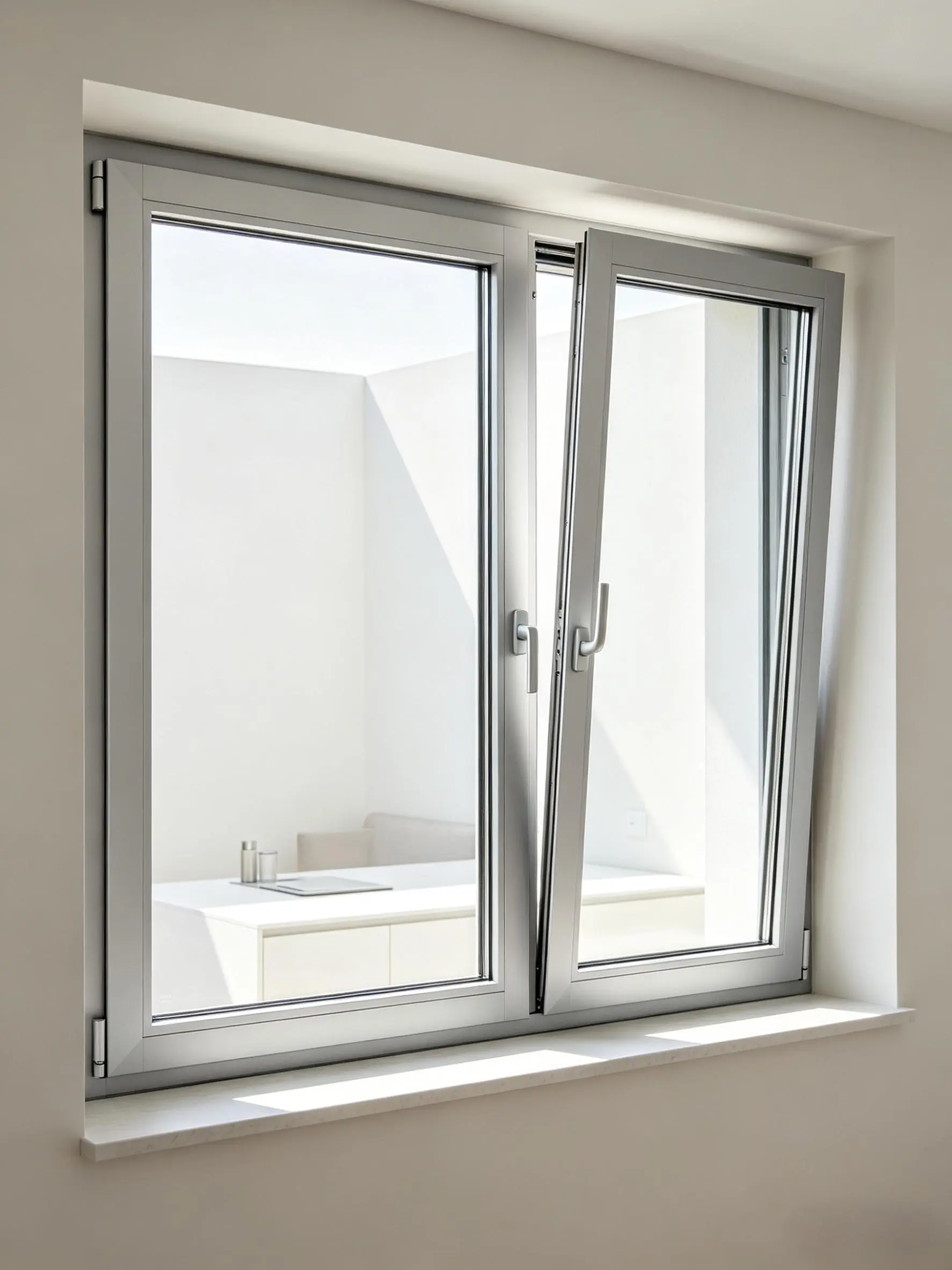
German style casement windows carry two different families of stainless part, and they see different conditions. Handles, hinges and the espagnolette sit on the weather side and take the deposition directly. The keepers on the inner frame sit in a dry zone. A specification that names one grade for the whole window either overpays on the inside or under-protects the outside.
How much chloride actually reaches a window one kilometre from the sea?
ISO 9223 sorts atmospheres by chloride deposition rate, measured in milligrams per square metre per day, and it decides the hardware grade on german style casement windows. Category C3 runs from 60 to 300, C4 from 300 to 1,500, and C5 from 1,500 to 6,000. A wind-driven coastal site at one kilometre from open water typically lands in C4, and a site inside 300 metres of breaking surf lands in C5 or beyond. These rates are site measurements, and the band a project falls into is confirmed by a deposition coupon on site, and a map only narrows the guess.
Two site conditions move a window up a band without changing its address. A sheltered recess behind a balcony soffit stops the rain from washing the salts off, so the deposition accumulates where a flushed facade would stay clean. And a seaward face that takes the prevailing wind collects several times what the lee face collects on the same building.
Exposure is a geometry question as much as a material one. A deep reveal, a soffit and a balcony parapet all cut the wind that carries the salt in, and they also cut the rain that would wash it off, so the trade is rarely a clean gain. Projects that have already worked through salt air exposure tend to settle the grade before the tender, which keeps every quotation on one basis.
| Distance to open water | ISO 9223 | Chloride, mg/(sqm day) | Stainless grade | EN 1670 class |
|---|---|---|---|---|
| over 10 km inland | C3 | 60 to 300 | 304 | class 3, 96 h |
| 1 to 10 km | C4 | 300 to 1,500 | 304, 316 on the seaward face | class 4, 240 h |
| 300 m to 1 km | C4 to C5 | 1,500 to 3,000 | 316 | class 4 to 5 |
| under 300 m or surf | C5 | 3,000 to 6,000 | 316, 2205 in splash | class 5, 480 h |
Bands are the ISO 9223 category boundaries and the EN 1670 neutral salt spray hours for each corrosion class. The distance column is a working rule that has to be replaced by a deposition coupon on the actual site. Calculated and standard values, not measurements from a project.
How much of the window is actually stainless?
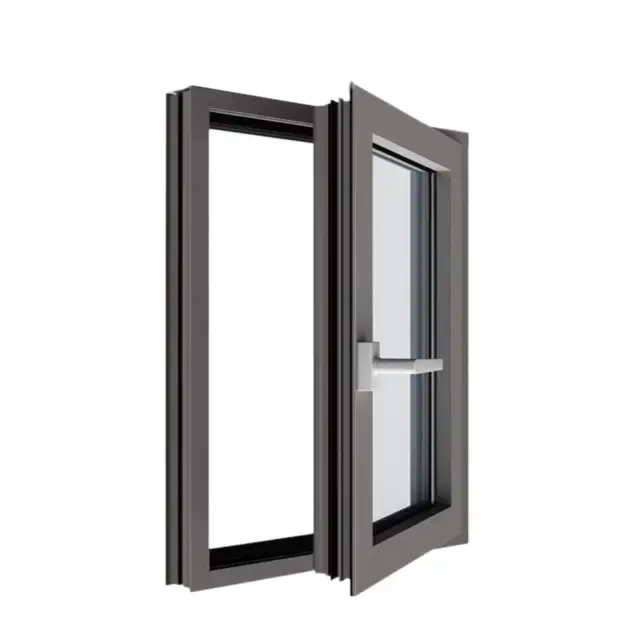
Take a german style casement window at 1,200 by 1,400 mm, single leaf. Glass at 2.5 kilograms per square metre per millimetre, two 4 mm panes, on 1.36 square metres of glass, is 27.2 kilograms. The aluminium profile for frame and sash adds about 12 kilograms, which puts the finished unit near 40 kilograms. The stainless set on that window, two handles, two hinges, one espagnolette and seven keepers, comes to roughly 2.2 kilograms.
That is 5.5 percent of the unit mass. It is also 100 percent of the parts that move, and the only parts that decide whether the sash swings freely in the eighth year. A buyer comparing two quotations by weight will find the 316 option heavier by a few grams and dismiss it on that line. The same buyer will then replace the handles on the seaward elevation four or five years into a C4 site.
Fasteners deserve their own line. A stainless screw into an aluminium hole is a bimetallic joint, and in a chloride film the aluminium around it becomes the anode and pits. Isolating washers, or a stainless screw into a stainless insert, close that path. The same logic applies at the sill, where a stainless setting block in standing water is worse than a plastic one.

Which coating thickness holds on a coastal aluminium frame?
Aluminium protects itself with an oxide film about four nanometres thick, and chloride breaks that film down. On german style casement windows the factory coating is what replaces it. EN 12206-1 sets 60 microns as the exterior minimum for polyester powder, and anodising to EN ISO 7599 class 15 gives 15 microns of sealed oxide. On a C4 or C5 elevation the working numbers are 80 microns of powder, or 20 microns of anodising with a sealed finish.
Thickness is not evenly distributed on a profile, and the places that matter are the ones a spray gun reaches worst. The inner corners of a drainage channel, the cut edge beside a weep slot, and the face behind a clip all run 20 to 30 percent below the nominal figure. That is why a coastal order should state a minimum on the coated part, checked at the drain slot, and not only the nominal microns on the quotation.
The thermal break itself is unaffected by salt. The polyamide strip is 25 percent glass fibre in PA66, and chloride does not attack it. Ultraviolet light does, over decades, so the strip belongs on the shaded side of the assembly and never on an exposed edge that faces the sun. A thermal break casement built this way holds its line in a salt atmosphere.
How should the coastal requirement be written on the order?
Five lines carry the coastal requirement on german style casement windows: stainless grade and PREN for the moving parts, EN 1670 class with the salt spray hours, minimum coating thickness with the test position, the isolation method at every fastener, and the cleaning access for the glass and the drain slots. Written this way, a quotation can be checked line by line. Written as "coastal grade hardware", it cannot.
Commercially an order for german style casement windows stays ordinary. Minimum order is 10-20 units and lead time is 25-30 days from an approved drawing, which is long enough to pull a deposition coupon result and confirm the grade before the hardware is ordered in.
| Parameter | Typical value | Note |
|---|---|---|
| Product | german style casement windows | inward or outward opening single and double leaf |
| Profile | 6063-T5, wall 1.4 to 2.0 mm | residential sections, thermal break PA66 GF25 |
| Glass | 4-16-4 low-e, argon filled | 1.2 to 1.6 W/(sqm K) for the glazed unit |
| Hardware | 304 standard, 316 for C4 and C5 | PREN 20 against PREN 24 |
| Hardware corrosion | EN 1670 class 3 to 5 | 96, 240 or 480 h neutral salt spray |
| Coating | 60 microns powder, 80 for coastal | EN 12206-1, anodising to EN ISO 7599 class 15 |
| Sash width | 600 to 1,200 mm | hinge load rises with the square of the width |
| Product standard | EN 14351-1 | air permeability to EN 12207 |
| Minimum order | 10-20 units | lead time 25-30 days |
Grade and coating are selected from the site deposition band; the figures above are the standard values for each class and are confirmed against the project specification.
What fails first on a coastal casement in year five?
In order: the hinge pin, the screw heads on the seaward face, the cut edge of the weep slot, and the handle spindle. All four are stainless or plated small parts, and all four cost less than one square metre of glass. The frame and the glazing unit are still serviceable when these fail, which is why the repair is cheap to specify at order stage and expensive to discover later.
Wind driven rain belongs in the same order as salt. A facade that takes both gets a higher EN 12207 air class and a higher water tightness class on the same window, and the hardware then sits in a wetter pocket for longer. Buyers in hurricane areas usually write both requirements on one line, because the two failures arrive together.
Upper floors on a coastal block often take the tilt and turn version of the same opening. The sash turns inside the frame, so wind load pushes it into the rebate and the hardware sits on the dry side. Frame and glass are common to both, which makes the swap cheap at tender stage and awkward after fabrication.
Site data beats a rule of thumb here. If the distance to open water, the facade orientation and the shelter condition are on the drawing, send them across and the grade, the EN 1670 class and the coating thickness for german style casement windows come back matched to that exposure, with the generic coastal label left out.
Frequently asked questions
What is the wholesale price for german style casement windows quoted from? From the sash size and count, the glass build-up, and the hardware grade. The grade is the line that changes least in money and most in service life, so it is quoted per elevation on coastal work.
Is 316 needed on the inland elevation of a coastal house? On a C4 site the lee side usually stays in the 304 range, and mixing grades by elevation is a normal way to hold the budget. It only works if the drawing marks which elevation gets which grade, so the two sets cannot be swapped on site.
Which is better on a salt facade, anodising or powder? Both hold when the thickness is right: 20 microns of sealed anodising or 80 microns of powder. Anodising keeps a metallic finish and shows scratches less; powder covers a wider colour range and is easier to touch up on site.
What is the minimum order and lead time? Minimum order is 10-20 units and lead time is 25-30 days from an approved drawing. Orders that mix 304 and 316 on one elevation are packed and marked by elevation, because the two sets are dimensionally identical.
Ordering from Haolv
Haolv Building Materials Co., Ltd. has been making doors and windows for 19 years. German style casement windows are built on 6063-T5 sections with a PA66 GF25 thermal break, glazed to EN 14351-1, and fitted with stainless hardware in the grade the site requires. Certification is available on request with the quotation. Minimum order is 10-20 units and lead time is 25-30 days.
Send the elevation drawing with the distance to open water and the facade orientation marked to kristin@haolvbuilding.com, or start from Haolv Building Materials Co., Ltd. and the hardware schedule comes back per elevation.
What this page calculates and what it leaves to the site: the PREN figures are arithmetic on standard alloy compositions, and the chloride bands are the ISO 9223 category boundaries. They are calculated and standard values, not measurements from a project. The deposition rate of a specific site, the salt spray result of a specific hardware batch and the film thickness on a specific extrusion are confirmed by coupon, by test report and by coating gauge.

References
- EN 10088-1:2014 — Stainless steels. List of stainless steels, the source of the chromium, molybdenum and nitrogen figures used in the PREN arithmetic.
- EN 1670:2007 — Building hardware. Corrosion resistance. Requirements and test methods, classes 3 to 5.
- ISO 9223:2012 — Corrosion of metals and alloys. Corrosivity of atmospheres, classification and estimation.
- EN 12206-1:2004 — Paints and varnishes. Coating of aluminium and aluminium alloys for architectural purposes.
- EN ISO 7599:2018 — Anodizing of aluminium and its alloys. Method for specifying decorative and protective anodic oxidation coatings.
- EN 14351-1:2006+A2:2021 — Windows and doors. Product standard, performance characteristics.
The PREN values, the chloride bands and the mass split in this guide are arithmetic on standard alloy compositions, published atmospheric categories and a stated glass weight of 2.5 kilograms per square metre per millimetre. They are calculated, not measured. A project grade is confirmed by a deposition coupon and a hardware test report.
Fast simple channel to send demands lock favorable price for building window door bulk purchases.