- English
- French
- German
- Portuguese
- Spanish
- Russian
- Japanese
- Korean
- Arabic
- Greek
- German
- Turkish
- Italian
- Danish
- Romanian
- Indonesian
- Czech
- Afrikaans
- Swedish
- Polish
- Basque
- Catalan
- Esperanto
- Hindi
- Lao
- Albanian
- Amharic
- Armenian
- Azerbaijani
- Belarusian
- Bengali
- Bosnian
- Bulgarian
- Cebuano
- Chichewa
- Corsican
- Croatian
- Dutch
- Estonian
- Filipino
- Finnish
- Frisian
- Galician
- Georgian
- Gujarati
- Haitian
- Hausa
- Hawaiian
- Hebrew
- Hmong
- Hungarian
- Icelandic
- Igbo
- Javanese
- Kannada
- Kazakh
- Khmer
- Kurdish
- Kyrgyz
- Latin
- Latvian
- Lithuanian
- Luxembou..
- Macedonian
- Malagasy
- Malay
- Malayalam
- Maltese
- Maori
- Marathi
- Mongolian
- Burmese
- Nepali
- Norwegian
- Pashto
- Persian
- Punjabi
- Serbian
- Sesotho
- Sinhala
- Slovak
- Slovenian
- Somali
- Samoan
- Scots Gaelic
- Shona
- Sindhi
- Sundanese
- Swahili
- Tajik
- Tamil
- Telugu
- Thai
- Ukrainian
- Urdu
- Uzbek
- Vietnamese
- Welsh
- Xhosa
- Yiddish
- Yoruba
- Zulu
Wholesale Horizontal Sliding Aluminum Windows for Distributor Stock Programs
Dealing with a wholesale horizontal sliding aluminum windows supplier is a stock decision before it is a design decision, because the roller grade, the track build and the glass unit have to survive a full container and two years of end user use, not one showroom cycle. A Horizontal Sliding Aluminum Windows unit carries its sashes sideways along a track instead of swinging them in or out, so nothing projects past the facade line and no floor space is lost to a door swing. That single movement governs everything else in the specification: the alloy wall thickness that keeps a two metre sash from bowing, the track arrangement that sets how much of the opening can be ventilated, the glazing build that fixes the U-value, and the sealing detail that decides whether dust and driven rain stay outside. The notes below are written for importers, distributors and project buyers who reorder by the pallet or the container rather than by the single unit.
In this guide:
- Framing alloy and track build that decides a wholesale order
- How wind rain and dust loads change a horizontal sliding aluminum window specification
- Where horizontal sliding aluminum windows lose to casement and tilt turn
- Wholesale sliding aluminum windows minimum quantity stock sizes and replenishment
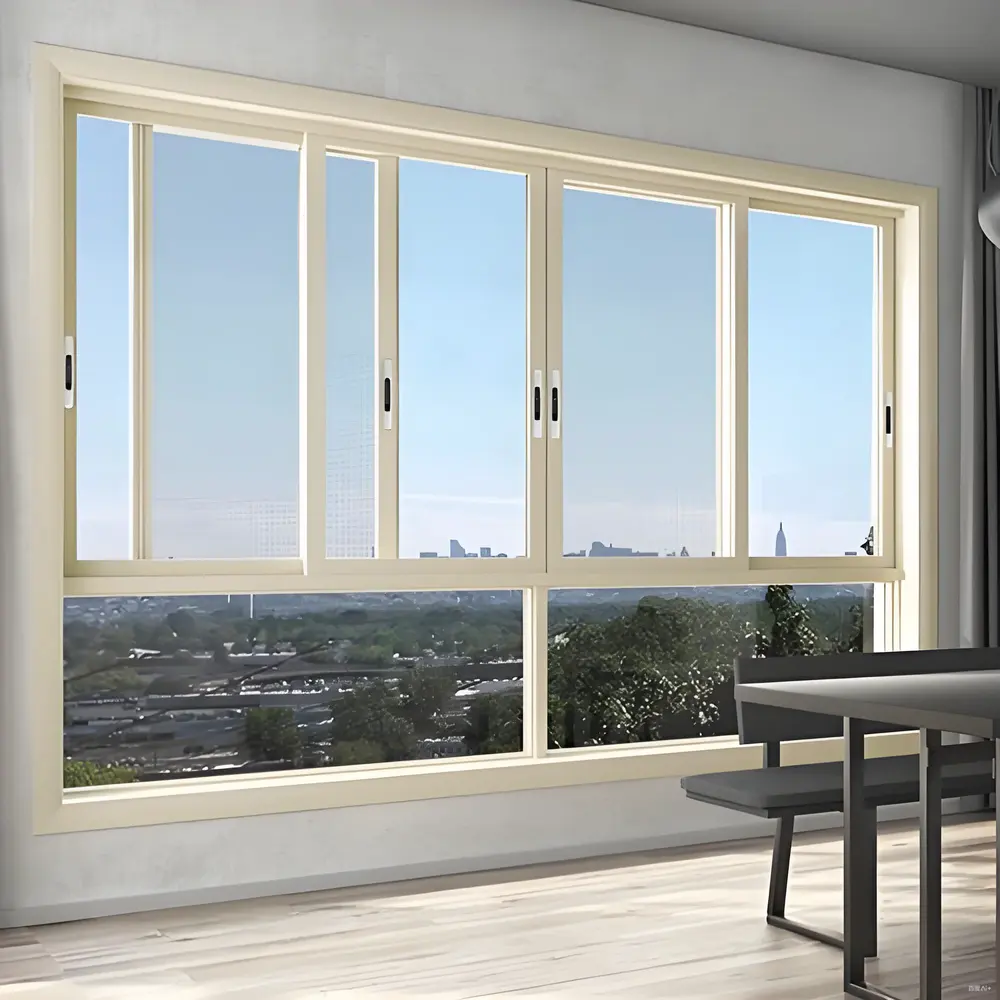
Short answer: a wholesale horizontal sliding aluminum window order is set by four items: 6063-T5 alloy at 1.4 to 2.0 mm wall, a single or double track arrangement matched to the opening, a sealed double or laminated glass unit with a stated U-value, and a roller grade rated for the sash weight rather than the sample weight.
| Parameter | Typical value | Note |
|---|---|---|
| Alloy and wall thickness | 6063-T5, 1.4 to 2.0 mm | Residential range; commercial elevations go heavier |
| Series depth | 60 / 70 / 80 / 90 series | Deeper series carries larger sashes and thicker glass |
| Track arrangement | Single track or double track | Double track gives a full clear opening and a screen |
| Glass build | Tempered, double glazed or laminated | U-value and SHGC follow the glass, not the frame |
| Sealing | Brush seal plus EPDM gasket | Brush handles dust on the track, EPDM handles air and water |
| Sound reduction | 30 to 35 dB with double glazing | Figures move with glass thickness and cavity width |
Framing Alloy and Track Build That Decides a Wholesale Order
Which Alloy and Wall Thickness Should a Stock Program Carry?
6063-T5 is the extrusion grade behind almost every aluminium window sold into export markets, and the wall thickness is where a cheap quotation hides its saving. At 1.4 mm the profile meets residential requirements and keeps the price where a distributor needs it. At 2.0 mm the section resists bowing on sashes above roughly 1.5 metres and takes a heavier glass unit without the sash corner lifting out of square. Commercial elevations, wind loaded facades and any opening wider than about 2.4 metres belong in the 2.5 to 3.0 mm band. Ask for the wall thickness per profile code in writing, because a single catalogue figure is usually the thinnest section in the range.
Alloy choice also decides how the finish ages. Powder coating and anodising both hold on 6063-T5, but a coastal stock program should specify the coating system and the nominal film thickness rather than a colour name. Where a distributor sells into several markets from one warehouse, the sensible split is a standard white and a standard anthracite in the fast moving sizes, with everything else made to order, because slow moving colours tie up capital for a whole season.
Single Track or Double Track for Volume Orders?
Track count is the first thing a buyer should settle, because it cannot be changed after extrusion. A single track sliding aluminum window carries one or two sashes in one plane: the sashes overlap when open, so the clear opening is roughly half the frame width, and there is nowhere to fit a sliding insect screen. A double track unit puts the sashes on two parallel planes, which returns the full clear opening and leaves a second channel free for a screen. On a residential stock program the double track version is the easier sell, since buyers compare ventilation and screening long before they compare price per square metre.
The track profile itself matters as much as the count. A raised outer rail with a drained channel below it lets water leave the frame instead of sitting against the gasket, and a stainless or nylon capped rail wears far better than bare aluminium under daily traffic. Where the same frame has to accept a screen, a lockable handle and a heavy duty roller, the track has to be specified as a system rather than assembled from standard stock sections.
What Roller Grade Separates a Container Order from a Showroom Sample?
Rollers are the cheapest component in a sliding aluminum window and the first to fail. A nylon wheel on a thin axle is adequate for a 40 kg sash in a mild climate; a stainless steel axle in a reinforced carriage is what holds a 90 kg triple glazed sash on a coastal facade for a decade. The specification line that protects a wholesale buyer is not the word heavy duty, it is the rated load per roller pair plus the number of test cycles. Anything sold without that figure is being sold on the sample, and the sample is always the good one.
How Wind Rain and Dust Loads Change a Horizontal Sliding Aluminum Window Specification
Coastal and Salt Laden Sites
Salt attacks the two places a sliding aluminum window cannot protect: the track channel and the roller carriage. Anodised or PVDF finishes hold up far better than a thin powder coat, and stainless hardware is not optional within about a kilometre of open sea. The drainage path also has to be checked, because a channel that drains onto a sill without a weep path will stain the reveal within one season and start corroding the frame from the inside.
For island and coastal projects, the practical answer is a heavier coating, stainless rollers and a specification that states the corrosion category the finish is expected to meet. That is a procurement line, not a marketing line: it tells the factory which pretreatment line the extrusion has to go through before it is cut.
Hot Dusty and Monsoon Climates
In dust heavy markets the brush seal does more work than the EPDM gasket, because the brush sweeps the track as the sash travels and stops grit reaching the roller. A worn or missing brush is what turns a smooth sliding aluminum window into a grinding one within a year. Specify a replaceable brush cassette if the market has a long dusty season, and ship a spare set in the first container, since the part costs almost nothing at the factory and is hard to source locally.
Monsoon conditions test watertightness rather than airtightness. The relevant classification is EN 12208, and the detail that carries it is the combination of a drained track, a cover strip over the roller slot and a gasket that compresses rather than folds. A window rated for a mild climate will pass a hose test and still leak in a two day storm, because the test duration is shorter than the event. Buyers in tropical markets should ask for the water test pressure, not just the pass mark.
High Rise Wind Pressure and Deflection
Wind load scales with height, and deflection is what fails first on a wide slider. A 2.4 metre sliding aluminum window sash in a 1.4 mm section will flex enough under gust load to break the gasket seal at the meeting stile, which shows up as a whistle rather than a leak. Above roughly eight storeys, the specification should move to the 2.0 mm band, add a reinforced meeting stile and state the EN 12210 class the assembly is expected to reach. That is a design decision the factory can only meet if the buyer states the building height at enquiry stage.
Interlocks deserve the same attention. The meeting stile of a sliding aluminum window is held by a hook or a blade interlock, and a shallow interlock on a tall sash racks open under pressure. A deep interlock with a continuous gasket line is the difference between a window that stays quiet in a gale and one that has to be serviced after the first storm season.
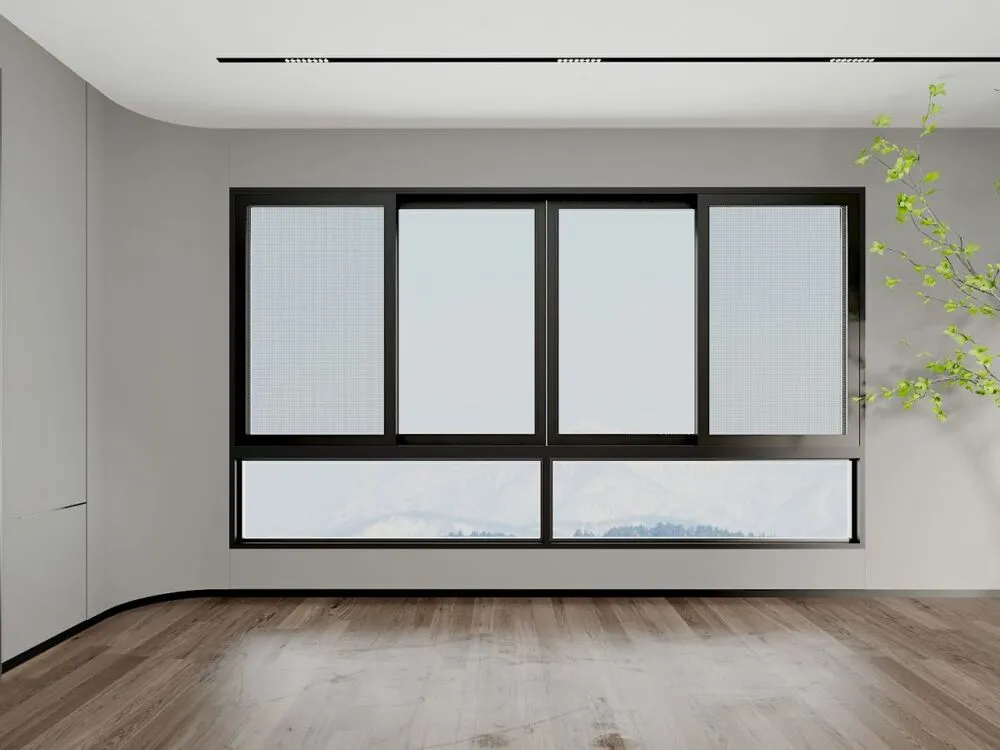
Where Horizontal Sliding Aluminum Windows Lose to Casement and Tilt Turn
Space and Operation Compared
The case for sliding is space. Nothing swings, so furniture, curtain tracks and balcony railings can sit right against the frame, and a wide opening can be glazed without a stack of sash weights. On a residential stock program that argument usually settles the range: the same distributor can sell a two track sliding windows line into apartments, offices and shopfronts without changing the hardware family.
The trade off is the seal. A sliding sash seals on a compression gasket only at the closing stile; the rest of the perimeter runs on a brush or a wiper, which is why a slider generally tests one class below a casement of the same frame depth on air permeability. That is acceptable in a mild or temperate market and becomes a real constraint once a project is specified to a strict EN 12207 class. Buyers who need the tighter class should be steered to a compression sealed product rather than sold a sliding aluminum window with a better brochure.
What a Casement or Tilt Turn Still Does Better
A casement compresses its gasket on all four sides, so it wins on air and water performance per millimetre of frame. A tilt turn adds inward opening for cleaning and secure night ventilation, which matters on upper floors where nobody can reach the outside face. The practical rule for a distributor is to carry both families: sliding for openings where space and width dominate, casement or tilt turn for exposed elevations and for any project that names a performance class in the tender. A horizontal sliding window comparison run on the same glass build usually shows the gap is in sealing and hardware, not in the aluminium itself.
Glass and U-Value Trade Offs
Because the frame is thin, a horizontal sliding aluminum window puts more glass into the same opening than a casement does, which helps daylight and hurts thermal performance unless the glass is upgraded. A standard double unit with a Low-E coating and an argon fill delivers a whole window U-value around 2.0 to 2.7 W/m2K in a thermally broken frame; a non thermally broken frame sits closer to 5.5 to 7.0 for the frame alone and drags the whole window figure up with it. On a wholesale program the honest split is a standard double unit for temperate markets and a thermally broken frame with a warm edge spacer for anything sold against an energy code.
Wholesale Sliding Aluminum Windows Minimum Quantity Stock Sizes and Replenishment
Minimum Quantity and Mixed Container Loading
A factory order for this product line starts at 10 to 20 units, which is deliberately low enough for a distributor to test a market before committing a container. Mixed loading is where the real economy sits: one container can carry several sizes, two colours and both single and double track versions as long as the packing list is fixed before production. The numbers that decide the price are total square metres, glass build and hardware grade, not the unit count on its own.
Buyers comparing quotations should normalise on three lines before comparing totals: the wall thickness per profile, the roller rating, and whether the screen and handle are included or priced separately. A single track versus multi track decision made after the quotation arrives is the most common reason a container has to be re-quoted, because track count changes the frame extrusion and the glass sizes together.
How the 25 to 30 Day Lead Time Is Held
Orders ship within 25 to 30 days of order confirmation, and that window assumes the drawings and the colour schedule are approved before production starts. The parts that move first are the extrusion and the glass unit, because both are made against the confirmed sizes; the assembly line is short. Where a project needs a colour outside the standard range, the coating run adds time and should be scheduled first rather than discovered at packing.
Packing Loading and Site Handover
Sliding units travel flat and are vulnerable at the corners and along the track, so packing should use corner blocks, a foam interlayer and a frame that keeps the track off the container floor. Labelling per elevation saves a day on site, because a 40 foot container of identical looking frames cannot be sorted by eye. Ask for a packing list that matches the shop drawing reference on every unit.
Handover documentation should include the glass build per unit, the hardware schedule and the installation sequence, since a sliding aluminum window is only as watertight as its sill detail. Most site leaks traced back to a slider originate at the sill and the head flashing rather than at the frame joint, and a one page detail drawing prevents the argument later.

Roller Replacement Track Cleaning and the Twenty Year Service View
What Maintenance Actually Extends Life
Cleaning the track channel and the drain slots twice a year does more for the service life of a sliding aluminum window than any other single action, because grit in the channel is what wears the roller and scores the rail. A dry brush and a vacuum are enough; solvent on the gasket accelerates ageing. Silicone spray on the rail, never oil, keeps the action light without attracting dust.
Replacement parts should be planned rather than improvised. Rollers, brush cassettes and gaskets are the three items that wear, and all three are cheap at the factory and awkward to match locally. A distributor who stocks one service kit per hundred units removes the main after sales complaint on this product line before it happens.
Early Warning Signs Worth Acting On
A sash that starts to drag at one end is signalling a roller or a track that has moved, not a frame that has failed. Water staining at the inner sill points to a blocked drain slot. A whistle at the meeting stile under wind means the interlock gasket has compressed past its recovery. Each of these is a small part and a short visit if it is caught in the first season, and a frame replacement if it is left for three.
Disclaimer: actual performance depends on the specified glass build, the installation detail, the exposure of the facade and the maintenance regime on site. The values quoted here describe typical configurations in this product range and are not a guarantee for a specific opening.
Conclusion
For a distributor building a stock program, the workable route is a 6063-T5 frame at 1.4 to 2.0 mm in a small number of fast moving sizes, double track as the standard configuration, a sealed double glazed unit with a stated U-value, and a roller grade written into the purchase order. Choosing a wholesale horizontal sliding aluminum windows supplier then comes down to whether that supplier will put the wall thickness, the roller rating and the water test pressure on paper before the deposit, because those three lines are what the end user experiences five years after the container has been unloaded.
FAQ
Q1: What is the minimum order quantity for bulk horizontal sliding aluminum windows?
A: The factory order starts at 10 to 20 units, and mixed sizes, colours and track versions can be loaded in one container as long as the packing list is confirmed before production. Small trial orders are accepted so a distributor can test a market before scaling.
Q2: Which track configuration should a wholesale buyer stock?
A: Double track is the safer standard for a residential sliding aluminum window program because it returns the full clear opening and leaves a channel for an insect screen. Single track suits price sensitive projects and small openings where a screen is not wanted.
Q3: What lead time applies to a repeat order of sliding aluminum windows?
A: Repeat orders ship within 25 to 30 days of order confirmation when the sizes, colour and glass build are already on file. A new colour outside the standard range adds a coating run and should be scheduled at the front of the program.
Q4: How is the price of a sliding aluminum window quoted for export?
A: Price is quoted per square metre or per unit with the glass build, hardware grade, screen and finish stated separately, so two quotations can be compared line by line. Buyers should ask for the wall thickness and the roller rating, since those two lines explain most of the difference between offers.
Partner with Haolv Building Materials for Wholesale Sliding Aluminum Window Supply
Haolv Building Materials Co., Ltd. has been manufacturing windows and doors for 19 years and supplies sliding, casement and tilt turn systems to importers and project buyers. Frames, glass, hardware and screens come from one supplier, orders ship within 25 to 30 days, and production starts from 10 to 20 units. Certification documents are available on request. Email us at kristin@haolvwindows.com with the opening schedule and the target market, and we will return a specification and a quotation against your drawings.
This guide is maintained by Haolv's engineering team and reviewed against EN 14351-1 and EN 12207 as standards change.

References
1. European Committee for Standardization. (2016). EN 14351-1: Windows and doors - Product standard, performance characteristics.
2. European Committee for Standardization. (2000). EN 12207: Windows and doors - Air permeability - Classification.
3. European Committee for Standardization. (2003). EN 12208: Windows and doors - Watertightness - Classification.
4. European Committee for Standardization. (2003). EN 12210: Windows and doors - Resistance to wind load - Classification.
5. Standardization Administration of China. (2020). GB/T 8478: Aluminium alloy windows and doors.
6. International Organization for Standardization. (2015). ISO 9001: Quality management systems - Requirements.
标题(Title):Wholesale Horizontal Sliding Aluminum Windows for Distributor Stock Programs 核心词(core_words):wholesale horizontal sliding aluminum windows supplier 长尾词(long_tail_keywords):horizontal sliding aluminum windows manufacturer; bulk aluminum sliding windows price; China sliding window factory; wholesale two track aluminum sliding windows supplier URL 路径(path):/knowledge/wholesale-horizontal-sliding-aluminum-windows-for-distributor-stock-programs
Fast simple channel to send demands lock favorable price for building window door bulk purchases.