- English
- French
- German
- Portuguese
- Spanish
- Russian
- Japanese
- Korean
- Arabic
- Greek
- German
- Turkish
- Italian
- Danish
- Romanian
- Indonesian
- Czech
- Afrikaans
- Swedish
- Polish
- Basque
- Catalan
- Esperanto
- Hindi
- Lao
- Albanian
- Amharic
- Armenian
- Azerbaijani
- Belarusian
- Bengali
- Bosnian
- Bulgarian
- Cebuano
- Chichewa
- Corsican
- Croatian
- Dutch
- Estonian
- Filipino
- Finnish
- Frisian
- Galician
- Georgian
- Gujarati
- Haitian
- Hausa
- Hawaiian
- Hebrew
- Hmong
- Hungarian
- Icelandic
- Igbo
- Javanese
- Kannada
- Kazakh
- Khmer
- Kurdish
- Kyrgyz
- Latin
- Latvian
- Lithuanian
- Luxembou..
- Macedonian
- Malagasy
- Malay
- Malayalam
- Maltese
- Maori
- Marathi
- Mongolian
- Burmese
- Nepali
- Norwegian
- Pashto
- Persian
- Punjabi
- Serbian
- Sesotho
- Sinhala
- Slovak
- Slovenian
- Somali
- Samoan
- Scots Gaelic
- Shona
- Sindhi
- Sundanese
- Swahili
- Tajik
- Tamil
- Telugu
- Thai
- Ukrainian
- Urdu
- Uzbek
- Vietnamese
- Welsh
- Xhosa
- Yiddish
- Yoruba
- Zulu
Wholesale UPVC Double Sliding Patio Doors Specification and Ordering Notes for Cold Climate Projects
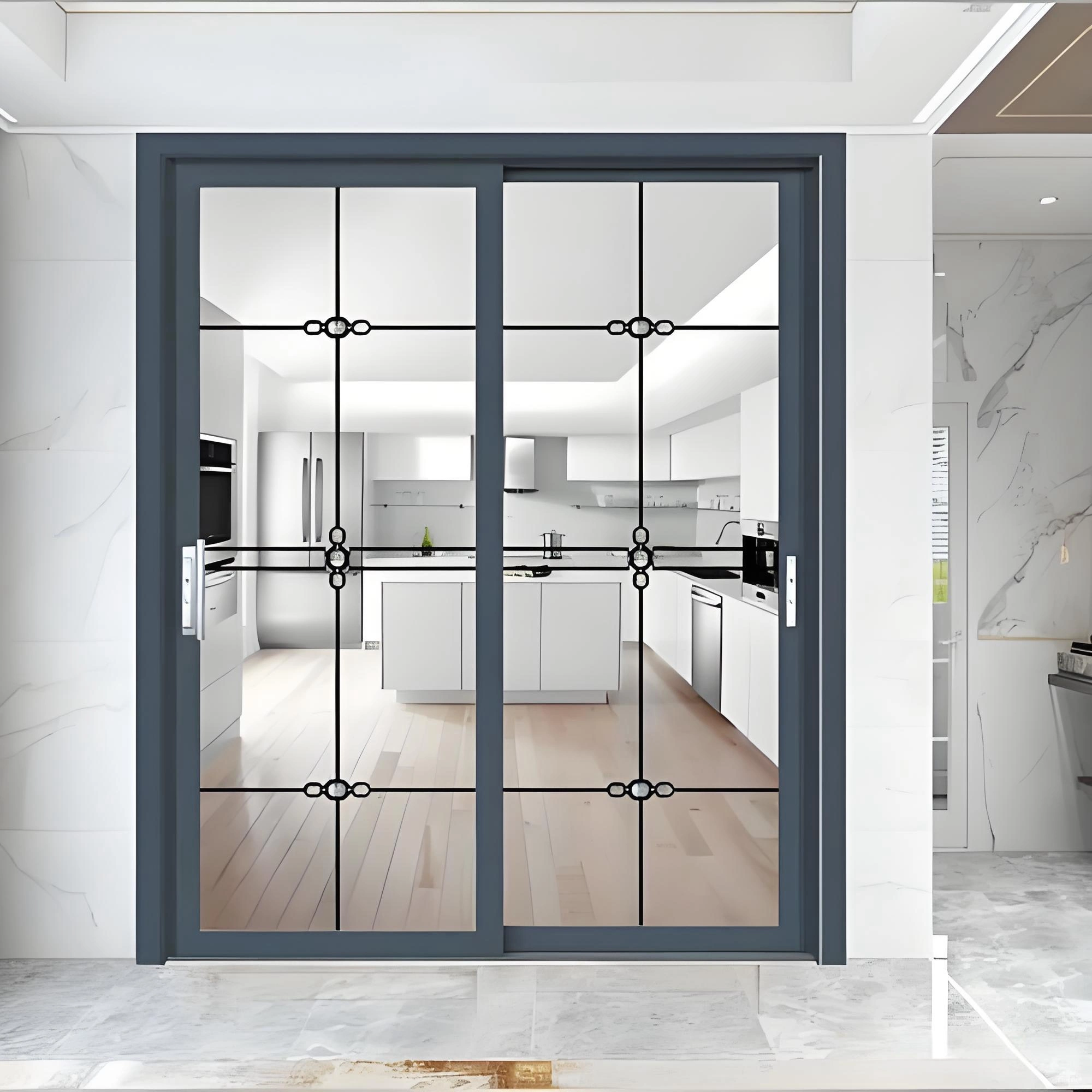
At -10 C outside and 20 C inside, the frame of UPVC double sliding patio doors sits at 14.5 C, while a plain aluminium bottom track on the same door drops to -1.5 C. Frost forms on the track, not on the profile, and no number of profile chambers fixes it. The track is the one place where the material stops being plastic.
Surface temperature, one line
Interior surface temperature = indoor air temperature minus U-value x Rsi x indoor-outdoor difference, with Rsi = 0.13 m2K/W from EN ISO 6946. At 30 K of difference that is 20 - U x 3.9. A PVC-U profile at U = 1.4 W/m2K lands on 14.5 C; a thermally broken aluminium track at 2.8 lands on 9.1 C; a plain aluminium track at 5.5 lands on -1.5 C.
In this guide:
Why does frost form on the track when the profile never frosts?
Because the two parts are made of different things. A multi-chamber PVC-U profile conducts very little heat, so its inner face stays close to room temperature and stays above the dew point. The bottom track is where the rollers run, and it is expected to take the whole weight of two leaves and the traffic of a household, so it is normally aluminium or stainless steel, sometimes with no thermal separation at all. Conduction through metal is roughly two orders of magnitude higher than through PVC-U, and that difference shows up as a cold strip along the floor.
The visual signature is specific. Condensation appears as a wet line along the track first, before any window in the room mists over, because the track is the coldest surface at floor level. In a cold snap it turns to white frost on the room side and melts into the carpet when the heating comes on, which is the point where a buyer who specified a good glass build starts wondering what went wrong with the glass.
Nothing about the glass caused it. A warm edge spacer and a low-e coating reduce heat loss through the glass, which lowers the indoor surface temperature of the glass too, and in a very well insulated unit the track becomes proportionally more dominant as the weak point. That is why cold climate projects specify the track explicitly and not as part of a general door description. The whole-unit view is in patio doors in cold climates.
How do you read a track option from its surface temperature?
Take the U-value of the track, multiply by 3.9 for a 30 K design difference, subtract from 20, and compare the result with the dew point of the indoor air. At 20 C and 50 per cent relative humidity the dew point is 9.3 C; at 65 per cent it is 13.2 C. A surface below those numbers is wet, and a surface below 0 C is frozen. The comparison takes one line per option and removes the argument entirely.
Read the numbers as a ranking rather than as pass and fail. A PVC-U clad track at 1.4 sits 5.2 K above the dew point at 50 per cent humidity and only 1.3 K above it at 65 per cent, so a bathroom-adjacent door in a humid house is already marginal. A thermally broken track at 2.8 is 0.2 K below the 50 per cent dew point, which means wet on most winter mornings. A plain track at 5.5 is more than 10 K below it and freezes.
Note where the indoor humidity figure comes from: it is a design assumption, and it should be the highest sustained value the building will see, not the annual average. A laundry room, an indoor pool hall or a kitchen with a boiling range running all evening can hold 65 per cent for hours. For those rooms the target is not a dryer track, it is a track plus local extract, and the specification for UPVC double sliding patio doors should say so.
| Track option | U-value | Surface at -10 C outside | Verdict at 50 % RH | Verdict at 65 % RH |
|---|---|---|---|---|
| PVC-U clad track, thermal break inside | 1.4 W/m2K | 14.5 C | Dry, 5.2 K margin | Marginal, 1.3 K margin |
| Thermally broken aluminium track | 2.8 W/m2K | 9.1 C | Wet, 0.2 K below dew point | Wet, 4.1 K below |
| Stainless track on insulation pads | 4.5 W/m2K | 2.5 C | Wet, 6.8 K below | Wet, 10.7 K below |
| Plain aluminium track | 5.5 W/m2K | -1.5 C | Frozen | Frozen |
Surface temperature = 20 - U x 0.13 x 30. Dew point 9.3 C at 20 C and 50 per cent RH, 13.2 C at 65 per cent. Calculated from the EN ISO 6946 internal surface resistance, not measured on a door. Track U-values are the export range for each construction and are confirmed on the datasheet of the actual order.
Where do UPVC double sliding patio doors lose air before the glass does?
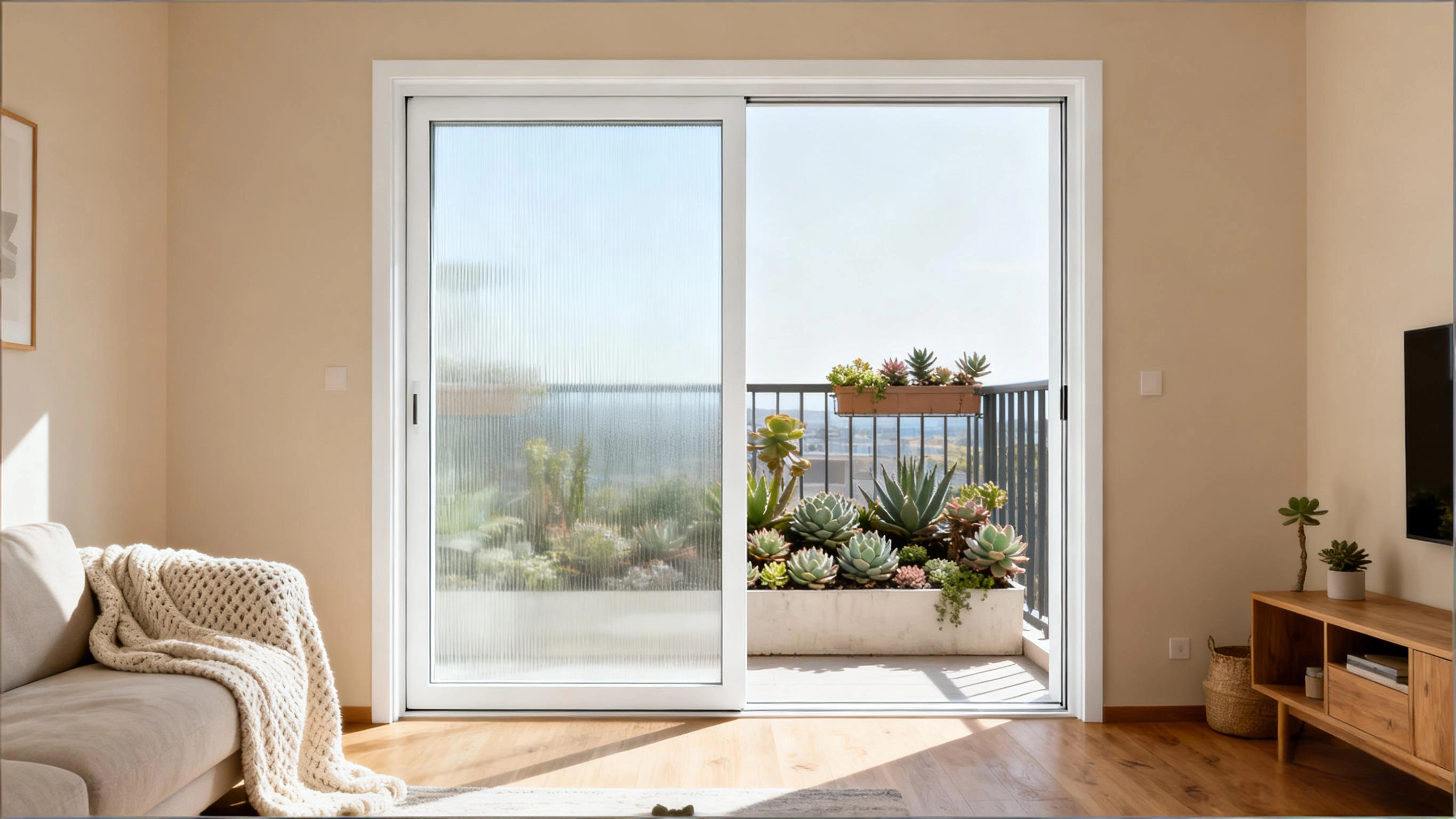
At the meeting stile, where the two leaves overlap. That joint is not a compression seal; it is a sliding joint with a brush or a wool pile, and it has to allow the leaf to travel. A perimeter gasket can be compressed by the lock, a meeting stile cannot. In practice the overlap is the first place a sliding door shows a draught, and it is also the place where the fix is cheapest: a deeper overlap and a double pile rather than a single one, specified on the drawing.
Read the air class with the door area in mind. EN 12207 class 4 is 3 m3 per hour per square metre of door area at 100 Pa, so a 2.4 by 2.1 m door is allowed 15 m3/h at that pressure. A 4 mm gap running the full 2,100 mm height of the meeting stile is 0.0088 m2 of open area, which is not a class 4 detail at any pressure. The class is earned by the pile, the overlap depth and the corner joints, and it is lost by one of them.
The same overlap carries the water argument as well, which is why it appears twice in a specification. An overlap that is too shallow lets the wind push water past the pile before the drainage path can take it away. On cold climate doors the overlap is therefore usually specified at 40 mm or more, and the pile is specified as two rows rather than one, even though neither number appears on a price list.
How much rain does the threshold have to shed, and where does it go?
Rainfall of 100 mm an hour onto a 3 m2 opening delivers 300 litres an hour, which is 0.083 litres a second arriving at the threshold of UPVC double sliding patio doors. Almost all of it is shed outside by the sash and the weather leg; the fraction that reaches the track has to leave through drainage slots before it can reach the inner leg. A low threshold shortens the height available for that path, which is why a flush threshold and a high water class are usually a trade rather than a package.
Water that leaves the slot has to go somewhere that is not the floor. On a slab-on-grade patio door the slots discharge onto a sill that has to fall away from the building and has to be below the interior finished floor by enough to matter. Where the exterior paving is level with the interior floor, the drainage detail is a design problem before it is a door problem, and no door will solve it.

What mass does each roller carry, and what changes it?
A 1,200 x 2,100 mm leaf glazed 4+16A+4 weighs about 45 kg: 2.52 m2 of glass at 8 mm is 50 kg of glazing minus the frame rebate, plus 8 to 10 kg of PVC-U profile and steel reinforcement. Split over two rollers that is 221 N each, and over four rollers 110 N each. The number that matters is not the load but the load per roller, and it is set by how many carriages the plant fits, which is a line in the quotation nobody reads.
Triple glazing is where this becomes a purchasing question. A third 4 mm pane adds 10 kg per square metre, so the same leaf moves from 45 kg to about 70 kg and the load per roller rises by more than half. Rollers are rated in newtons and in cycles, and a cheap carriage rated for a light leaf will still run for a year before it starts to flat-spot. That failure shows up as a leaf that drops out of square, and it is read as an installation fault.
Ask for the carriage rating and the number of carriages per leaf as two separate answers. Where the same door range is offered in a lighter vinyl sliding patio doors version, the carriage count is usually the difference between the two lines, and it is the reason one of them is quieter after five years.
Which track should a cold climate buyer specify on UPVC double sliding patio doors?
Specify the track by construction and by U-value, not by brand and not by the word heavy duty. The minimum that survives a -10 C design condition at 65 per cent indoor humidity is a PVC-U clad track with a thermal break inside it, which lands about 1.3 K above the dew point. Everything below that number in the table above is a door that will show water on winter mornings, and the buyer will be told it is ventilation behaviour.
If the schedule is already fixed, send it over and each line can be returned with the track construction, the surface temperature at the project design condition and the roller count per leaf. Those three numbers decide whether the door is comfortable in February, and all three are free to change before the profiles are cut.
One more comparison worth running: the same arithmetic on an aluminium frame. Where a project mixes aluminium sliding patio doors with UPVC on the same elevation, the aluminium line needs a thermally broken track as a minimum rather than an upgrade, because its frame U-value is roughly double.
What should a wholesale order for UPVC double sliding patio doors fix in writing?
Six lines: track construction with its U-value, the design indoor humidity and outdoor temperature the track is sized against, the meeting stile overlap depth and pile rows, the drainage slot count and the sill fall, the carriage rating and count per leaf, and the glass build written as a total thickness. A wholesale order for UPVC double sliding patio doors that carries only size, colour and glass build leaves the six decisions that matter to whoever is packing that week.
Two of those lines are unusual enough to be worth explaining to a supplier. Design humidity is not a standard input, so state it as a percentage and a temperature rather than as cold climate. Sill fall is a builder decision, so state the height difference you are designing to rather than assuming the door can absorb it. Both are one sentence each and both prevent the commonest cold climate complaint.
Where the door is part of a heated extension rather than a replacement, run the whole-wall figure as well. On a cold climate renovation the track is the visible problem but the wall junction is usually the larger one, and that comparison is set out in energy efficient patio doors.
| Parameter | Typical value | Note |
|---|---|---|
| Configuration | UPVC double sliding patio doors, one fixed or both sliding | Meeting stile overlap 40 mm or more |
| Profile | PVC-U multi-chamber, steel reinforced | Reinforcement carries the leaf, not the profile alone |
| Track option | PVC-U clad with thermal break, U about 1.4 W/m2K | Plain aluminium track freezes at -10 C outside |
| Surface temperature | 20 - U x 0.13 x indoor-outdoor difference | 14.5 C for a 1.4 track at 30 K |
| Dew point | 9.3 C at 20 C and 50 % RH, 13.2 C at 65 % | Compare before choosing the track |
| Roller load | 45 kg leaf on two carriages, 221 N each | Triple glazing pushes the same leaf to about 70 kg |
| Air permeability | EN 12207 class per contract | Class 4 is 3 m3/(h.m2) at 100 Pa |
| Watertightness | EN 12208 class per contract | Low threshold trades against the class |
| Whole unit U-value | 1.2-1.6 W/m2K double, 0.8-1.2 triple | Frame material moves the lower bound |
| Lead time and MOQ | 25-30 days, 10-20 units | Applies to standard glass builds |
Values describe the common export range for two panel UPVC sliding patio doors. A specific order is confirmed against its own specification sheet, profile datasheet and the project design conditions.
Frequently asked questions
What is the minimum order for wholesale UPVC double sliding patio doors?
Minimum order is 10-20 units and lead time is 25-30 days for standard glass builds. A track upgrade is quoted alongside UPVC double sliding patio doors rather than added later, because it changes the profile that the leaf is cut to fit.
Is a thermally broken track worth the extra cost in a mild climate?
Run the surface temperature before answering. At 10 C outside instead of -10 C the same 30 K difference becomes 20 K, so a 2.8 track sits at 12.7 C instead of 9.1 C and stays just above a 50 per cent dew point. In a mild climate the upgrade on UPVC double sliding patio doors is a comfort choice; in a cold climate it is the difference between a dry floor and a wet one.
Can the meeting stile overlap be increased on a standard door?
Only by changing the profile set, because the overlap is built into the sash and outer frame sections. It has to be decided at quotation stage. Suggesting 40 mm on a range built around 25 mm is not a small request, and a supplier who accepts it without changing anything is describing the overlap, not building it.
Does triple glazing make track condensation worse?
It makes the track relatively more important rather than worse in absolute terms. Better glass lowers the glass surface temperature and cuts heat loss, so less heat reaches the track from the room and the track runs slightly colder. On a triple glazed door the track specification matters more, not less.
Ordering from Haolv
Haolv Building Materials Co., Ltd. has been making windows and doors for 19 years, including two panel UPVC sliding patio doors for cold climate residential projects. Profiles, glazing, track and hardware are assembled in one plant, so the track construction, the roller count and the glass mass are decided by the same team that cuts the profile. Certification documents are available on request. Minimum order is 10-20 units and lead time is 25-30 days.
Send the opening sizes, the design outdoor temperature and the indoor humidity the building will hold, to kristin@haolvbuilding.com, and the quotation comes back with the track construction and its surface temperature stated per line.
Surface temperatures in this guide are calculated, not measured: indoor air temperature minus U-value times the EN ISO 6946 internal surface resistance of 0.13 m2K/W times the indoor-outdoor difference. Dew points follow the standard saturation curve and assume still air at the stated humidity. Leaf masses use 2.5 kg per square metre per millimetre of glass thickness. No shipment record and no test report is used, and no door was instrumented for this article. Track U-values, roller ratings and air classes are confirmed against the datasheets and the specification of the actual order for UPVC double sliding patio doors.

References
- EN 14351-1:2006+A2:2016 — Windows and doors. Product standard, characteristics and performance.
- EN ISO 6946:2017 — Building components and building elements. Thermal resistance and thermal transmittance. Calculation methods.
- EN ISO 10077-1:2017 — Thermal performance of windows, doors and shutters. Calculation of thermal transmittance. General.
- ISO 13788:2012 — Hygrothermal performance of building components and building elements. Internal surface temperature to avoid critical surface humidity and interstitial condensation.
- EN 12207:2017 — Windows and doors. Air permeability. Classification.
- EN 12208:2000 — Windows and doors. Watertightness. Classification.
Fast simple channel to send demands lock favorable price for building window door bulk purchases.