- English
- French
- German
- Portuguese
- Spanish
- Russian
- Japanese
- Korean
- Arabic
- Greek
- German
- Turkish
- Italian
- Danish
- Romanian
- Indonesian
- Czech
- Afrikaans
- Swedish
- Polish
- Basque
- Catalan
- Esperanto
- Hindi
- Lao
- Albanian
- Amharic
- Armenian
- Azerbaijani
- Belarusian
- Bengali
- Bosnian
- Bulgarian
- Cebuano
- Chichewa
- Corsican
- Croatian
- Dutch
- Estonian
- Filipino
- Finnish
- Frisian
- Galician
- Georgian
- Gujarati
- Haitian
- Hausa
- Hawaiian
- Hebrew
- Hmong
- Hungarian
- Icelandic
- Igbo
- Javanese
- Kannada
- Kazakh
- Khmer
- Kurdish
- Kyrgyz
- Latin
- Latvian
- Lithuanian
- Luxembou..
- Macedonian
- Malagasy
- Malay
- Malayalam
- Maltese
- Maori
- Marathi
- Mongolian
- Burmese
- Nepali
- Norwegian
- Pashto
- Persian
- Punjabi
- Serbian
- Sesotho
- Sinhala
- Slovak
- Slovenian
- Somali
- Samoan
- Scots Gaelic
- Shona
- Sindhi
- Sundanese
- Swahili
- Tajik
- Tamil
- Telugu
- Thai
- Ukrainian
- Urdu
- Uzbek
- Vietnamese
- Welsh
- Xhosa
- Yiddish
- Yoruba
- Zulu
Custom Glass Builds for Aluminum Windows Which Step Earns Its Price at a U Value Target
A glass build moves from 2.7 to 1.5 W/m2K for no weight at all, from 1.5 to 0.85 for 10 kg per square metre, and from 0.85 to 0.70 for a change of gas worth 0.15. On thermally broken casement windows the curve bends at the third step, where most buyers spend and gain least.
The curve in four numbers
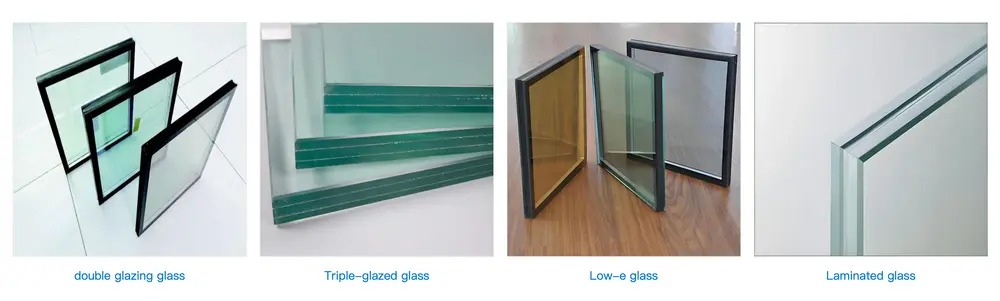
Glass U-value = 1 / (1/23 + 1/8 + gap resistance + pane resistances). With Rsi 0.125 and Rse 0.043 the fixed part is 0.168 m2K/W, so the gap resistance decides everything: 0.19 for 16 mm air, 0.26 for argon, 0.50 with a low-e coating, 0.62 with krypton. One cavity gives 2.7, 2.3, 1.5; two cavities give 0.85 and 0.70.
In this guide:
How is the U-value of a glass build actually calculated?
The calculation is a series of thermal resistances, and it is short enough to do on a quotation. Start with the two surface films: an external resistance of 0.043 and an internal one of 0.125 square metre kelvin per watt, which together make 0.168. Add the resistance of each glass pane, about 0.004 for a 4 mm sheet. Add the resistance of each cavity, and that is the only term that changes between builds. Invert the total.
Everything then hangs on the cavity figure, and the cavity figure is set by two things: how thick the gap is and what is in it. Convection and conduction through the gas give a resistance that rises with thickness up to about 16 mm and then falls again as the gas starts to circulate. Radiation across the gap is added to that, and a low-e coating is what suppresses it. A coating does not thicken the glass build, does not add mass, and does not change the frame; it changes one number inside the bracket.
Silvering the surface is why a coated unit can reach 1.5 W/m2K with the same 8 mm of glass as an uncoated unit at 2.7. This is the cheapest step in the whole curve in weight terms, and it is the one a buyer should never trade away to save a line item. Where the elevation is a thermally broken aluminium system such as flush aluminium windows, the coating is also what makes the frame worth its price.
What does each step add in mass and in millimetres?
Four steps, and only one of them adds anything you can feel. Air to argon adds no thickness and no mass and moves the cavity resistance from 0.19 to 0.26, which is 0.4 W/m2K on the glass. Adding a low-e coating adds nothing at all and moves it to 0.50, which is another 0.8. The third pane adds a sheet and a cavity: 4 mm of glass, 10 kg per square metre, and the glass build goes from 8 mm to 12 mm of glass in a 40 mm unit.
The last step is not glass at all. Krypton instead of argon raises the cavity resistance from 0.50 to 0.62, which is 0.15 W/m2K, and it adds no mass and no thickness. It adds cost, it adds a slower filling line, and it adds a tighter requirement on gas retention, because a unit that loses its fill has paid for nothing. That is why the last step is a process purchase rather than a materials purchase.
Read the whole column as a rate. The first two steps buy 1.2 W/m2K for zero kilograms. The third buys 0.65 for 10 kg, which is 0.065 W per kilogram. The fourth buys 0.15 for zero kilograms but at gas cost. Judged by weight, the order of preference is coating, gas, then a third pane; judged by total cost the order is coating, third pane, then a change of gas. The other flush line this plant carries, flush sash windows, runs the same curve with a different frame share.
| Glass build | Glass thickness | Cavity fill | U-value | Glass mass | Step gain | Mass added |
|---|---|---|---|---|---|---|
| 4/16/4 | 8 mm | air | 2.7 W/m2K | 20 kg/m2 | baseline | none |
| 4/16/4 | 8 mm | argon | 2.3 W/m2K | 20 kg/m2 | -0.4 | none |
| 4/16/4 low-e | 8 mm | argon | 1.5 W/m2K | 20 kg/m2 | -0.8 | none |
| 4/16/4/16/4 low-e | 12 mm | argon | 0.85 W/m2K | 30 kg/m2 | -0.65 | +10 kg/m2 |
| 4/16/4/16/4 low-e | 12 mm | krypton | 0.70 W/m2K | 30 kg/m2 | -0.15 | none, gas cost |
Glass U-value = 1 / (0.168 + cavity resistance + 0.004 per pane), using Rse 0.043 and Rsi 0.125. Cavity resistances 0.19 air, 0.26 argon, 0.50 argon with low-e, 0.62 krypton. Glass mass = thickness x 2.5 kg/m2/mm. Calculated from EN 673 logic and the standard glass weight, not measured on a sample of each build.
Why does the whole window improve less than the glass does?
Because the window is a sum of three parts and only one of them is the glass. Whole window U-value = (glass area x glass U + frame area x frame U + glass perimeter x edge psi) / total area. On a 1,200 x 1,500 mm unit the frame takes about 28 per cent of the area, the glass perimeter is 4.9 m, and the edge term is not a rounding error: at 0.08 W per metre kelvin it lands at 0.22 W/m2K on its own.
Run the numbers and the gap opens immediately. Moving the glass from 2.7 to 1.5 takes the window from 2.9 to 2.0, a gain of 0.9. Moving the glass from 1.5 to 0.85 takes the window from 2.0 to 1.56, a gain of 0.47 on a glass gain of 0.65. Each further step delivers roughly 70 per cent of what the glass delivered, and the missing 30 per cent is the frame and the edge, which did not move.
There is a floor as well. Set the glass U-value to zero, which no glass build reaches, and this window still sits at 0.95 with an aluminium edge and 0.81 with a warm edge. That is the frame and the edge talking, and it is the reason a project that targets 1.1 W/m2K cannot get there by buying better glass on an unchanged aluminium frame.
| Glass build | Glass U | Frame | Edge | Whole window U | Comment |
|---|---|---|---|---|---|
| 4/16/4 air | 2.7 | Thermally broken aluminium, 2.6 | Aluminium, 0.08 | 2.89 | Baseline for the frame |
| 4/16/4 low-e argon | 1.5 | Thermally broken aluminium, 2.6 | Aluminium, 0.08 | 2.03 | Glass gained 1.2, window gained 0.86 |
| 4/16/4/16/4 low-e argon | 0.85 | Thermally broken aluminium, 2.6 | Aluminium, 0.08 | 1.56 | Third pane is where the curve bends |
| 4/16/4/16/4 low-e argon | 0.85 | Thermally broken aluminium, 2.6 | Warm edge, 0.03 | 1.42 | Same glass, same weight, 0.14 better |
| 4/16/4/16/4 low-e krypton | 0.70 | Thermally broken aluminium, 2.6 | Aluminium, 0.08 | 1.45 | Gas change buys 0.11, not 0.15 |
| 4/16/4/16/4 low-e argon | 0.85 | PVC-U, 1.4 | Warm edge, 0.03 | 1.09 | Frame change buys 0.47, more than any glass step |
Window 1,200 x 1,500 mm, frame 28 per cent of area, glass perimeter 4.9 m. Whole window U = (1.296 x glass U + 0.504 x frame U + 4.9 x edge psi) / 1.8. Frame and psi values are the common export range for each construction. Calculated, not measured; a project is confirmed against its own test report or its own calculation.
Where does the edge of the unit take over from the centre?
At the point where the edge penalty becomes a larger number than the next glass improvement. On this window the edge term is 0.22 W/m2K with an aluminium spacer and 0.08 with a warm edge. The difference, 0.14, is larger than the whole krypton step, and it arrives with no extra weight, no extra thickness and no change to the glass build at all. A spacer swap is the only line in the table that improves the window without touching anything anyone can see.
The edge term also explains a size effect that buyers find counterintuitive: small windows always score worse than large ones on the same glass build, because the perimeter per square metre is higher. A 600 x 900 mm unit carries 4.8 m of glass edge per square metre of window, while a 1,200 x 1,500 mm unit carries 2.7. On the same triple glazed build with an aluminium edge that is 1.72 against 1.56, a spread of 0.16 created by geometry alone.
That has a purchasing consequence. A project that averages its U-value across a mix of sizes will pass on paper and fail on the small units, which are usually the bathroom and stair windows. If the calculation is done per unit rather than as an average, the small units are the ones that need the warm edge and the coating, and the large sliding units can carry a cheaper glass build without moving the building average.
Which step still earns its money when the target is 1.1 W/m2K?
None of the glass steps, on an aluminium frame. The best this frame reaches is 1.31 with krypton and a warm edge, and 1.42 with argon and a warm edge. To reach 1.1 the frame has to change, because the frame term of 0.504 x 2.6 divided by 1.8 is 0.73 W/m2K on its own. Dropping the frame to 1.4 takes the same triple argon glass build to 1.09 without touching the glass at all.
So the order of spending depends entirely on the target, and that is what a supplier comparison should be built around. Below 2.0 the coating is the whole answer. Between 2.0 and 1.4 the third pane earns its weight. Between 1.4 and 1.1 the warm edge earns more than the gas. Below 1.1 nothing on the glass side helps, and the conversation has to move to the frame and to the glazing ratio.
Where a project carries a mix of fixed and opening units on the same elevation, the opening ones usually have a higher frame ratio and therefore a worse U-value at the same glass build. If the schedule is already fixed, send it over and the whole window figure can be returned per unit, with the frame share, the edge term and the glass contribution separated, before any profile is cut. A change at that point is a line in a document.
How does a warm edge spacer compare with a third pane on cost and on mass?
On mass the comparison is not close. The third pane adds 10 kg per square metre of glass and pushes the unit to 40 mm, which then needs a deeper profile, a heavier sash and, on an opening light, a stronger hinge group. The spacer adds nothing: same 28 mm or 40 mm unit, same weight, same profile, same hardware. On this window the spacer is worth 0.14 and the third pane is worth 0.47, so the third pane is still the bigger single step; the point is that the spacer is 30 per cent of that gain for none of the consequences.
On durability the comparison is also asymmetric. A spacer is a passive part: it does not lose performance over time, it does not need gas to stay inside it, and its psi value is a property of the material. A gas fill is an active promise, and it is only as good as the seal around the perimeter of the unit, which is why gas retention is tested rather than assumed and why EN 1279-2 exists.
Read together, the two lines give a rule that survives a change of project: fix the spacer before the gas, and fix the glass count before either. A warm edge on a triple glazed unit is a better purchase than krypton on the same unit at the same money, because it cannot leak. The same arithmetic is set out for sliding units in double pane versus triple pane.
What should a bulk order fix so the curve is not lost between quotation and delivery?
Five lines carry the whole curve: the glass build written as a total thickness with each pane and each cavity named, the coating declared by emissivity rather than by the word low-e, the gas named and its retention standard referenced, the spacer type with its psi value, and the whole window U-value declared per unit rather than as an average. A quotation that says double glazing low-e has said nothing that can be checked.
Emissivity is the line buyers most often leave out and the one that moves the number most. A coating at 0.05 and a coating at 0.20 are both low-e and they are not the same product; the difference shows up directly in the cavity resistance, which is the term that produced the 1.5 in the first place. Ask for the emissivity figure and for the declaration it comes from.
Where the same project also carries fixed lights and opening lights, specify one glass build across both so that the delivered elevation behaves as one wall. Mixing a better glass build into the fixed lights and a cheaper one into the openings is the commonest way to lose a calculated average, and it is invisible on a packing list unless the build is written per unit. Frame selection for these mixed elevations is covered in windows for energy efficient buildings.
Which numbers must a buyer recompute before signing?
Three, and all three take one line each. The frame ratio, because it sets how much of the window is not glass. The glass perimeter divided by the window area, because it sets the edge penalty. And the glass U-value for the build actually offered, because it sets the largest single term. With those three, any quotation can be reproduced or contradicted in a few minutes.
Recompute them per unit, never as an average. A building average hides the two units that will be complained about in the first winter, and those are almost always the smallest. The size table below shows the spread on an identical glass build, and the spread is entirely geometric: no one supplied a worse product, the window was simply smaller.
| Window size | Window area | Glass edge length | Edge per m2 | Whole window U | Against the 1.8 m2 unit |
|---|---|---|---|---|---|
| 600 x 900 mm | 0.54 m2 | 2.6 m | 4.8 m/m2 | 1.72 W/m2K | +0.16 worse |
| 900 x 1,200 mm | 1.08 m2 | 3.8 m | 3.5 m/m2 | 1.63 W/m2K | +0.07 worse |
| 1,200 x 1,500 mm | 1.80 m2 | 4.9 m | 2.7 m/m2 | 1.56 W/m2K | reference |
| 1,800 x 2,100 mm | 3.78 m2 | 7.4 m | 2.0 m/m2 | 1.51 W/m2K | -0.05 better |
All four units carry the same triple glazed low-e argon build with an aluminium edge on a thermally broken frame at 2.6. Frame share held at 28 per cent of area. Whole window U = (glass area x 0.85 + frame area x 2.6 + edge length x 0.08) / window area. Calculated, not measured.
| Parameter | Typical value | Note |
|---|---|---|
| Glass U-value, double low-e argon | 1.4-1.6 W/m2K | Built up from cavity resistance, not a catalogue claim |
| Glass U-value, triple low-e argon | 0.8-0.9 W/m2K | Adds 10 kg per m2 for a 4 mm third pane |
| Cavity resistance | 0.19 air, 0.26 argon, 0.50 low-e, 0.62 krypton | The only term that changes between builds |
| Edge psi | 0.08 aluminium spacer, 0.03 warm edge | Worth 0.14 W/m2K on a 1.8 m2 unit |
| Frame U-value | 2.5-3.2 thermally broken, 1.3-1.6 PVC-U | PA66 GF25 barrier at about 0.3 W/(m.K) |
| Whole unit U-value | 2.0-2.7 thermally broken double, 1.1-1.4 triple | Frame share decides the floor |
| Solar factor | SHGC by glass build and coating | A second coating choice, not a free upgrade |
| Air permeability | EN 12207 class per contract | Class 4 is 3 m3/(h.m2) at 100 Pa |
| Lead time and MOQ | 25-30 days, 10-20 units | Applies to standard glass builds |
Values describe the common export range for aluminium windows with insulated glazing. A specific order is confirmed against its own glass datasheet, spacer datasheet and whole window calculation.
Frequently asked questions
What is the minimum order for custom glass builds in bulk?
Minimum order is 10-20 units and lead time is 25-30 days for standard glass builds. A change of gas or spacer outside the standard set adds to the lead time because the unit is filled or assembled to order, and it is confirmed at quotation stage rather than after release.
Is krypton worth it over argon on an aluminium frame?
On this window it buys 0.11 W/m2K, against 0.14 for a warm edge at no gas cost and no filling risk. The order of preference on an aluminium frame is warm edge first, then krypton if the target still needs it. On a PVC-U frame the same gas step is worth about the same and the frame already carries most of the gain.
Can a 1.1 W/m2K target be met on a thermally broken aluminium frame?
Not on a 28 per cent frame ratio at 2.6, where the best case is 1.31. It becomes reachable with a lower frame U-value, a smaller frame share such as a fixed light with a narrow sightline, or a warm edge combined with krypton. The glass alone cannot get there, which is the single most useful thing to know before a tender.
Why do two quotations with the same glass build give different whole window values?
Because the frame share, the frame U-value or the spacer are different, and each of those moves the answer more than a step of glass does at this end of the curve. Ask for the three inputs rather than for an explanation: frame ratio, frame U-value and edge psi. If a supplier cannot state them, the number being quoted is not a calculation.
Ordering from Haolv
Haolv Building Materials Co., Ltd. has been making windows and doors for 19 years, including thermally broken aluminium windows with double and triple glazed units. Profiles, glazing, spacers and hardware are assembled in one plant, so the glass build, the spacer and the frame are decided by the same team that cuts the profile. Certification documents are available on request. Minimum order is 10-20 units and lead time is 25-30 days.
Send the opening schedule with the U-value target written per unit, not as an average, to kristin@haolvbuilding.com, and the reply comes back with the frame share, the edge term and the glass term separated, so the step that is worth paying for is named before anything is cut.
Every U-value in this guide is calculated, not measured. Glass values are built from series resistances with Rse 0.043 and Rsi 0.125 square metre kelvin per watt and cavity resistances of 0.19 for 16 mm air, 0.26 for argon, 0.50 for argon with low-e and 0.62 for krypton. Whole window values add frame area times frame U plus glass perimeter times the edge psi, divided by window area. Glass mass uses 2.5 kg per square metre per millimetre. No shipment record, no test report and no sample measurement is used. Frame U-values, psi values and gas retention are confirmed against the datasheets and the whole window calculation for the actual order.

References
- EN 673:2011 — Glass in building. Determination of thermal transmittance (U value). Calculation method.
- EN 410:2011 — Glass in building. Determination of luminous and solar characteristics of glazing.
- EN ISO 10077-1:2017 — Thermal performance of windows, doors and shutters. Calculation of thermal transmittance. General.
- EN ISO 10077-2:2017 — Thermal performance of windows, doors and shutters. Numerical method for frames.
- EN 1279-2:2018 — Glass in building. Insulating glass units. Long term test method for moisture penetration.
- EN 14351-1:2006+A2:2016 — Windows and doors. Product standard, characteristics and performance.
Fast simple channel to send demands lock favorable price for building window door bulk purchases.