- English
- French
- German
- Portuguese
- Spanish
- Russian
- Japanese
- Korean
- Arabic
- Greek
- German
- Turkish
- Italian
- Danish
- Romanian
- Indonesian
- Czech
- Afrikaans
- Swedish
- Polish
- Basque
- Catalan
- Esperanto
- Hindi
- Lao
- Albanian
- Amharic
- Armenian
- Azerbaijani
- Belarusian
- Bengali
- Bosnian
- Bulgarian
- Cebuano
- Chichewa
- Corsican
- Croatian
- Dutch
- Estonian
- Filipino
- Finnish
- Frisian
- Galician
- Georgian
- Gujarati
- Haitian
- Hausa
- Hawaiian
- Hebrew
- Hmong
- Hungarian
- Icelandic
- Igbo
- Javanese
- Kannada
- Kazakh
- Khmer
- Kurdish
- Kyrgyz
- Latin
- Latvian
- Lithuanian
- Luxembou..
- Macedonian
- Malagasy
- Malay
- Malayalam
- Maltese
- Maori
- Marathi
- Mongolian
- Burmese
- Nepali
- Norwegian
- Pashto
- Persian
- Punjabi
- Serbian
- Sesotho
- Sinhala
- Slovak
- Slovenian
- Somali
- Samoan
- Scots Gaelic
- Shona
- Sindhi
- Sundanese
- Swahili
- Tajik
- Tamil
- Telugu
- Thai
- Ukrainian
- Urdu
- Uzbek
- Vietnamese
- Welsh
- Xhosa
- Yiddish
- Yoruba
- Zulu
Custom UPVC Composite Front Doors for Residential Entrance Programs Options MOQ and Lead Times
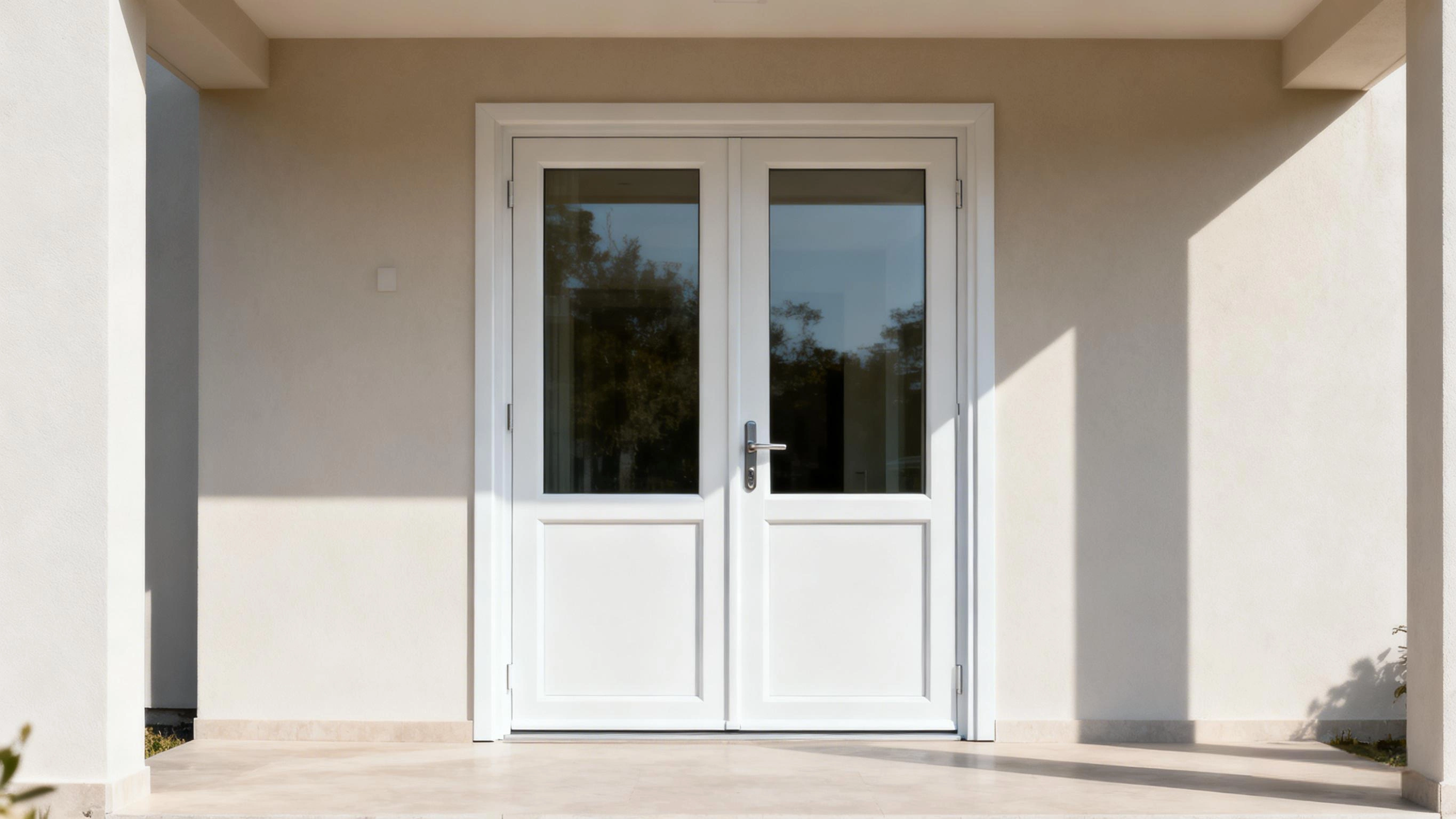
A 950 mm UPVC composite front door leaf grows about 2.7 mm across a 40 K surface temperature swing, while the steel core inside the same leaf grows 0.5 mm. The 2 mm difference lands on the lock edge, and it is larger than the adjustment most keeps allow. Custom UPVC composite front doors are specified on that tolerance, not on colour or panel pattern.
One coefficient decides the latch
PVC-U moves at 0.07 mm per metre per kelvin, aluminium at 0.023 and steel at 0.012. On a 0.95 m leaf across 40 K: 2.66 mm of movement in the PVC-U shell, 0.87 mm in an aluminium frame, 0.46 mm in the steel core. The lock keep has to absorb the difference, not the seal.
In this guide:
Why does a composite front door stop closing properly after one summer?
On a UPVC composite front door the complaint usually arrives in autumn, not in summer: the door catches at the top corner, the latch needs a push, the handle feels tight. Nothing was adjusted and nothing broke. What changed is that the leaf and the frame cooled at different rates after a summer of direct sun, and the lock line moved by a millimetre or two relative to where it was set in spring.
A dark coloured door face in direct summer sun reaches 60 °C or more while the shaded frame stays near 30 °C. That is a 30 to 40 K differential across the same product, and PVC-U is the material that reacts most to it. The door is not faulty. The clearance was set for one temperature and the product lives in a range.
This is also why a door that was fine in a mild climate fails after installation on a west facade. The specification did not change; the surface temperature did. Resetting the keep in autumn without changing the clearance only moves the failure to the next spring.
How far does a PVC U leaf actually move across a 40 K swing?
Linear movement is length × coefficient × temperature difference. For PVC-U the coefficient is about 0.07 mm per metre per kelvin, so a 0.95 m leaf across 40 K moves 0.07 × 0.95 × 40 = 2.66 mm. An aluminium frame of the same size moves 0.87 mm. The leaf is the part that travels furthest, and it travels towards the lock.
Two consequences follow. The gap on the hinge side has to be set wider than on a timber or aluminium door, and the lock keep has to be adjustable by at least the calculated movement plus a millimetre of assembly tolerance. A fixed keep with 1 mm of adjustment is the single most common reason a good door gets rejected on site.
The same arithmetic explains why a UPVC swing doors unit behaves differently from a window in the same wall: the door leaf is taller and wider, so the same temperature step produces a larger absolute movement on the lock edge.
| Leaf width | Movement at 20 K | At 40 K | At 60 K | Keep adjustment needed |
|---|---|---|---|---|
| 900 mm | 1.26 mm | 2.52 mm | 3.78 mm | ±3 mm plus 1 mm assembly tolerance |
| 950 mm | 1.33 mm | 2.66 mm | 3.99 mm | ±3 mm plus 1 mm assembly tolerance |
| 1000 mm | 1.40 mm | 2.80 mm | 4.20 mm | ±4 mm plus 1 mm assembly tolerance |
Calculated from the PVC-U linear expansion coefficient of 0.07 mm per metre per kelvin. These are lock edge movement values for a UPVC composite front door, arithmetic rather than measurements from a tested door.
What does the steel core do to that movement?
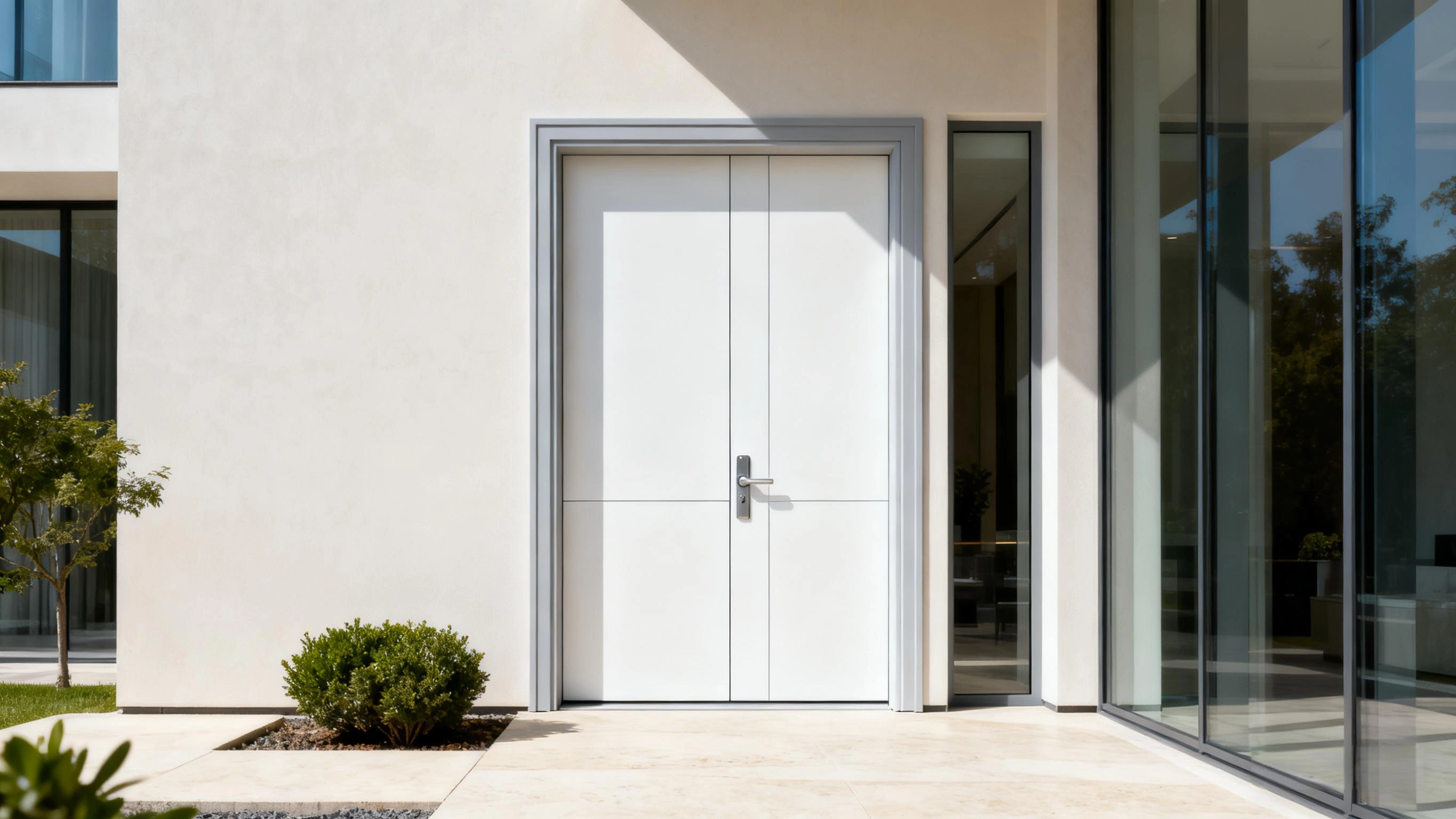
A composite leaf is a PVC-U shell around a stiffening core, usually steel or a steel and timber frame with insulation between. The core moves at about 0.012 mm per metre per kelvin — six times less than the shell. So the shell wants to travel 2.66 mm while the core stays almost still, and something between them has to give.
Three outcomes are possible and all three are visible on returned units. The shell slides on the core, which is harmless if the bond is designed for it. The shell is bonded rigidly to the core, so the stress collects at the two ends and appears as a hairline crack at the bottom corner or a lifted edge on the face. Or the core is too light to restrain the shell, and the whole leaf bows outward in the middle.
This is the question to put to a factory: how is the skin attached to the core, and what allowance exists at the two ends. An answer in millimetres is a real answer. An answer about "high quality materials" is not. The same logic decides whether a product suits humid coastal climates, where the daily swing is smaller but the humidity load is continuous.
What hinge and lock specification follows from the leaf weight?
A 950 × 2100 mm composite leaf at 30 kg/m² weighs about 60 kg. Weight is carried by the hinges and by the frame reinforcement behind them, not by the shell, so the frame must have a steel or aluminium insert at every hinge position. Ask for the hinge count, the rated load per hinge and where the reinforcement sits.
Three hinges at 60 kg is 20 kg each, which is inside the range of most entrance hardware, but the margin disappears as soon as a glazed leaf or a wide leaf is ordered. Hinge classes under EN 1935 are graded, so the order should name the class that matches the calculated leaf weight rather than the model that happened to be on the sample.
Security follows the same route. EN 1627 resistance classes describe what a mounted door resists in a timed attack with hand tools, and the class is a property of the assembled door, frame and hardware together. A leaf sold as a high class product with a standard keep and a light frame does not have that class in service. Weather classes follow the same rule: the EN 12208 watertightness class and the EN 12210 wind load class are measured on the assembled door with its own threshold, so a leaf quoted without them is quoted on the wrong basis.
| Parameter | Typical value | Note |
|---|---|---|
| Configuration | UPVC composite front door, single leaf or with sidelight | Sidelight changes the frame load path |
| Leaf construction | PVC-U skin over steel core with insulation | Ask how the skin is fixed to the core |
| Leaf thickness | 44-70 mm | Thicker leaf carries more core, not more insulation by default |
| Leaf mass | 26-35 kg/m² | Glazed and wide leaves sit at the top of the range |
| Hinge | 3 hinges, EN 1935 class matched to leaf mass | Reinforcement at every hinge position |
| Lock edge movement | 2.5-2.8 mm on a 0.95 m leaf at 40 K | Keep must be adjustable by at least that |
| Security | EN 1627 class tested on the assembled door | Class covers leaf, frame and hardware together |
| Air permeability | EN 12207 class per project | Third seal on the frame improves the class |
Values describe the common export range for composite entrance doors; the figure for a specific order is confirmed against its own specification sheet.
Which tolerances belong in a bulk order for composite front doors?
Five numbers for a UPVC composite front door, all in millimetres: the clearance on the hinge side before the keep is adjusted, the adjustment range of the keep, the maximum leaf width the profile is rated for, the reinforcement position at each hinge, and the permitted bow of the leaf measured on a diagonal. Orders that list colour, panel and glass but leave these five open are the ones that generate site claims in the second summer.
Pair the entrance door with the rest of the elevation. A UPVC balcony door on the same project uses the same profile family, so it will move by the same rules; if the two are specified with different clearances, one of them will be wrong.
Working drawings make the difference. For a UPVC door style guide the elevation is enough, but once the leaf goes above 2100 mm or the face turns dark, the fabrication drawing has to show the clearance and the keep range, because those two are what the installer cannot fix later.
What can be checked on a sample before production starts?
Four checks, all doable in an afternoon with a steel rule and a thermometer. One: measure the hinge side clearance cold and note it on the drawing. Two: confirm the keep adjustment range by moving it to both ends. Three: put the sample in sun or under lamps until the face reaches 55 to 60 °C, then close the door and see whether the latch still enters without a push. Four: measure the leaf diagonal before and after, and record the change.
The third check is the one that matters, and almost nobody runs it. A door that only closes in the morning is a door that will be rejected, and the reason will be blamed on installation. If you have an entrance schedule with opening sizes and facade orientation, send it over and the clearance can be calculated per door before the profile is ordered.
Frequently asked questions
Can custom UPVC composite front doors be made to metric opening sizes?
Yes. Doors are fabricated to the opening schedule in millimetres, with the frame sized to the structural opening and the leaf sized from the frame. Minimum order is 10-20 units and lead time is 25-30 days.
What drives the price of a UPVC composite front door?
Four items move the price more than the rest: the mass of the core, the glazed area, the hardware class under EN 1935 and EN 1627, and the number of leaves above 1000 mm wide. Colour and panel pattern are the cheapest variables and usually the ones buyers negotiate first.
How is a composite door tested for security?
The assembled door, frame and hardware are attacked with a defined set of hand tools for a defined time, and the class under EN 1627 records how long the assembly resists. A leaf tested with a different keep or a lighter frame does not carry the same class, so the test report should name the configuration that is being ordered.
Do composite doors need a different installation method?
The frame is fixed the same way, but the clearances are not. Leave the hinge side wider than for a timber door, do not pack the threshold solid, and set the keep last, at the temperature the door will normally work at rather than at the temperature of the installation day.
Ordering from Haolv
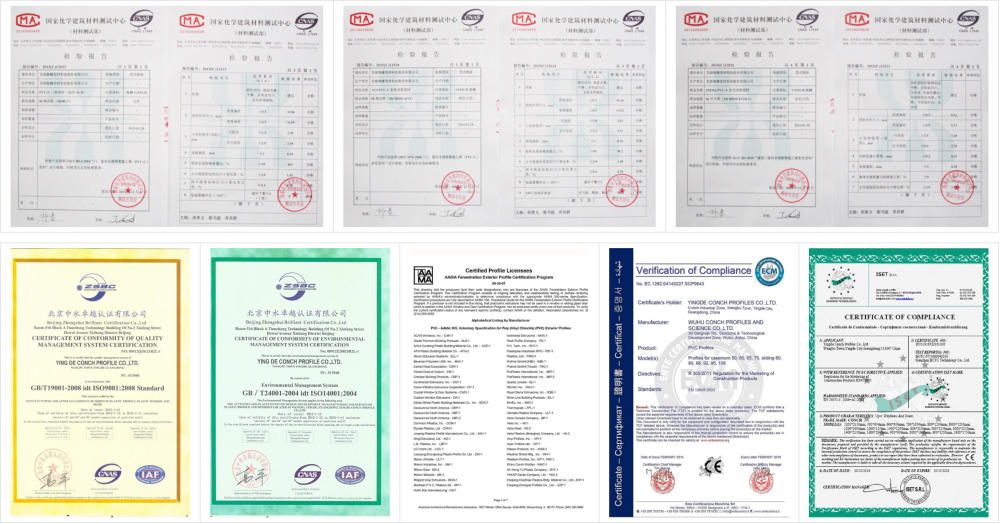
Haolv Building Materials Co., Ltd. has been making doors and windows for 19 years, including UPVC composite front doors and entrance sets for residential programmes. Profiles, reinforcement and hardware are assembled in one plant, so the clearance on the drawing and the clearance on the delivered door come from the same fabrication sheet. Certification documents are available on request. Minimum order is 10-20 units and lead time is 25-30 days.
Send the entrance schedule with opening sizes, facade orientation and the security class required to kristin@haolvwindows.com, and the quotation comes back with the clearance and keep range written per door rather than as a general note.
The movement figures in this guide are calculated from published linear expansion coefficients — 0.07 mm per metre per kelvin for PVC-U, 0.023 for aluminium, 0.012 for steel — multiplied by leaf length and temperature difference. They are arithmetic, not measurements on a tested door, and no shipment data is used. Real movement depends on colour, sun exposure, glass area and how the skin is bonded to the core. Final clearance is confirmed on the fabrication drawing for the actual order.
References
- EN 14351-1:2006+A2:2016 — Windows and doors. Product standard, characteristics and performance.
- EN 12608-1:2016 — Unplasticized polyvinylchloride (PVC-U) profiles for the fabrication of windows and doors. Classification, requirements and test methods.
- EN 1627:2011 — Pedestrian doorsets, windows, curtain walling, grilles and shutters. Burglar resistance. Requirements and classification.
- EN 1935:2002 — Building hardware. Single-axis hinges. Requirements and test methods.
- EN 12207:2017 — Windows and doors. Air permeability. Classification.
- ISO 9001:2015 — Quality management systems. Requirements.
Fast simple channel to send demands lock favorable price for building window door bulk purchases.