- English
- French
- German
- Portuguese
- Spanish
- Russian
- Japanese
- Korean
- Arabic
- Greek
- German
- Turkish
- Italian
- Danish
- Romanian
- Indonesian
- Czech
- Afrikaans
- Swedish
- Polish
- Basque
- Catalan
- Esperanto
- Hindi
- Lao
- Albanian
- Amharic
- Armenian
- Azerbaijani
- Belarusian
- Bengali
- Bosnian
- Bulgarian
- Cebuano
- Chichewa
- Corsican
- Croatian
- Dutch
- Estonian
- Filipino
- Finnish
- Frisian
- Galician
- Georgian
- Gujarati
- Haitian
- Hausa
- Hawaiian
- Hebrew
- Hmong
- Hungarian
- Icelandic
- Igbo
- Javanese
- Kannada
- Kazakh
- Khmer
- Kurdish
- Kyrgyz
- Latin
- Latvian
- Lithuanian
- Luxembou..
- Macedonian
- Malagasy
- Malay
- Malayalam
- Maltese
- Maori
- Marathi
- Mongolian
- Burmese
- Nepali
- Norwegian
- Pashto
- Persian
- Punjabi
- Serbian
- Sesotho
- Sinhala
- Slovak
- Slovenian
- Somali
- Samoan
- Scots Gaelic
- Shona
- Sindhi
- Sundanese
- Swahili
- Tajik
- Tamil
- Telugu
- Thai
- Ukrainian
- Urdu
- Uzbek
- Vietnamese
- Welsh
- Xhosa
- Yiddish
- Yoruba
- Zulu
Sourcing German Tilt and Turn Windows and the Handing Matrix Buyers Get Wrong
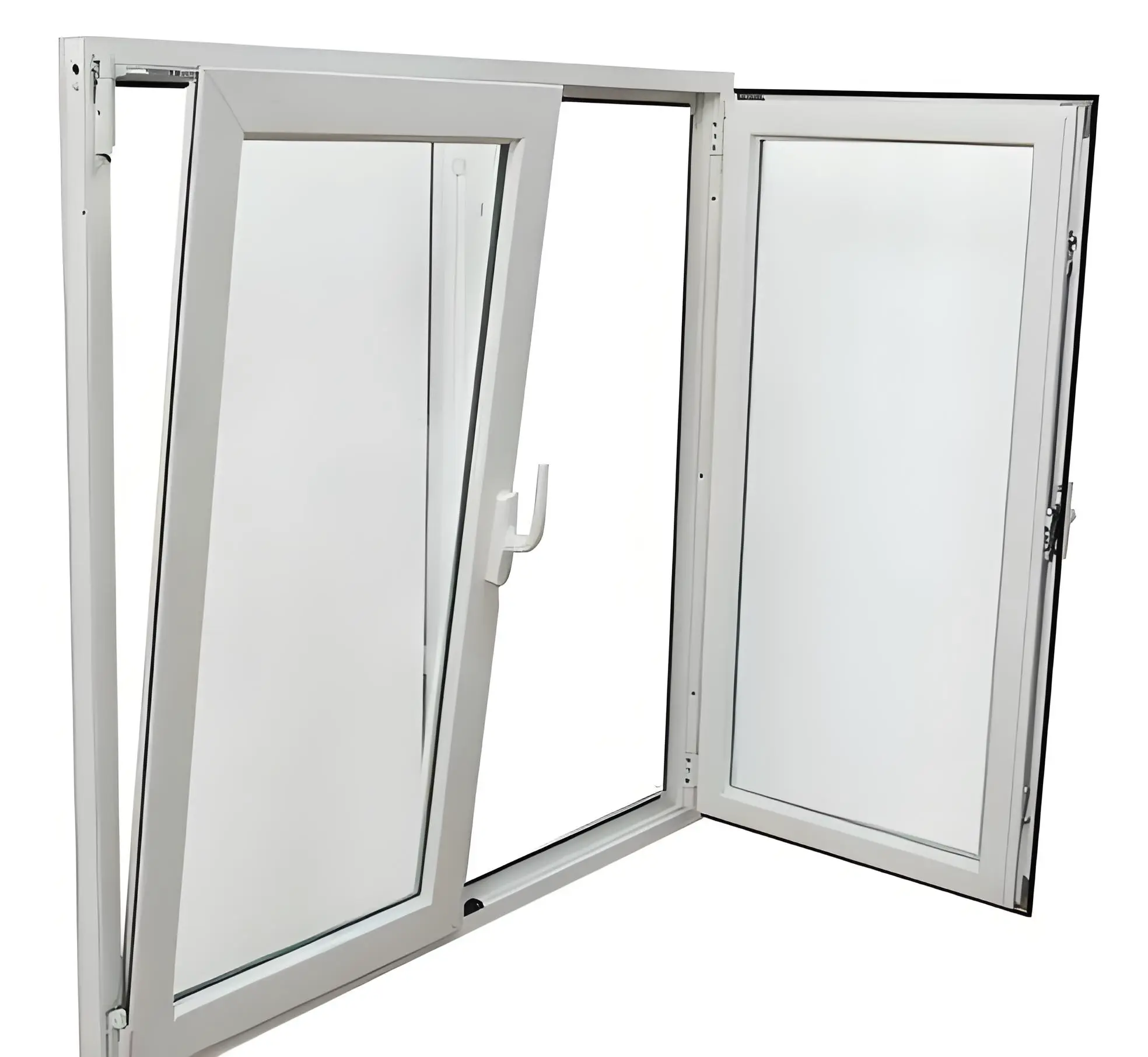
German tilt and turn windows carry 2 handling options, 2 functions and 3 sizes, which is 12 position types on a twelve window elevation. A wrong hand scraps the whole frame, because the keepers are screwed to it and cannot be moved.
One elevation, twelve variants
Take a twelve window elevation in three sizes, with both functions available. Hand gives two options, function gives two, size gives three, so the site needs 2 x 2 x 3 = 12 distinct position types. An order sheet written by size alone gives three lines and hides nine of them, and every hidden one is a frame that arrives with keepers on the wrong side.
In this guide:
Why does handing decide whether the frame survives?
Handing on german tilt and turn windows is read under DIN 107, from the side the sash opens toward, which on an inward opening sash is the room side. Stand inside, look at the window: hinges on the left is DIN left, hinges on the right is DIN right. That reading is fixed by the hardware, and it never changes once the frame is drilled.
The reason it cannot be fixed later is the keeper. A tilt and turn sash locks against mushroom cams that seat into keepers on the outer frame, and those keepers sit on the handle side. Reverse the hand and every keeper is on the wrong face, the corner drive no longer reaches the cam it drives, and the frame is scrap. A casement can often be saved by re-hanging the sash; this hardware cannot.
So the hand belongs on the order sheet next to the size, written as DIN left or DIN right with the view stated. Two suppliers reading the same drawing from opposite sides is a documented failure mode, and it is the one error that costs a whole frame on a tilt turn window order.
How many variants does one elevation actually contain?
German tilt and turn windows multiply three things: hand, function and size. Function means turn only, tilt and turn, or a fixed light. A four storey block with one window per floor and one size is two variants, because the hand alternates between floors for handle access. The same block with three sizes is six.
| Position | Function | Clearance inside | Variant driver |
|---|---|---|---|
| Bathroom, above the bath | tilt and turn | 110 mm at the head | hand plus sill height, no turn use |
| Living room, free wall | tilt and turn | full sash width | hand plus size |
| Within 900 mm of a return wall | tilt only | 110 mm at the head | hand is irrelevant, one variant |
| Stairwell, high level | tilt only, pole handle | 110 mm at the head | pole length sets the handle height |
Clearance is the free distance between the sash face and the nearest obstruction. A tilt and turn sash needs its own width to swing in; a tilt only sash needs 110 mm at the head. Both figures are geometry, not measurements of a delivered window.
The cheapest way to cut the matrix is to remove function, and the position that allows it is the one against a return wall. Where the sash cannot swing in, a tilt only sash does the same ventilation job with one hardware set, one variant and a narrower frame, and the elevation still reads as the same window from outside.
How much room does an inward opening sash need inside?
On german tilt and turn windows the turn position is the one that needs space, and the number is the sash width. A 1,230 by 1,480 mm window carries a 1,075 by 1,330 mm sash, so the swing needs 1,075 mm of clear floor and sweeps 1.43 square metres of it. Put a radiator, a sink or a wardrobe inside that, and the sash opens to 60 degrees at best.
The tilt position is a different order of magnitude: 110 mm at the head over the sash width, which is 0.118 square metres of opening and clears a 900 mm deep counter without touching it. That is why kitchens and bathrooms take the tilt as the working position and the turn as the cleaning position, once a year.
Where the opening sits in a cold climate the sash has to hold a sealed unit heavy enough for the U-value target, and the vinyl tilt turn windows in the same range use the deeper frame that a 24 mm strip needs. The clearance numbers above stay the same; only the sash depth changes.
What does the tilt position weigh, and which hinge class carries it?
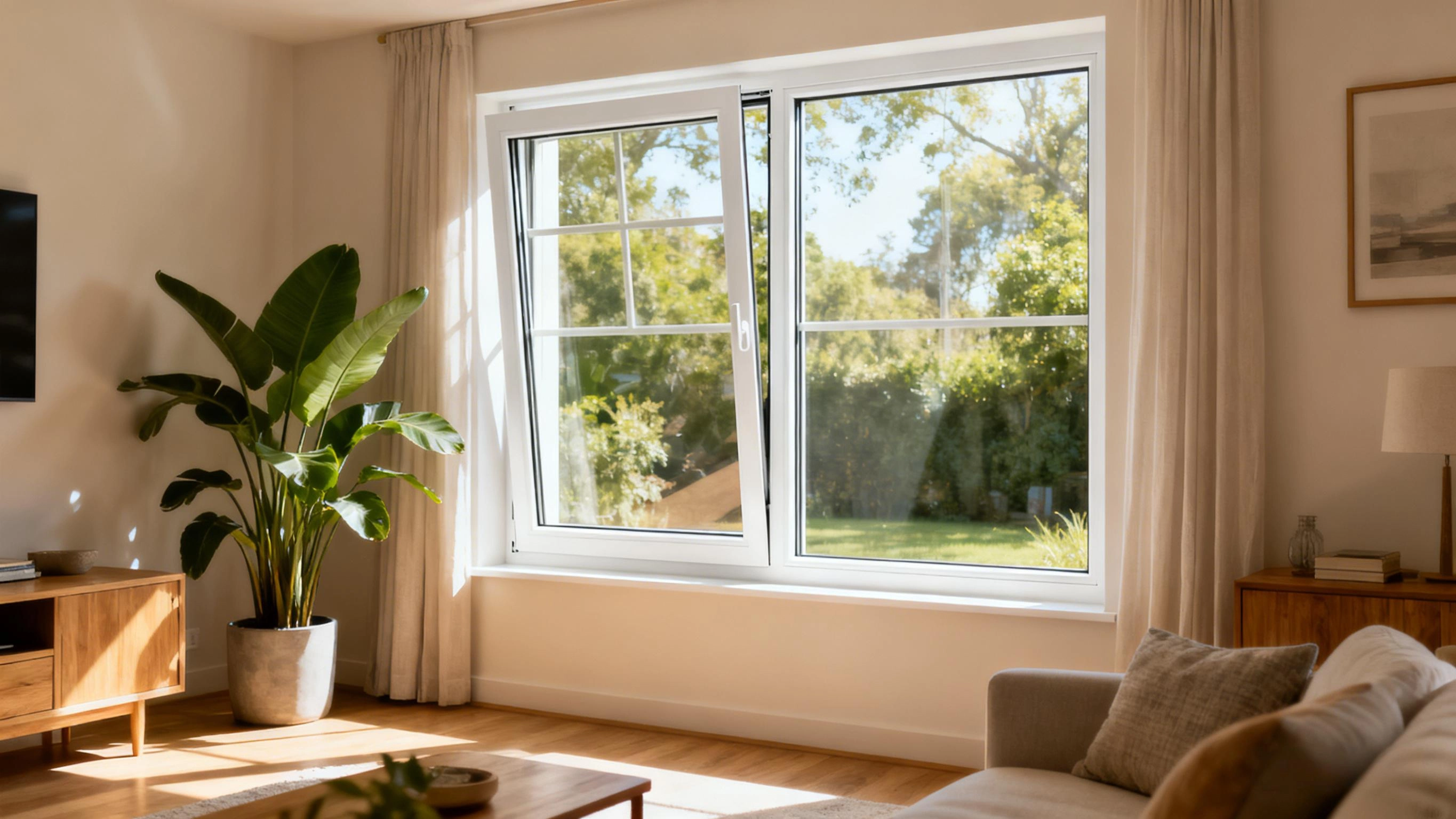
German tilt and turn windows put the whole sash on two bottom hinges, because the top of the sash swings out into the tilt position. On the 1,075 by 1,330 mm sash the glass is 1.43 square metres; at 2.5 kg per square metre per millimetre, a 4-16-4 unit is 28.6 kg and a 5-9-5 unit is 35.8 kg.
The sash section adds the rest. At 4.81 m of perimeter, 1.35 kg per metre of PVC-U gives 6.5 kg, and the steel liner at 0.55 kg per metre gives 2.6 kg, so the two builds come out at 37.7 and 44.9 kg, or 18.9 and 22.5 kg on each of the two bottom hinges. A 60 kg hinge pair covers both; a 40 kg pair covers neither with any margin.
That is where german tilt and turn windows differ from a plain casement in cost, and it is not the profile. The hinge class, the corner drive and the tilt stay are the three parts that scale with sash mass, and they are the three lines a quote hides inside a square metre rate.
Why does a PVC-U tilt and turn sash need its liner more than an aluminium one?
PVC-U sits at about 2.8 GPa in modulus and steel at 210 GPa, a ratio of 75. In a 60 mm deep section the PVC-U walls carry roughly 0.9 million mm4 of second moment against 0.15 million for a 1.5 mm liner, and multiplying by modulus gives 2.5 against 31.5 billion N mm2, so the liner carries 93 per cent of the bending on a sixth of the section.
The practical consequence on german tilt and turn windows is about where the liner stops. Cut it 100 mm short of each corner and that 100 mm is PVC-U alone, with 7 per cent of the composite stiffness, so the same load bends it about thirteen times as far. That is the local step that shows up as a sash that drops at the handle end after two seasons.
The coating matters for the same reason it is invisible: the liner sits inside a closed chamber where condensation forms every winter. A Z275 coating to EN 10346 is 275 grams per square metre over both faces, about 19 microns a side, and a UPVC window profile drawing that names the coating is telling you more than one that names the wall thickness.

What belongs on the order sheet before the price is quoted?
Send the elevation with a position number on every opening, each line carrying size, hand, function and sill height, to kristin@haolvbuilding.com. With that sheet the variant count comes back before the price does, and a position that can drop to tilt only is flagged while the frame is still a drawing.
Two numbers then decide the frame: the sash mass for the hinge class, and the clearance for the function. At 44.9 kg a 1,075 mm sash sits comfortably on a standard pair; past 60 kg the class steps up and the sash width comes down, which is the same limit that makes 1,300 mm the practical ceiling on inward opening UPVC windows of this type.
Which numbers should the specification lock down?
| Parameter | Typical value | Note |
|---|---|---|
| Product | german tilt and turn window | PVC-U, multi chamber, steel liner |
| Overall size | 1,230 by 1,480 mm | sash 1,075 by 1,330 mm |
| Function options | tilt and turn, tilt only, fixed | one hardware set per function |
| Handing | DIN left or DIN right, DIN 107 | read from the room side |
| Sash mass | 37.7 to 44.9 kg | 4-16-4 or 5-9-5, calculated |
| Bottom hinges | two, 60 kg class | 18.9 to 22.5 kg each |
| Tilt clearance | 110 mm at the head | 0.118 square metres of opening |
| Turn clearance | 1,075 mm of floor | sweeps 1.43 square metres |
| Glazing | 4-16-4 to 5-9-5, low-e and argon | U-value 1.2 to 1.6 W per square metre kelvin |
| Minimum order | 10-20 units | lead time 25-30 days from approved drawing |
Masses are calculated from the sash size, the glass weight of 2.5 kg per square metre per millimetre and a 1.35 kg per metre PVC-U section with a 0.55 kg per metre liner. They are not weighed on a delivered window. Hinge class and U-value are confirmed per order against the hardware datasheet and the glazing supplier.
Frequently asked questions
What is the minimum order for german tilt and turn windows? Minimum order is 10-20 units and lead time is 25-30 days from an approved drawing. A single size in one hand ships on the standard schedule; a mixed elevation with four variants adds a hardware picking step before assembly.
Does wholesale pricing change with the handing mix? Yes, in the hardware line. Each variant needs its own set cut to length, so ten windows in one hand and one size prices better than ten windows across four variants, and the difference sits in the corner drive and the stay, not in the profile.
Can a tilt and turn window be changed to tilt only on site? The sash can be locked out of the turn position with a restrictor, and the frame stays as built. The reverse is not possible: a tilt only frame has no keepers for the turn position, so it cannot be upgraded later.
How is the hand checked before shipping? Against the elevation sheet, position by position, with the handle side marked on the frame protection. A photograph of each position with its number is the cheapest proof, and it is the step that catches a reversed reading before the container is loaded.
Ordering from Haolv
Haolv Building Materials Co., Ltd. has been making doors and windows for 19 years, and german tilt and turn windows are welded and glazed on the same line as the casements in the range. Certification for the profiles and the glazing is available on request with the quotation. Minimum order is 10-20 units and lead time is 25-30 days.
Send the elevation with position numbers to kristin@haolvbuilding.com, or start from Haolv Building Materials Co., Ltd. and the variant list, the sash mass and the clearance check come back with the price.
What this page claims and what it leaves open: the 37.7 kg, the 44.9 kg, the 93 per cent and the 0.118 square metres are arithmetic on a stated sash size, the standard glass weight of 2.5 kg per square metre per millimetre and a stated section weight. They are calculated, not measured. The handing rule follows DIN 107 and the hinge class follows the hardware datasheet for the set you order.

References
- DIN 107:2018 — Hand of doors and windows. Definition and designation.
- EN 12608-1:2016 — Unplasticized polyvinylchloride profiles for the fabrication of windows and doors. Classification.
- EN 10346:2015 — Continuously hot-dip coated steel flat products for cold forming. Technical delivery conditions.
- EN 14351-1:2006+A2:2016 — Windows and doors. Product standard. Performance characteristics.
- EN 12207:2017 — Windows and doors. Air permeability. Classification.
- EN ISO 10077-1:2017 — Thermal performance of windows, doors and shutters. Calculation of thermal transmittance.
Every mass, clearance and stiffness figure in this guide is arithmetic on a described sash, the standard glass weight of 2.5 kg per square metre per millimetre and published material constants. They are calculations from a drawing, not measurements of a delivered window, and the hardware class of any set is taken from the datasheet for that specification.
Fast simple channel to send demands lock favorable price for building window door bulk purchases.