- English
- French
- German
- Portuguese
- Spanish
- Russian
- Japanese
- Korean
- Arabic
- Greek
- German
- Turkish
- Italian
- Danish
- Romanian
- Indonesian
- Czech
- Afrikaans
- Swedish
- Polish
- Basque
- Catalan
- Esperanto
- Hindi
- Lao
- Albanian
- Amharic
- Armenian
- Azerbaijani
- Belarusian
- Bengali
- Bosnian
- Bulgarian
- Cebuano
- Chichewa
- Corsican
- Croatian
- Dutch
- Estonian
- Filipino
- Finnish
- Frisian
- Galician
- Georgian
- Gujarati
- Haitian
- Hausa
- Hawaiian
- Hebrew
- Hmong
- Hungarian
- Icelandic
- Igbo
- Javanese
- Kannada
- Kazakh
- Khmer
- Kurdish
- Kyrgyz
- Latin
- Latvian
- Lithuanian
- Luxembou..
- Macedonian
- Malagasy
- Malay
- Malayalam
- Maltese
- Maori
- Marathi
- Mongolian
- Burmese
- Nepali
- Norwegian
- Pashto
- Persian
- Punjabi
- Serbian
- Sesotho
- Sinhala
- Slovak
- Slovenian
- Somali
- Samoan
- Scots Gaelic
- Shona
- Sindhi
- Sundanese
- Swahili
- Tajik
- Tamil
- Telugu
- Thai
- Ukrainian
- Urdu
- Uzbek
- Vietnamese
- Welsh
- Xhosa
- Yiddish
- Yoruba
- Zulu
UPVC Door and Window Profiles Factory Checklist for Steel Liner and Coating
On UPVC door and window profiles a 1.5 mm steel liner takes 93 per cent of the bending on a sixth of the section. One tonne of extrusion makes about 60 windows, and the liner inside them decides whether those windows hold their shape.
From tonnes to windows
A 1,200 by 1,400 mm casement consumes 5.2 m of frame and 4.8 m of sash, so 10.0 m of profile, and 8 per cent cutting waste takes it to 10.8 m. At 1.30 kg per metre average that is 14.0 kg of PVC-U plus 2.6 kg of liner, which is 16.6 kg per window and 60 windows to the tonne.
In this guide:
What does a metre of UPVC door and window profiles actually buy?
It buys a length, and the length is the only unit a profile mill can price. A fabricator buys windows, so the two units are bridged by the metres per window, and that figure moves with every frame and sash combination added to the schedule. UPVC door and window profiles priced per tonne and profiles priced per metre differ by exactly this bridge, and by the wall thickness inside it.
The bridge is geometry. Frame perimeter plus sash perimeter plus mullions plus waste is the whole calculation, and for a plain casement it lands at 10.8 m. Multiply by the section weight and one tonne of extrusion becomes 60 windows, a number a buyer can check against a quote in a minute.
Order ten tonnes and the difference between 1.25 and 1.35 kg per metre is 600 kg of PVC-U, which is about 36 windows of material. That is why the section weight belongs in the enquiry, on the best UPVC profile shortlist and in the comparison sheet next to the price.
Which wall thickness class does the frame need?
EN 12608-1 sorts UPVC door and window profiles into three classes by outer wall thickness: class A at 2.8 mm and above, class B at 2.5 mm, class C at 2.2 mm. The classes exist because the outer wall is what takes the screw, the weld and the wind, and a 0.6 mm step is 27 per cent of the wall.
| Class | Outer wall | Where it fits | What it costs |
|---|---|---|---|
| A | 2.8 mm and above | full height glazing, door leaves, wind loaded facades | highest kilogram per metre |
| B | 2.5 mm | standard residential windows, mild wind zones | about 6 per cent lighter than A |
| C | 2.2 mm | internal partitions, small fixed lights | lightest, screws need care |
Wall thickness classes are those of EN 12608-1. The weight difference is arithmetic on the same section outline, and the class a project needs is set by the wind load and the sash size on that drawing.
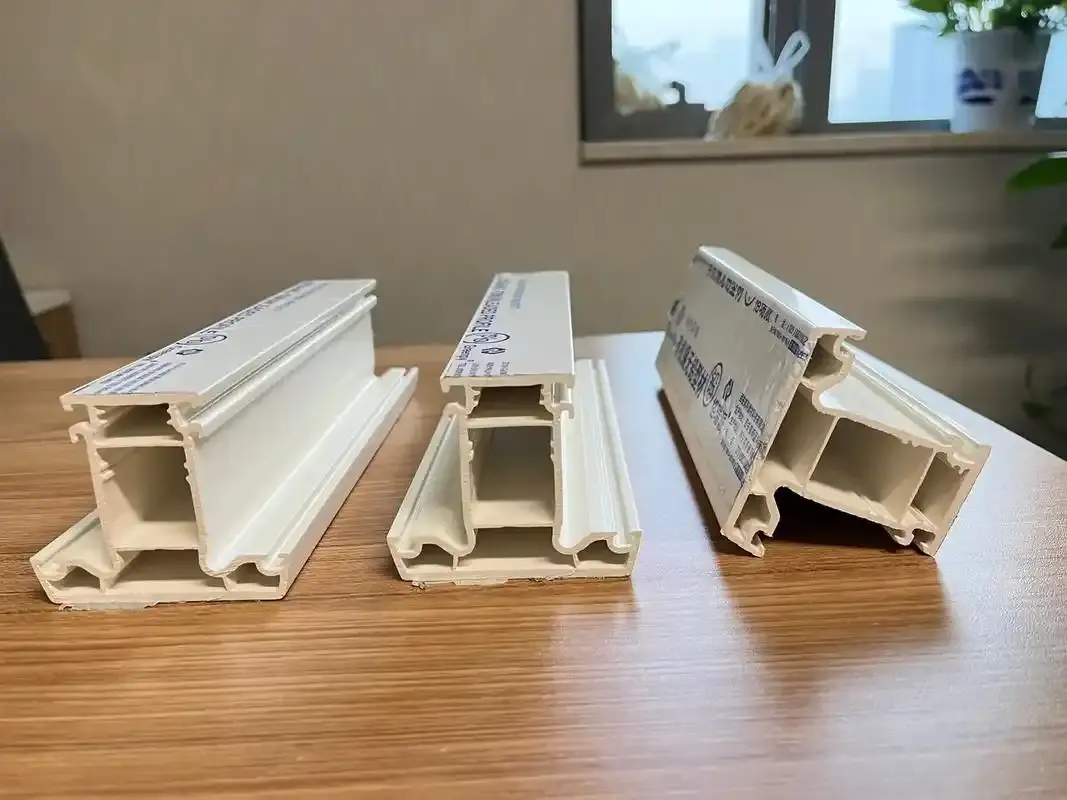
The screw point is the one buyers miss. A hinge screw bites into 2.2 mm of PVC-U with a liner behind it, and the liner is 1.5 mm of steel, so the screw holds. Take the liner out of a class C section and the same screw holds 2.2 mm of polymer on its own, which is where a dropped sash starts.

Why is the steel liner the structural member?
Because modulus decides, and the ratio is 75. PVC-U runs at about 2.8 GPa, steel at 210 GPa. On UPVC door and window profiles of 60 mm depth the PVC-U walls give roughly 0.9 million mm4 of second moment and a 1.5 mm liner about 0.15 million, so stiffness comes out at 2.5 against 31.5 billion N mm2 and the liner carries 93 per cent of the bending.
That single number reframes the material. UPVC door and window profiles are sold as polymer, and the polymer is the weather skin, the thermal break and the shape. The span is carried by a cold rolled strip that costs a fraction of the extrusion and never appears on a data sheet.
So the first three lines of any comparison between two quotes are liner thickness, liner height and liner continuity, with chamber count after them. The UPVC and aluminium profiles differ here in a way that a section drawing shows and a photograph does not.
Does the liner have to reach the welded corner?
Yes, and the reason is local. Stop the liner 100 mm short of each corner and that 100 mm carries the same load on 7 per cent of the stiffness, which bends it about thirteen times as far. The corner weld then sees a rotation it was never designed for, and the visible result is a sash that sags at the handle end.
Two checks settle it in a factory: cut a sample profile lengthwise and look at where the liner ends, and measure the liner wall with a calliper at three points. On UPVC door and window profiles the liner is 1.2 to 2.0 mm on a residential window and 2.5 mm on a door leaf, and the thin end of that range is worth a question.
What coating keeps the liner alive inside the chamber?
The liner sits in a closed chamber and sees condensation every winter, so it is a wet steel part. A Z275 coating to EN 10346 is 275 grams of zinc per square metre over both faces, which at 7.14 grams per cubic centimetre works out to about 19 microns a side, and that is the number that decides whether the strip lasts as long as the window.
Two smaller things matter as much on UPVC door and window profiles. The liner should be closed at the ends, because an open end wicks water along the fold, and the drain slots in the frame should not be drilled through the liner channel, because that turns a protected part into an unprotected edge.
What belongs in the inspection before shipment?
Ask for six items with the loading photos: liner thickness at three points, liner continuity at the cut ends, coating weight or a mill certificate, outer wall class, section weight per metre, and the weld test on a corner sample. Send the list to kristin@haolvbuilding.com and it comes back filled in against the batch that actually ships.
That list also answers the price question. Two mills quoting the same figure per tonne can differ by 1.5 kg per window once liner thickness and wall class are pinned, which on 60 windows is 90 kg of material and a visible step in the quote for vinyl window profiles of the same sash size.
Where does a five chamber profile earn its money?
In the frame, and only in the frame. On UPVC door and window profiles the chambers slow convection inside the section, and the frame U-value falls from about 1.8 W per square metre kelvin on a three chamber section to about 1.3 on a five or six chamber one with the same 60 mm depth.
That gain shrinks once it is weighted by area. A 1.2 by 1.4 m window has 0.79 square metres of frame against 2.10 of glass, so 0.5 W per square metre kelvin on the frame is 0.13 on the window, while one step of glazing from a 4-16-4 unit to a low-e argon unit is worth about 0.35. The UPVC trim profiles and the chamber count are the second purchase, and the glazing is the first.

Which figures should the profile order state?
| Parameter | Typical value | Note |
|---|---|---|
| Product | UPVC door and window profiles | lead free stabiliser, co-extruded capstock on request |
| Outer wall class | A at 2.8 mm, B at 2.5 mm | EN 12608-1 classification |
| Section weight | 1.25 to 1.35 kg per metre | 60 mm frame, sash lighter |
| Steel liner | 1.5 mm residential, 2.5 mm door leaf | closed ends, full length to the corner |
| Liner coating | Z275, about 19 microns a side | EN 10346 |
| Chambers | five or six in the frame | frame U-value 1.3 to 1.8 W per square metre kelvin |
| Metres per window | 10.8 m for a 1,200 by 1,400 mm casement | includes 8 per cent cutting waste |
| Windows per tonne | about 60 | 16.6 kg per window, calculated |
| Glazing | 4-16-4 to 5-9-5, low-e and argon | U-value 1.2 to 1.6 W per square metre kelvin |
| Minimum order | 10-20 units | lead time 25-30 days from approved drawing |
Metres per window and windows per tonne are arithmetic on a stated casement size and an 8 per cent cutting allowance, not a production record. Section weight, liner thickness and coating are confirmed against the mill certificate for the batch.
Frequently asked questions
What is the minimum order for UPVC door and window profiles? Minimum order is 10-20 units, which on a full schedule is about a tonne of extrusion, and lead time is 25-30 days from an approved drawing. Colour and capstock add a run before extrusion starts.
Is bulk pricing quoted per tonne or per metre? Both, and the two are only comparable once the section weight is stated. Per tonne hides a thinner wall and a shorter liner; per metre hides the same thing in the other direction, because a lighter section measures the same and weighs less.
Can the same profile be used for doors and windows? The frame can, the leaf cannot. A door leaf carries a 2.5 mm liner and heavier hardware, and the sash profile on UPVC door and window profiles is a different section with a deeper reinforcement chamber.
How is the coating checked without a lab? A mill certificate gives the coating mass in grams per square metre, and a magnetic thickness gauge reads it on the strip in seconds. Z275 should read 18 to 22 microns a side; a reading under 12 means the batch is Z100 or uncoated.
Ordering from Haolv
Haolv Building Materials Co., Ltd. has been making doors and windows for 19 years, and UPVC door and window profiles are supplied either as extrusion for a fabricator or built into finished windows on the same line. Certification for the profiles is available on request with the quotation. Minimum order is 10-20 units and lead time is 25-30 days.
Send the window schedule with sizes and quantities to kristin@haolvbuilding.com, or start from Haolv Building Materials Co., Ltd. and the metres per window, the tonnage and the liner specification come back with the price.
What this page claims and what it leaves to the batch: the 93 per cent, the 16.6 kg, the 60 windows and the 19 microns are arithmetic on a stated casement, published moduli of 2.8 GPa for PVC-U and 210 GPa for steel, and the coating mass of Z275. They are calculated, not measured. The liner and the coating on any delivery come off the mill certificate for that batch.

References
- EN 12608-1:2016 — Unplasticized polyvinylchloride profiles for the fabrication of windows and doors. Classification.
- EN 10346:2015 — Continuously hot-dip coated steel flat products for cold forming. Technical delivery conditions.
- EN 14351-1:2006+A2:2016 — Windows and doors. Product standard. Performance characteristics.
- EN ISO 10077-1:2017 — Thermal performance of windows, doors and shutters. Calculation of thermal transmittance.
- EN 12207:2017 — Windows and doors. Air permeability. Classification.
- ISO 9001:2015 — Quality management systems. Requirements.
Stiffness shares, metres per window and windows per tonne in this guide are arithmetic on a stated casement, published material moduli and an 8 per cent cutting allowance. They are calculations from a schedule, not records from a production run, and the section weight, liner thickness and coating of any batch are taken from its mill certificate.
Fast simple channel to send demands lock favorable price for building window door bulk purchases.