- English
- French
- German
- Portuguese
- Spanish
- Russian
- Japanese
- Korean
- Arabic
- Greek
- German
- Turkish
- Italian
- Danish
- Romanian
- Indonesian
- Czech
- Afrikaans
- Swedish
- Polish
- Basque
- Catalan
- Esperanto
- Hindi
- Lao
- Albanian
- Amharic
- Armenian
- Azerbaijani
- Belarusian
- Bengali
- Bosnian
- Bulgarian
- Cebuano
- Chichewa
- Corsican
- Croatian
- Dutch
- Estonian
- Filipino
- Finnish
- Frisian
- Galician
- Georgian
- Gujarati
- Haitian
- Hausa
- Hawaiian
- Hebrew
- Hmong
- Hungarian
- Icelandic
- Igbo
- Javanese
- Kannada
- Kazakh
- Khmer
- Kurdish
- Kyrgyz
- Latin
- Latvian
- Lithuanian
- Luxembou..
- Macedonian
- Malagasy
- Malay
- Malayalam
- Maltese
- Maori
- Marathi
- Mongolian
- Burmese
- Nepali
- Norwegian
- Pashto
- Persian
- Punjabi
- Serbian
- Sesotho
- Sinhala
- Slovak
- Slovenian
- Somali
- Samoan
- Scots Gaelic
- Shona
- Sindhi
- Sundanese
- Swahili
- Tajik
- Tamil
- Telugu
- Thai
- Ukrainian
- Urdu
- Uzbek
- Vietnamese
- Welsh
- Xhosa
- Yiddish
- Yoruba
- Zulu
Sourcing Thermal Break Aluminum Profiles by Weight and by Metre
Thermal break aluminum profiles weigh about 0.96 kg per metre at 60 by 70 mm and 1.4 mm wall, and that single figure is what lets two quotations be compared at all, one written per kilo and the other per metre. The polyamide barrier adds 0.10 kg to that metre and 0.080 m²K/W to the section, and the second number sets the frame U-value.
Four numbers, one section
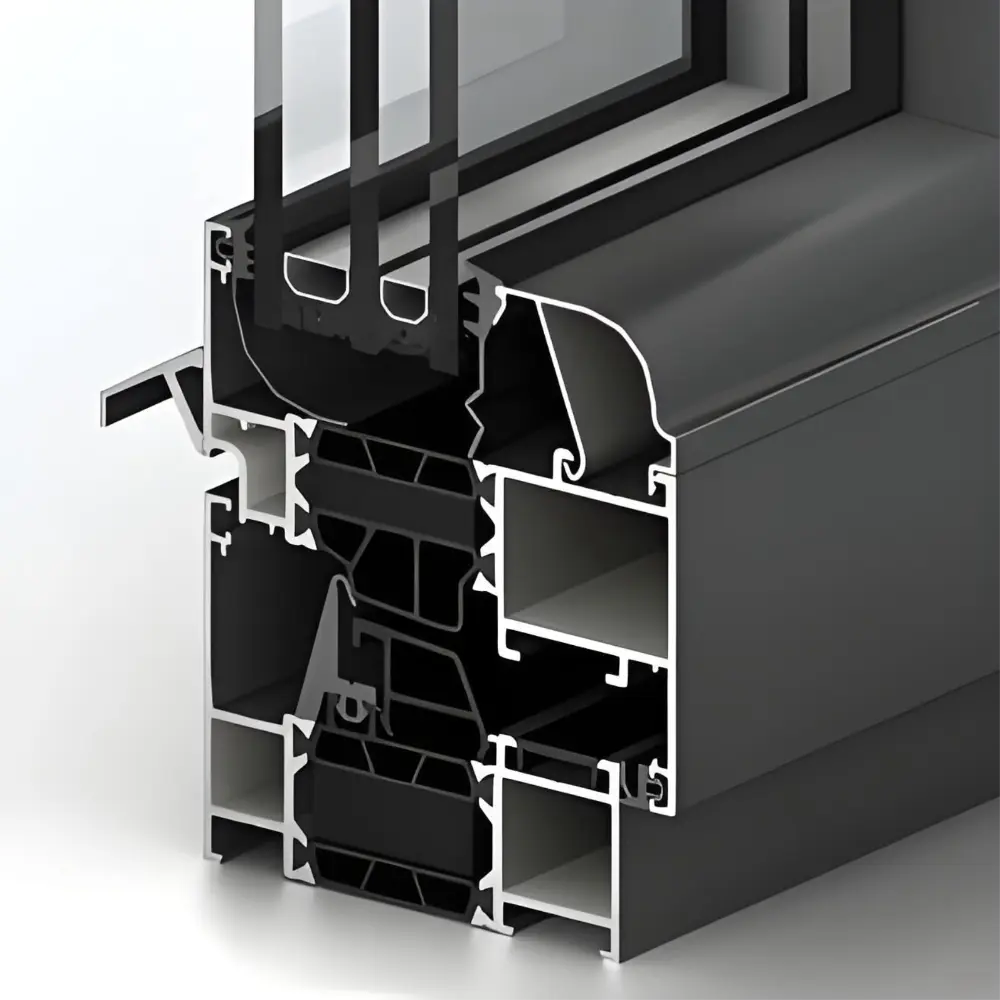
Section 356 mm² → 0.96 kg/m at 2.70 g/cm³. Barrier 72 mm² of PA66 GF25 → 0.10 kg/m. Barrier resistance 0.024 / 0.3 = 0.080 m²K/W. With surface films, frame U = 1 / (0.17 + 0.080) = 4.0 W/m²K.

In this guide:
How much do thermal break aluminum profiles weigh per metre?
Mass per metre in thermal break aluminum profiles comes out of the section, not the catalogue. Take the outer rectangle, subtract the void, and multiply by the density of 6063-T5, which is 2.70 g per cubic centimetre. A 60 by 70 mm frame at 1.4 mm wall leaves 356 mm² of metal, so the metre weighs 0.96 kg. Run the same sum at 2.0 mm wall and it becomes 1.36 kg, 41 per cent heavier for a wall that is 43 per cent thicker.
The barrier sits inside that figure and is easy to misjudge. Two strips of 24 by 1.5 mm in PA66 GF25 are 72 mm² at 1.35 g per cubic centimetre, which is 0.10 kg per metre, so a broken profile of the same outer size arrives near 1.06 kg. Weight is the wrong place to look at a thermal break: it is 9 per cent of the mass and most of the thermal resistance in the section.
That split is what a buyer is actually checking on the drawing. A thermally broken casement built on a 60 mm frame carries 24 mm of polyamide as a visible line in the section, and the wall thickness of the two aluminium halves is stated separately on each side of it. The same detail on thermal break casement windows is where a cold climate order earns or loses its U-value, long before the glass is chosen.
How much of the frame U-value sits in the polyamide barrier?
Almost all of it. Conductivity of PA66 GF25 is around 0.3 W per metre kelvin, against 160 to 200 for the aluminium either side, so the metal contributes a rounding error and the barrier carries the resistance. Frame U-value in thermal break aluminum profiles is therefore governed by one dimension, and that dimension is the width of the polyamide.
Set the barrier at 24 mm and its resistance is 0.024 divided by 0.3, which is 0.080 m²K/W. Add the indoor and outdoor surface films of 0.13 and 0.04 and the frame lands at 1 divided by 0.25, or 4.0 W/m²K. At 14 mm the same arithmetic gives 4.6 and at 34 mm it gives 3.5. These are one-dimensional figures for the section, calculated from barrier width and material conductivity, and they leave out the frame corner, which is always worse.
| Barrier width | Barrier R, m²K/W | Frame U, 1-D | Window U, 1.4 glass | Verdict |
|---|---|---|---|---|
| 14 mm | 0.047 | 4.6 | 2.08 | passes a mild climate condensation check, nothing more |
| 24 mm | 0.080 | 4.0 | 1.97 | the normal export specification |
| 34 mm | 0.113 | 3.5 | 1.89 | 0.08 at the window for 10 mm of barrier |
| 44 mm | 0.147 | 3.2 | 1.83 | passive house territory, the frame stops being the limit |
Frame U of thermal break aluminum profiles is the one-dimensional value 1 / (Rsi + Rse + b / 0.3) with Rsi 0.13 and Rse 0.04. Window U applies EN ISO 10077-1 to a 1,200 x 1,400 mm window with a 60 mm frame, 1.4 W/m²K glass and a 0.04 W/mK spacer. Calculated from published conductivities, not measured on a finished frame.
Where does a wider barrier stop paying for itself?
The return falls away fast. The first ten millimetres of barrier, 14 to 24, cut frame U by 0.61. The second ten, 24 to 34, cut it by 0.47. A third step to 44 mm adds 0.35 and moves the frame into passive house territory where the frame is no longer the component holding the window back.
That is why most export orders of thermal break aluminum profiles settle on 24 mm and 34 mm is sold as an upgrade. A barrier under 14 mm exists to pass a condensation test in a mild climate; a buyer working to a 1.4 W/m²K whole window target is looking at a different product and should say so in the enquiry.
What does 0.6 W/m²K at the frame do to the whole window?
It reaches the window divided by area. On a 1,200 by 1,400 mm window with a 60 mm frame, the frame is 0.30 m² out of 1.68 m², or 17.7 per cent. A 0.61 W/m²K gain at the frame becomes 0.11 W/m²K at the window. The same nominal step in the glass, from 1.4 to 0.8, is worth 0.38 W/m²K under the same arithmetic.
One glass step is worth three barrier steps. So the order of operations is glass first, then a 24 mm barrier, then stop. Buyers who start at thermal break aluminum profiles spend the budget on the component with the smallest lever, and the quotation looks expensive for a window that is still at 1.97 W/m²K.
Write that order into the specification, because the two items are quoted separately and then compared as if they were equal. A worked version of the same accounting across a whole assembly is set out under profile energy performance, where the frame, the glass and the spacer are weighed against each other.

How do you compare a price per kilo with a price per metre?
Convert first, then compare. At 0.96 kg per metre of thermal break aluminum profiles, 3.60 USD per kilo is 3.46 USD per metre. A competing quote at 3.30 per kilo on a 1.15 kg section is 3.80 per metre, so the cheaper headline belongs to the dearer profile. The same trap sits in coating: a 60 micron finish and an 80 micron finish weigh the same per metre and last differently.
Send the section drawing and the cutting list to kristin@haolvbuilding.com and the comparison comes back in metres, with the offcut that the bar length forces included. Two suppliers can only be ranked once both are quoted in the unit the workshop actually consumes.
What does the cutting list do to the tonnage you order?
Bar length sets the waste. A 1,200 by 1,400 mm window needs 9,920 mm of cut length across head, sill, jambs and sash. Two 6 m bars supply 12,000 mm, so 2,080 mm leaves the saw as offcut, which is 17 per cent of the metal invoiced on an order of thermal break aluminum profiles.
Mixed sizes nest those offcuts. Two window sizes on the same profile can pull waste under 10 per cent without changing anything in the product, which is why a single-size trial order is the most expensive way to buy. The same nesting logic drives thermal break folding doors, where five leaves of different widths come off one bar.
Which four checks belong on the profile order?
Four lines, each a number: alloy and temper, 6063-T5; wall thickness at a named face, because a 1.4 mm nominal frame of thermal break aluminum profiles is often 1.35 at the thin side; barrier width and material, 24 mm PA66 GF25; coating type and film thickness. Every one can be measured on arrival with a caliper and a micrometer, which is the point of putting them on the order.
| Parameter | Typical value | Note |
|---|---|---|
| Profile | thermal break aluminum profiles, 6063-T5 with PA66 GF25 barrier | 24 mm barrier standard, 34 mm on request |
| Wall thickness | 1.4 to 2.0 mm residential, 2.5 to 3.0 mm commercial | measured at the thin face, stated on the order |
| Barrier width | 14 / 24 / 34 / 44 mm | 24 mm for a 1.4 to 1.6 W/m²K window |
| Mass | 0.96 kg/m at 60 by 70 mm and 1.4 mm wall | calculated from the section, 2.70 g/cm³ |
| Bar length | 6.0 m standard, cut to length on request | a 5.8 m cut leaves 200 mm per bar |
| Tolerance | EN 12020-2 | dimensional and form, checked on arrival |
| Coating | powder 60 to 80 microns, anodised 15 to 20 microns | film thickness written on the order |
| Frame U | 3.2 to 4.6 W/m²K by barrier width | one-dimensional value, corner excluded |
| Barrier strength | EN 14024 shear and peel | tested on the assembly |
| Minimum order | 10-20 units | lead time 25-30 days from approved drawing |
Usual range for this profile family. Wall thickness, barrier width and coating are confirmed per order; the mass and the frame U are calculated from the section and published conductivities, not measured on a delivered bar.
Cutting practice belongs with the order too, since the profile arrives single length and the workshop decides what the first cut costs. A carbide blade with a negative rake is the aluminium tool, and the same blade on PVC-U tears the surface. cutting aluminium profile sets out the blade, the feed and the clamping in more detail.
Frequently asked questions
What is the minimum order for thermal break aluminum profiles and how long is production? Minimum order is 10-20 units and lead time is 25-30 days from approved drawings. A new barrier width needs its own extrusion die, so the drawing is agreed before the die is cut.
Can you quote per metre when the enquiry is written per kilo? Yes, and it is the better unit. Give the section drawing and the total cut length per size, and the quotation returns a price per metre with the bar length and the expected offcut stated, so a wholesale order can be checked against the workshop figure.
Which barrier width should a cold climate project take? 24 mm for a 1.4 to 1.6 W/m²K window, 34 mm where the target is 1.2 or below. The step from 14 to 24 is the one that changes a window; the step from 24 to 34 is worth 0.08 at the window and belongs in the same decision as the glass.
Does a heavier profile mean a stronger window? Not on the numbers. Mass follows the wall, and stiffness follows the depth cubed, so a 60 by 80 mm section at 1.4 mm carries 1.11 kg per metre against 0.96 for 60 by 70 mm and is close to twice as stiff in bending. Asking for a heavier wall buys metal; asking for more depth buys stiffness.
Ordering from Haolv
Haolv Building Materials Co., Ltd. has been extruding and assembling doors and windows for 19 years, with thermal break aluminum profiles in the range from 14 to 44 mm barrier width. Certification for the profiles and the glazing is available on request with the quotation. Minimum order is 10-20 units and lead time is 25-30 days.
Send the section drawing and the cutting list to kristin@haolvbuilding.com, or start from Haolv Building Materials Co., Ltd. and the weight per metre, the barrier width and the offcut estimate come back with the price.
What this guide claims and what it does not: the 0.96 kg, the 0.10 kg and the 4.0 W/m²K are arithmetic on a stated section and published conductivities, and anyone can redo them with a caliper and a calculator. They are calculated, not measured. The real frame U-value of an order is confirmed by test on the finished assembly, and the offcut percentage depends on the cutting list of that particular order.

References
- EN 12020-2:2022 — Aluminium and aluminium alloys. Extruded precision profiles in alloys 6060 and 6063. Tolerances on dimensions and form.
- EN ISO 10077-2:2017 — Thermal performance of windows, doors and shutters. Numerical method for frames.
- EN 14024:2004 — Metal profiles with thermal barrier. Mechanical performance. Requirements, proof and tests.
- EN 14351-1:2006+A2:2016 — Windows and doors. Product standard. Performance characteristics.
- EN 755-2:2016 — Aluminium and aluminium alloys. Extruded rod, bar, tube and profiles. Mechanical properties.
- EN ISO 13788:2012 — Hygrothermal performance of building components. Internal surface temperature to avoid critical surface humidity.
Weights and U-values in this guide are calculated from the section geometry, the density of 6063-T5 and the published conductivity of PA66 GF25. They are arithmetic on a stated section, not measurements of a delivered profile, and the frame value of any order is confirmed by test on the finished assembly.
Fast simple channel to send demands lock favorable price for building window door bulk purchases.