- English
- French
- German
- Portuguese
- Spanish
- Russian
- Japanese
- Korean
- Arabic
- Greek
- German
- Turkish
- Italian
- Danish
- Romanian
- Indonesian
- Czech
- Afrikaans
- Swedish
- Polish
- Basque
- Catalan
- Esperanto
- Hindi
- Lao
- Albanian
- Amharic
- Armenian
- Azerbaijani
- Belarusian
- Bengali
- Bosnian
- Bulgarian
- Cebuano
- Chichewa
- Corsican
- Croatian
- Dutch
- Estonian
- Filipino
- Finnish
- Frisian
- Galician
- Georgian
- Gujarati
- Haitian
- Hausa
- Hawaiian
- Hebrew
- Hmong
- Hungarian
- Icelandic
- Igbo
- Javanese
- Kannada
- Kazakh
- Khmer
- Kurdish
- Kyrgyz
- Latin
- Latvian
- Lithuanian
- Luxembou..
- Macedonian
- Malagasy
- Malay
- Malayalam
- Maltese
- Maori
- Marathi
- Mongolian
- Burmese
- Nepali
- Norwegian
- Pashto
- Persian
- Punjabi
- Serbian
- Sesotho
- Sinhala
- Slovak
- Slovenian
- Somali
- Samoan
- Scots Gaelic
- Shona
- Sindhi
- Sundanese
- Swahili
- Tajik
- Tamil
- Telugu
- Thai
- Ukrainian
- Urdu
- Uzbek
- Vietnamese
- Welsh
- Xhosa
- Yiddish
- Yoruba
- Zulu
Sourcing UPVC Accordion Doors and the Seam Count Nobody Prices
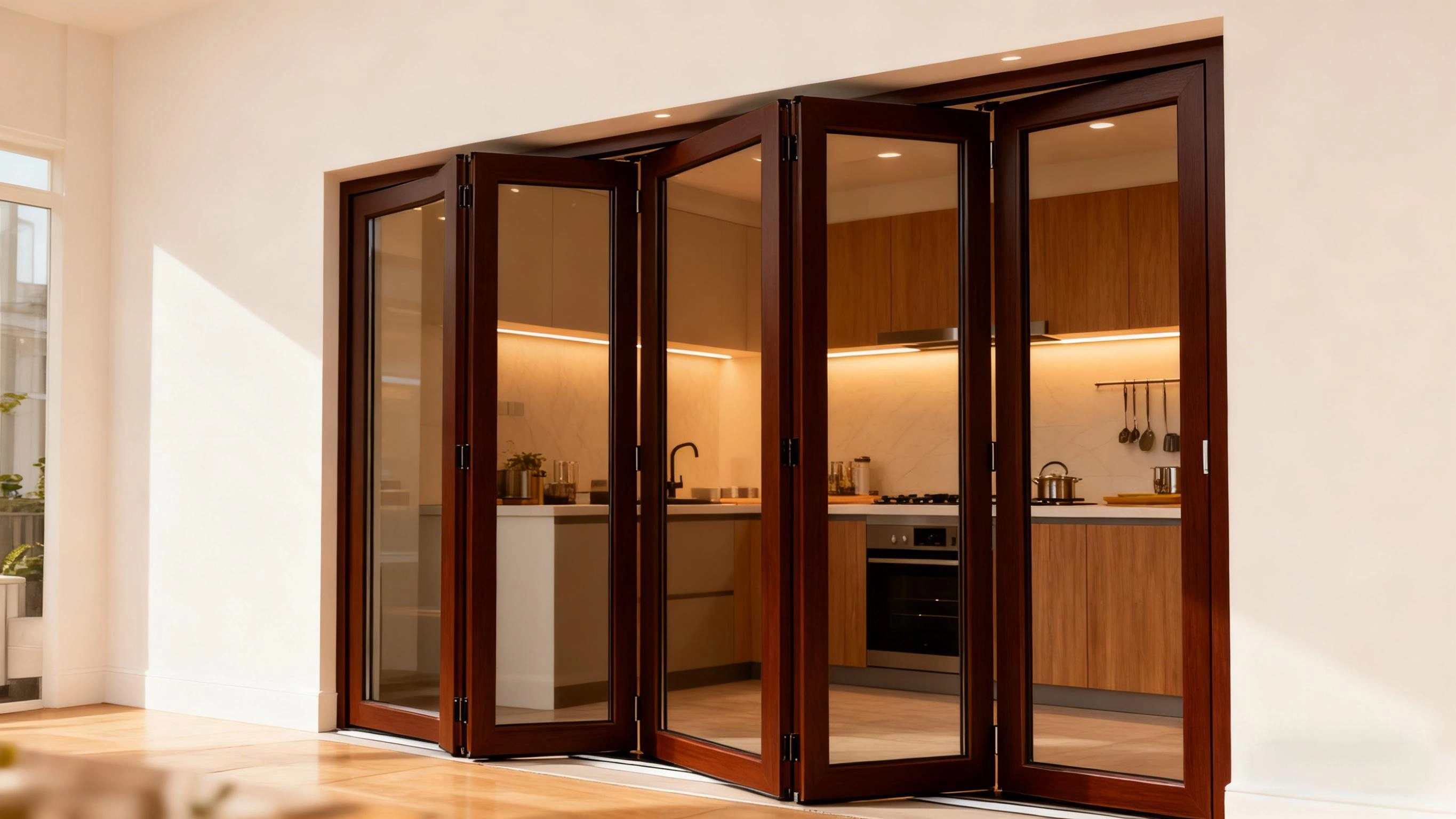
Six UPVC accordion doors leaves give the largest clear opening on a 2,400 mm aperture at 1,657 mm, and eight leaves give 1,621 mm. The extra two leaves add 4 m of seam and cost 18 per cent of the air leakage budget, so leaf count is a specification decision before it is a style one.
Four numbers on one opening
A 2,400 by 2,100 mm aperture has 9.0 m of perimeter seam. Each joint adds 2.0 m of vertical seam and 4 mm of overlap, so six leaves need 403 mm leaves. Folded, six leaves occupy 743 mm of width, which leaves 1,657 mm clear. Class 4 of EN 12207 allows 3 m³ per hour per square metre, which is 15.1 m³ per hour on 5.04 m².
In this guide:
How many leaves does a 2400 mm UPVC accordion door need?
Leaf width follows from the aperture and the overlap, and nothing else. With 4 mm of overlap at every joint, six UPVC accordion doors leaves need (2,400 + 5 × 4) ÷ 6, which is 403 mm each. Four leaves need 603 mm, five need 483 mm, and eight need 303 mm on the same opening.
The folded stack is what turns leaf width into a clear opening. Each folded leaf lies against the next with one frame thickness plus 8 mm of running clearance, so six leaves at 60 mm deep occupy 403 + 5 × 68, which is 743 mm. Subtract that from the aperture and 1,657 mm stays open.
That 1,657 mm is 69 per cent of the aperture, and it is the number a buyer should put in the enquiry. Anyone comparing slimline UPVC bifold doors with an accordion on the same opening will find the accordion gives back 3 to 5 per cent more clear width, because bifold leaves stack in pairs and pairs are wider than single leaves.
What does each extra leaf add to the seam length?
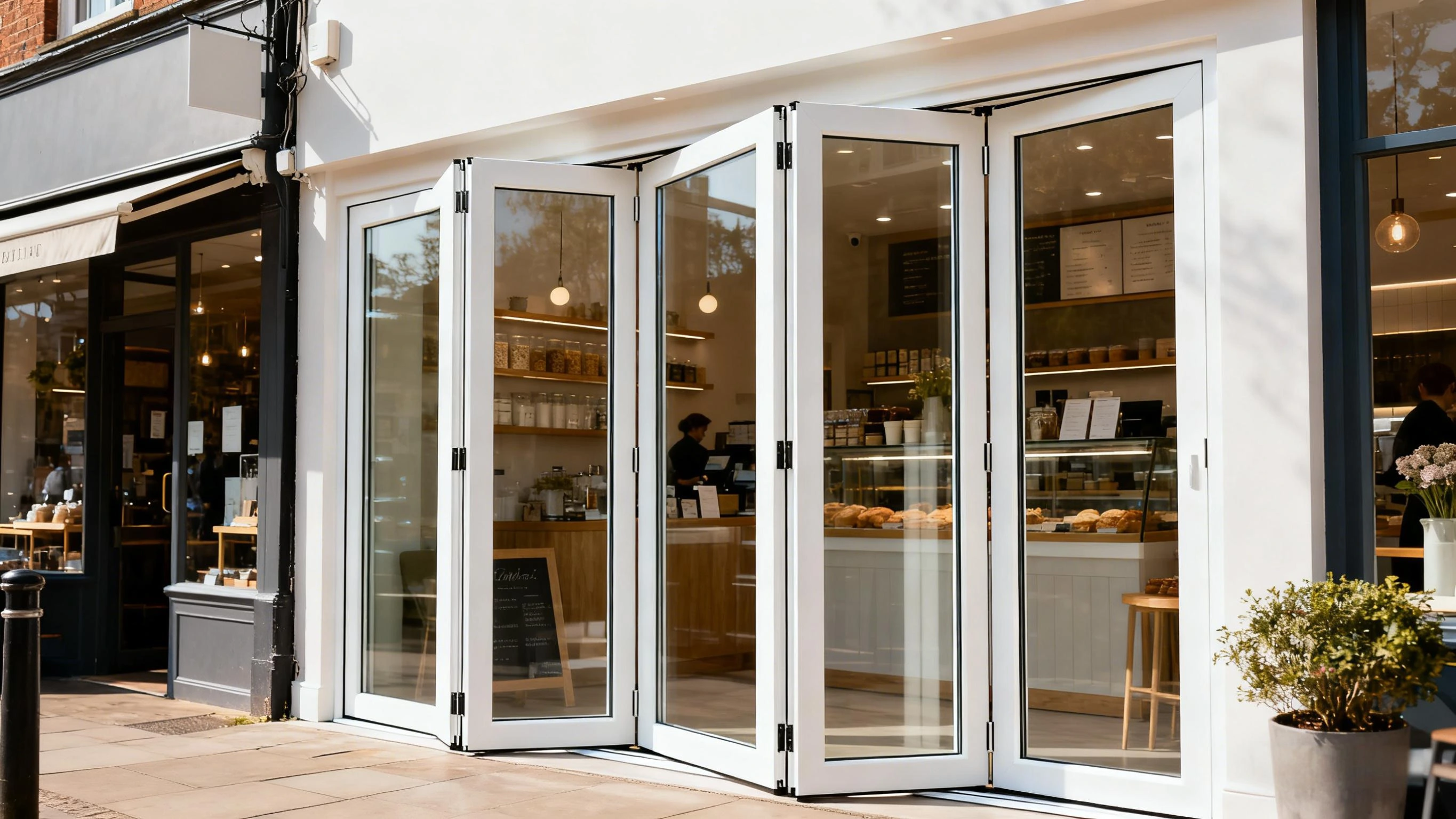
Every extra leaf on UPVC accordion doors adds two metres of vertical seam and one more hinge joint. The perimeter of a 2,400 by 2,100 mm opening is 9.0 m, and every joint between leaves adds the full leaf height of 2.0 m once the track is deducted. Four leaves carry 15.0 m of seam, six carry 19.0 m, and eight carry 23.0 m.
Seam is the part of a door that leaks, and it grows faster than the aperture does. Going from four leaves to eight takes the seam from 15.0 to 23.0 m, a 53 per cent increase on an opening that did not change size. That is the arithmetic behind the price difference nobody explains.
How tight does the air leakage budget get at eight leaves?
On UPVC accordion doors, Class 4 of EN 12207 allows 3 m³ per hour per square metre of opening area at 100 Pa. On 5.04 m² that is a total of 15.1 m³ per hour for the whole door. Spread that over the seam and four leaves have 1.01 m³ per hour per metre of seam to work with, six leaves 0.80, and eight leaves 0.66.
That is what a buyer actually spends on an eight leaf unit: the gasket has to be better at every one of 23 m, including the seven internal joints where the two gaskets meet at a mitre. A double gasket on the joints and a continuous corner are what the extra money buys, and none of it is visible on a photograph.
Water follows the same logic with different numbers. EN 12208 rates a door by the pressure it holds without penetration, and a joint is the first place water crosses. Fewer joints is a cheaper way to hold class 6 than a deeper threshold, which is the argument for keeping the leaf count low on an exposed elevation. The accordion vs bifold comparison shows the same trade in aluminium.
Why do eight leaves give a smaller opening than six?
On UPVC accordion doors the stack grows faster than the leaf shrinks. Going from six leaves to eight saves 200 mm of leaf width and adds 136 mm of stack, so the clear opening drops 36 mm while the seam grows 4 m and the hinge count goes from seven to nine. Eight leaves are more parts, more leak, less opening.
| Leaves | Leaf width | Stack width | Clear opening | Seam length | Verdict |
|---|---|---|---|---|---|
| 4 | 603 mm | 807 mm | 1,593 mm, 66% | 15.0 m | widest leaves, easiest gasket |
| 5 | 483 mm | 755 mm | 1,645 mm, 69% | 17.0 m | odd leaf against one jamb |
| 6 | 403 mm | 743 mm | 1,657 mm, 69% | 19.0 m | largest clear opening on this aperture |
| 8 | 303 mm | 779 mm | 1,621 mm, 68% | 23.0 m | more parts, 18 per cent less air budget |
Aperture 2,400 by 2,100 mm, 4 mm overlap per joint, frame depth 60 mm plus 8 mm running clearance per folded leaf. Clear opening and seam length are geometry, calculated, not measured on a hung door.
Read the last two columns together. The best clear opening sits at six leaves and the eighth leaf is negative value on both counts. If the elevation calls for a narrow look, four leaves at 603 mm give the same performance with 8 m less seam and two fewer hinge sets.
What do the leaf, track and hinge figures look like?
A six-leaf set of UPVC accordion doors at 403 by 2,100 mm weighs 21.3 kg per leaf with 4/20/4 argon glazing, so the hung load is 128 kg spread over seven hinge sets and one top track. That is 18 kg per hinge set, and the track carries the lot in bending over 2,400 mm.
| Parameter | Typical value | Note |
|---|---|---|
| Product | UPVC accordion doors, PVC-U profile to EN 12608-1 | concertina folding, top hung |
| Leaf width | 303 to 603 mm on a 2,400 mm aperture | set by aperture and overlap, not by taste |
| Leaf mass | 21.3 kg at 403 by 2,100 mm | 4/20/4 argon unit at 20 kg per square metre |
| Frame depth | 60 mm | plus 8 mm running clearance per folded leaf |
| Glazing | double or triple, low-e and argon | U-value 1.2 to 1.6 W/m²K double, 0.8 to 1.2 triple |
| Hinge sets | one per joint plus two ends | seven sets on six leaves |
| Seam length | 19.0 m on six leaves | 9.0 m perimeter plus 5 joints at 2.0 m |
| Air permeability | EN 12207, Class 4 target | 3 m³ per hour per square metre at 100 Pa |
| Water tightness | EN 12208 | fewer joints holds a higher class |
| Minimum order | 10-20 units | lead time 25-30 days from approved drawing |
Leaf mass is arithmetic on a 4/20/4 unit at 20 kg per square metre of glass plus 4.4 kg of PVC-U frame. U-values are the usual range for the glazing described and are confirmed by test on the finished assembly.
Which leaf count should a trade buyer order?
The answer for UPVC accordion doors is six on an opening between 2,200 and 2,600 mm, four below that and five when the jamb detail needs an odd count. The rule holds because the stack and the leaf width move in opposite directions and the two curves cross in the middle, which is where the largest clear opening sits.
Send the aperture, the wall build-up and the exposure to kristin@haolvbuilding.com and the leaf count, the stack width and the seam length come back with the price, checked against the glazing you intend to use.
Two lines on the order do most of the work: the leaf count with the leaf width, and the seam allowance with the gasket type at the joints. A supplier who quotes a price without asking for the aperture is quoting a catalogue leaf, and a catalogue leaf is where the clear opening goes wrong.
What changes for a coastal site?
The profile and the hardware, in that order. PVC-U for external use carries titanium dioxide as a UV stabiliser and a cap-stock layer on the weathering face, and on a coastal elevation the salt load makes the cap-stock thickness worth naming. Under EN 12608-1 the profile is classified on wall thickness and on impact, and the class travels with the order.
Hardware is the second half. Salt eats plated hinges at the joint where two leaves meet, so specify stainless or a marine-grade coating on all seven sets, and count them in the unit price. The UPVC door profiles used here are the same family on a coastal job, and the difference sits in the cap-stock and the coating.
Glazing choice follows the same principle as the leaf count: the gain from triple glazing on a 69 per cent opening is smaller than the gain from sealing 19 m of seam properly. folding doors space planning and gasket detail belong in the same conversation, because both are decided by the joint.

Frequently asked questions
What is the minimum order for UPVC accordion doors? Minimum order is 10-20 units and lead time is 25-30 days from an approved drawing. Leaf width is cut to the aperture, so the drawing is agreed before the run starts and the leaf count is fixed at that point.
How do I compare a wholesale price between two leaf counts? Divide the price by the clear opening in square metres, not by the aperture. Six leaves give 1,657 mm on a 2,400 mm aperture and eight give 1,621 mm, so a per square metre figure built on the aperture hides the 36 mm the eighth leaf costs.
Can the leaves be supplied wider than 603 mm? On a single pair, yes, up to about 700 mm before the hinge load and the leaf deflection become the limit. On a folding run the wider leaf simply takes more stack, so the clear opening does not improve as much as the leaf count suggests.
Do UPVC accordion doors need a bottom track? A bottom guide at the sill, sized to the leaf width, and it is what keeps the leaves in line when the door is part open. The guide leaves the threshold flat for trolleys and for grit to be swept away, which a full bottom track does not.
Ordering from Haolv
Haolv Building Materials Co., Ltd. has been making doors and windows for 19 years, and the UPVC accordion doors here are assembled on PVC-U profile to EN 12608-1 with the leaf width cut to the aperture on the drawing. Certification for the profiles and the glazing is available on request with the quotation. Minimum order is 10-20 units and lead time is 25-30 days.
Send the aperture and the exposure to kristin@haolvbuilding.com, or start from Haolv Building Materials Co., Ltd. and the leaf count, the stack width and the seam length come back with the price.
What this guide claims and what it does not: the 1,657 mm, the 19.0 m of seam and the 0.80 m³ per hour per metre are geometry and a standard divided out, and any reader can redo them from the aperture and the overlap. They are calculated, not measured. The air permeability of a delivered door belongs to that assembly and is confirmed by test, and the gasket detail that reaches Class 4 is agreed on the drawing.

References
- EN 12608-1:2016+A1:2020 — Unplasticized polyvinylchloride profiles for the fabrication of windows and doors. Classification, requirements and test methods.
- EN 12207:2017 — Windows and doors. Air permeability. Classification.
- EN 12208:2000 — Windows and doors. Watertightness. Classification.
- EN 13126-8:2017 — Building hardware. Hardware for windows and door height windows. Requirements and test methods.
- EN 14351-1:2006+A2:2016 — Windows and doors. Product standard. Performance characteristics.
- EN ISO 10077-1:2017 — Thermal performance of windows, doors and shutters. Calculation of thermal transmittance.
Leaf width, stack width, clear opening and seam length in this guide are geometry on a stated aperture, a stated overlap and a stated frame depth. They are calculations from a drawing, not measurements of a hung door, and the permeability of any unit is confirmed by test on the finished assembly.
Fast simple channel to send demands lock favorable price for building window door bulk purchases.