- English
- French
- German
- Portuguese
- Spanish
- Russian
- Japanese
- Korean
- Arabic
- Greek
- German
- Turkish
- Italian
- Danish
- Romanian
- Indonesian
- Czech
- Afrikaans
- Swedish
- Polish
- Basque
- Catalan
- Esperanto
- Hindi
- Lao
- Albanian
- Amharic
- Armenian
- Azerbaijani
- Belarusian
- Bengali
- Bosnian
- Bulgarian
- Cebuano
- Chichewa
- Corsican
- Croatian
- Dutch
- Estonian
- Filipino
- Finnish
- Frisian
- Galician
- Georgian
- Gujarati
- Haitian
- Hausa
- Hawaiian
- Hebrew
- Hmong
- Hungarian
- Icelandic
- Igbo
- Javanese
- Kannada
- Kazakh
- Khmer
- Kurdish
- Kyrgyz
- Latin
- Latvian
- Lithuanian
- Luxembou..
- Macedonian
- Malagasy
- Malay
- Malayalam
- Maltese
- Maori
- Marathi
- Mongolian
- Burmese
- Nepali
- Norwegian
- Pashto
- Persian
- Punjabi
- Serbian
- Sesotho
- Sinhala
- Slovak
- Slovenian
- Somali
- Samoan
- Scots Gaelic
- Shona
- Sindhi
- Sundanese
- Swahili
- Tajik
- Tamil
- Telugu
- Thai
- Ukrainian
- Urdu
- Uzbek
- Vietnamese
- Welsh
- Xhosa
- Yiddish
- Yoruba
- Zulu
Vinyl Window Profiles Supplier Comparison for Dark Colours and Thermal Movement
A 3 m dark grey sash in vinyl window profiles grows 11.6 mm on a summer afternoon and the same sash in aluminium grows 3.8 mm. That 3 mm difference decides which colours a PVC line will run, and it is a length problem long before it is a colour problem.
Four coefficients and one afternoon
Across vinyl window profiles the linear expansion per kelvin runs PVC-U 7 x 10 to the minus 5, aluminium 2.3 x 10 to the minus 5, steel 1.2 x 10 to the minus 5, glass 0.9 x 10 to the minus 5. On 3,000 mm with a 55 K rise that reads 11.6 mm, 3.8 mm, 2.0 mm and 1.5 mm. The gap between the frame and the glass is 10 mm of movement, and the gap between the frame and its steel liner is 9.6 mm.
In this guide:
How far does a 3 m vinyl frame move between winter and a summer afternoon?
The arithmetic is one line: length times coefficient times temperature difference. A 3,000 mm white profile at a 25 K rise moves 5.25 mm, the same profile in dark grey at 55 K moves 11.55 mm, and an aluminium one at 55 K moves 3.80 mm. All three numbers are for the same opening, and the first two are the same product.
| Material | Expansion per K | 3 m at 25 K | 3 m at 55 K | Role |
|---|---|---|---|---|
| PVC-U | 7 x 10⁻⁵ | 5.3 mm | 11.6 mm | the frame and sash |
| Aluminium 6063-T5 | 2.3 x 10⁻⁵ | 1.7 mm | 3.8 mm | frame on the aluminium range |
| Steel liner | 1.2 x 10⁻⁵ | 0.9 mm | 2.0 mm | carries the sash load |
| Glass, soda lime | 0.9 x 10⁻⁵ | 0.7 mm | 1.5 mm | the infill |
| PA66 GF25 strip | 3 x 10⁻⁵ | 2.3 mm | 5.0 mm | thermal break on the frame |
Coefficients are the usual published values for these materials and vary by a few per cent between grades. The 25 K column is a light colour on a sunny wall; the 55 K column is a dark colour under direct sun.
That movement on vinyl window profiles has to land somewhere legal. The frame is fixed at packers and the sash is fixed at hinges, so the growth shows as a gap closing at one end and opening at the other. On a 3 m run with 11.6 mm of growth, 6 mm at each end is the minimum clearance a dark PVC frame needs before the section starts pushing against its own fixings.
A white frame on the same elevation gets away with 3 mm per end. That is why colour on UPVC trim profiles and frames is a structural decision, and the shade is simply where the decision shows. Two suppliers quoting the same profile in the same colour can differ by whether that clearance is in the fabrication drawing at all.
Why does a dark vinyl profile reach 80 C on a 30 C day?
On vinyl window profiles a surface in sun absorbs more than it can lose by convection. A white profile under 900 W per square metre of irradiance settles about 25 K above ambient; a dark grey or black one settles 50 to 60 K above it. On a 30 C afternoon that puts the white section at 55 C and the anthracite section at 80 to 90 C, and only one of those two numbers is comfortable for a thermoplastic.
That matters because PVC-U softens near 76 to 80 C on the Vicat B scale. At 80 C the modulus of the compound falls to roughly half its 23 C value, so a dark sash that is stiff in the workshop is half as stiff in the sun. Every load case in the design, wind, glass weight and its own span, is being carried by a material that has changed properties.
The counter measure is a lighter colour, a through-coloured section, or a foil that survives the surface temperature. A laminated foil rated to 70 C will lift at the edges on a black profile in a Mediterranean summer, which is the failure buyers photograph and send back.

What happens when the steel liner expands one tenth as much?
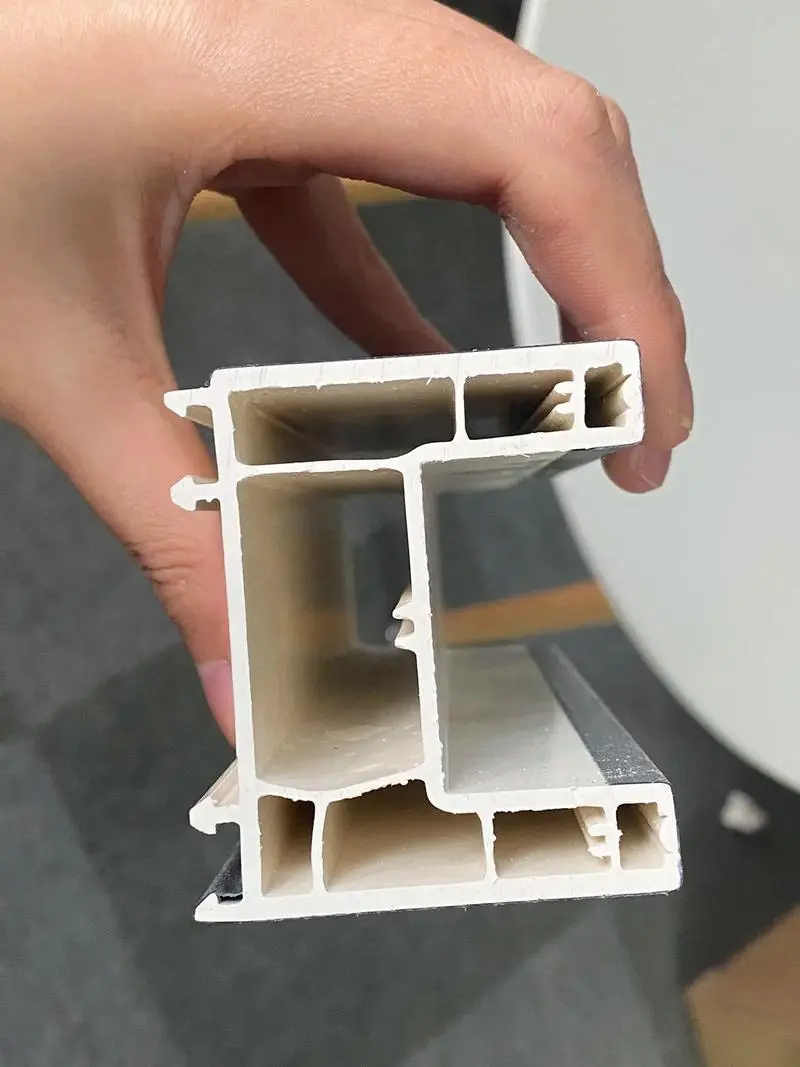
In vinyl window profiles the liner and the profile it sits in are two materials with a sixfold difference in expansion, locked together along a 3 m length. At 55 K the PVC grows 11.55 mm and the steel grows 2.00 mm, so 9.55 mm of relative movement has to be absorbed. If both ends of the liner are screwed through the profile, nothing absorbs it and the section is loaded in tension and compression at once.
Put a number on that load. The relative strain is 9.55 over 3,000, which is 0.32 per cent. On a 500 mm squared profile at a 2,800 N per square millimetre modulus that is 0.0032 times 2,800 times 500, or 4,480 N, close to half a tonne pushing along the length of a window frame.
The correct detail fixes the liner at one point near mid height and leaves the rest free to slide, with at least 10 mm of clearance at each end of the chamber. It costs two screws and appears on no price sheet, and the alternative, a frame that bows, shows up two summers later as a sash that will not close at the bottom corner.
Does the movement arrive as a colour problem or as an air leak?
On vinyl window profiles the movement arrives as a bow, and a bow is an air leak. When one face of a profile runs hotter than the other, the section curves with a curvature of alpha times the temperature difference across the depth, divided by the depth. Five kelvin across 70 mm on PVC-U gives 5.0 x 10 to the minus 6 per millimetre, and on a 3,000 mm length the middle of the sash stands 5.6 mm off the line.
The 3 mm that the gasket had
A compression gasket on a PVC sash is set to 3 mm of squash. A dark 3 m sash bows 5.6 mm at mid height on a 5 K gradient, so the middle of the leaf is past the seal and the ends are over compressed. The same bow in aluminium is 1.85 mm, which stays inside the 3 mm.
This is why a dark PVC window that passes an air test in the factory can fail on a west facade in August. The test is run at 20 C on a flat bench; the facade runs at 80 C with a 5 K gradient across the depth. Air permeability class EN 12207 does not model that, so the class is a statement about the sample and the bow is a statement about the elevation.
Two details buy most of it back. Hinging a dark sash on three points drops the mid height bow to half, and putting the fixed frame in a lighter colour than the sashes keeps the frame line straight where the seals land. The anthracite grey UPVC windows that survive in hot markets are specified this way.
Which colours will a vinyl line run at all?
Most lines divide into three groups. White and light pastels run on any standard compound with 4 to 6 phr of titanium dioxide. Mid tones run as a co-extruded capstock of 0.4 to 0.5 mm over a white or grey core. Dark tones run as through-coloured compound or as a foil, and both cost a separate extrusion run.
| Colour group | Surface at 30 C ambient | How it is made | What it constrains |
|---|---|---|---|
| White | about 55 C | single compound, 4 to 6 phr TiO2 | nothing beyond normal clearance |
| Light grey or cream | about 62 C | capstock over white core | capstock thickness 0.4 mm minimum |
| Anthracite or mid grey | about 75 C | capstock or through colour | sash width and liner clearance |
| Black or dark brown | about 85 C | through colour or foil only | sash length, three point hanging |
Surface temperatures are calculated from a 25 K rise for white and a 55 K rise for black, added to a 30 C ambient. They are planning values for a sunny elevation and are confirmed by the compound supplier for a given colour.
So a buyer should ask one concrete question on vinyl window profiles in a dark colour: what sash width and what liner clearance do you use for anthracite. The answer tells you whether the supplier has run the colour before or is quoting a sample. The anthracite grey energy performance question usually follows the same conversation.
What should a comparison sheet ask both suppliers?
Five lines separate a supplier who understands the material from one who sells colour samples. State the compound and the colour route, the sash width and height, the liner fixing method with its end clearance, the surface temperature the colour is rated for, and the gasket compression with the hinge count per sash.
Send the elevation, the colour and the sash sizes to kristin@haolvbuilding.com and the growth, the bow, the liner clearance and the hinge count come back on one sheet per elevation, checked against the section the factory would actually extrude in that colour.
Which lengths and sash widths need reinforcing first?
On vinyl window profiles the limit is set by the 11.6 mm of growth and the 5.6 mm of bow, and both scale with length. On a 1,200 mm sash the growth is 4.6 mm and the bow 0.9 mm, which the seals absorb without notice. On a 1,800 mm sash it is 7.0 mm and 2.0 mm, at the edge. Beyond 1,300 mm of sash width in a dark colour, the usual answer is through colour plus three point hanging plus a liner that is free at both ends.
Height matters more than width on vinyl window profiles, because the bow scales with the square of the length while the growth is linear. Going from a 1,400 to a 2,400 mm sash multiplies the growth by 1.7 and the bow by 2.9. That is why a tall dark casement is where this argument lands in practice, and why a 2,400 mm dark sash is usually quoted with a mid rail.

Where does aluminium stop having this problem?
Aluminium shifts the threshold. At 2.3 x 10 to the minus 5 the same 3 m sash grows 3.8 mm at 55 K and bows 1.85 mm at a 5 K gradient, both inside what a 3 mm gasket absorbs. What aluminium adds instead is a thermal break, where the polyamide strip at 3 x 10 to the minus 5 has to follow the aluminium on both sides.
That strip is why the thermal break aluminium profiles line survives a dark colour at 3 m where a PVC one needs a mid rail. The strip is short, its movement over 24 mm is 0.04 mm at 55 K, and the roller and the crimp carry it. The limitation moves from the material to the paint and the powder bake.
The commercial consequence for vinyl window profiles is simple. Up to about 1,300 mm of sash in a dark colour, they are cheaper and thermally equal. Beyond that the aluminium range wins on everything except price per square metre, and the price gap narrows once the mid rail, the third hinge and the through colour are added to the PVC side.
| Parameter | Typical value | Note |
|---|---|---|
| Product | vinyl window profiles, PVC-U | white, capstock and through colour routes |
| Expansion | 7 x 10⁻⁵ per K | 3 m sash, 11.6 mm at 55 K |
| Surface temperature | 55 C white, 85 C black | 30 C ambient, 900 W per square metre |
| Softening | 76 to 80 C on Vicat B | modulus halves at 80 C |
| Steel liner | 1.2 x 10⁻⁵ per K | fixed at mid height, 10 mm free each end |
| Liner load at 55 K | 4,480 N on 500 mm squared | if both ends are fixed through |
| Bow at 3 m | 5.6 mm on a 5 K gradient | 1.85 mm in aluminium |
| Sash limit, dark | 1,300 mm wide, 2,400 mm high | mid rail above that |
| Standard | EN 12608-1 and EN 14351-1 | profile and product standard |
| Minimum order | 10-20 units | lead time 25-30 days from approved drawing |
Expansion, bow and liner load are calculated from published coefficients, a stated sash length and a stated temperature rise, and are not measurements from a delivered window. Surface temperatures are planning values and the colour route is confirmed with the compound supplier.
Frequently asked questions
What is the minimum order for vinyl window profiles? Minimum order is 10-20 units and lead time is 25-30 days from an approved drawing. White ships from an existing run; a capstock colour adds one co-extrusion change, and a through colour adds a full cleaning cycle before the run starts.
Can vinyl window profiles in a dark colour be used on a 3 m sash? At 3 m the growth is 11.6 mm and the bow 5.6 mm on a 5 K gradient, and the gasket has 3 mm. It can be done with through colour, three point hanging and a mid rail, and at that point the aluminium range is usually the cheaper way to the same result.
Does the steel liner have to be continuous? It has to reach the corners where the load lands, and it has to be free to slide. A continuous liner fixed at both ends is the worst of both: it carries the load and it fights the profile with 4,480 N at 55 K.
Why not simply specify white everywhere? Because buyers ask for dark and the market pays for it. The honest answer is that a dark vinyl window is a different window: shorter sashes, more hinges, a free liner and a gasket with more travel. Quoting it as a white window in another colour is where projects go wrong.
Ordering from Haolv
Haolv Building Materials Co., Ltd. has been extruding and assembling doors and windows for 19 years, and the vinyl window profiles on a set are co-extruded and lined on the same line as the frame they become. Certification for the profiles and the glazing is available on request with the quotation. Minimum order is 10-20 units and lead time is 25-30 days.
Send the elevation, the colour and the sash sizes to kristin@haolvbuilding.com, or start from Haolv Building Materials Co., Ltd. and the growth, the bow and the liner detail come back with the price.
What this page claims and what it does not: the 11.6 mm, the 5.6 mm, the 4,480 N and the 1.85 mm are arithmetic on published expansion coefficients, a stated sash length and a stated temperature rise, and any reader can redo them. They are calculated, not measured. The coefficients of a delivered compound belong to that grade, the surface temperature belongs to that colour in that climate, and both are confirmed with the compound supplier.

References
- EN 12608-1:2016+A1:2020 — Unplasticized polyvinylchloride profiles for the fabrication of windows and doors. Classification, requirements and test methods.
- EN ISO 306:2013 — Plastics. Thermoplastic materials. Determination of Vicat softening temperature.
- EN ISO 2505:2005 — Thermoplastics pipes. Longitudinal reversion. Test method and parameters.
- EN 12207:2017 — Windows and doors. Air permeability. Classification.
- EN 14351-1:2006+A2:2016 — Windows and doors. Product standard. Performance characteristics.
- ISO 4892-2:2013 — Plastics. Methods of exposure to laboratory light sources. Xenon arc lamps.
Expansion, bow, liner load and surface temperature in this guide are arithmetic on published coefficients for PVC-U, aluminium, steel and glass, a stated sash length and a stated temperature rise. They are calculations from a drawing and a climate assumption, not measurements of a delivered window, and the coefficients and colour performance of any order are confirmed with the compound supplier.
Fast simple channel to send demands lock favorable price for building window door bulk purchases.