- English
- French
- German
- Portuguese
- Spanish
- Russian
- Japanese
- Korean
- Arabic
- Greek
- German
- Turkish
- Italian
- Danish
- Romanian
- Indonesian
- Czech
- Afrikaans
- Swedish
- Polish
- Basque
- Catalan
- Esperanto
- Hindi
- Lao
- Albanian
- Amharic
- Armenian
- Azerbaijani
- Belarusian
- Bengali
- Bosnian
- Bulgarian
- Cebuano
- Chichewa
- Corsican
- Croatian
- Dutch
- Estonian
- Filipino
- Finnish
- Frisian
- Galician
- Georgian
- Gujarati
- Haitian
- Hausa
- Hawaiian
- Hebrew
- Hmong
- Hungarian
- Icelandic
- Igbo
- Javanese
- Kannada
- Kazakh
- Khmer
- Kurdish
- Kyrgyz
- Latin
- Latvian
- Lithuanian
- Luxembou..
- Macedonian
- Malagasy
- Malay
- Malayalam
- Maltese
- Maori
- Marathi
- Mongolian
- Burmese
- Nepali
- Norwegian
- Pashto
- Persian
- Punjabi
- Serbian
- Sesotho
- Sinhala
- Slovak
- Slovenian
- Somali
- Samoan
- Scots Gaelic
- Shona
- Sindhi
- Sundanese
- Swahili
- Tajik
- Tamil
- Telugu
- Thai
- Ukrainian
- Urdu
- Uzbek
- Vietnamese
- Welsh
- Xhosa
- Yiddish
- Yoruba
- Zulu
Wholesale Slimline UPVC Bifold Doors and the Threshold Nobody Measures
A 12 mm threshold on slimline UPVC bifold doors clears a 100 mm per hour storm with 37 times the flow it needs, and it stops holding water back once wind reaches 14 metres per second. Sill height decides pressure resistance, and drainage decides almost nothing.
Two numbers on a 2,400 mm opening
Weir flow over the 12 mm sill of a slimline UPVC bifold door, across 2,400 mm, is 1.705 x 2.4 x 0.012 to the power 1.5, which is 5.4 litres per second. The design storm of 100 mm per hour on 5.28 square metres of door asks for 0.147 litres per second. The same 12 mm of water is 118 Pa, and 118 Pa is a 13.9 metres per second wind.
In this guide:
What does slimline actually change on a UPVC bifold door?
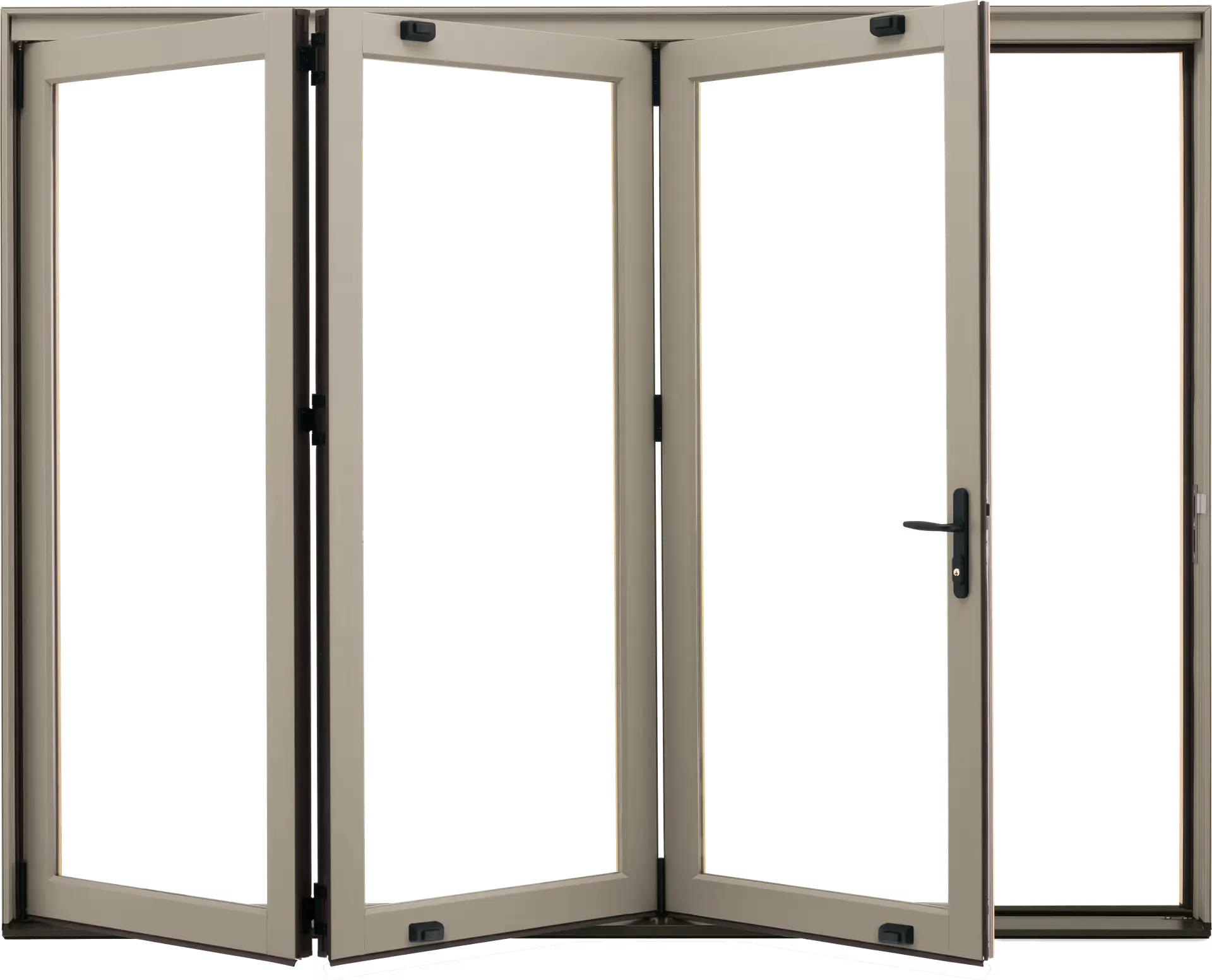
A slimline UPVC bifold door takes 6 mm off the frame face on each side, which is the visible part, and about 12 mm off the depth of the bottom track, which is the part that matters. A 70 mm frame still carries the same 4-16-4 sealed unit and the same top hung carriage in PVC-U. What changes is how much water the sill can hold before it spills inward.
That is why the brochure photograph is misleading. Two sets photographed from the same angle look identical whether the sill sits 12 mm or 20 mm above the finished floor, and the difference only shows when the wind drives rain against the door at an angle. A wholesale order placed on a photograph buys the appearance and takes whatever sill detail the factory happens to run.
The frame width is not the binding constraint on this door. The depth behind the track is. Ask for the sill section before the price, and compare it against other UPVC bifold patio doors on the same elevation, because a 20 mm sill on one opening and a 12 mm sill on the next reads as a mistake to anyone walking the floor.
How low can the threshold sit before water crosses it?
Water crosses a sill when the head of water on the outside exceeds the height of the upstand, and wind sets that head. Rain builds the film and wind builds the pressure: driving rain arrives at an angle and wets the face, then the pressure that pushes that film inward is the same 0.6 times air density times wind speed squared that a facade engineer uses for cladding.
At 12 mm the upstand holds 118 Pa. Air density of 1.225 kg per cubic metre puts that at 13.9 metres per second, which is a strong gust on an exposed site and an ordinary afternoon on a coast. A 20 mm upstand holds 196 Pa and 17.9 metres per second. Neither number comes from the drainage calculation, and neither appears on a door datasheet.
So the sill height belongs in the specification next to the wind load, and the wind load belongs to the site. A sheltered courtyard and a fifth floor balcony on the same order cannot share one sill detail, and a buyer who specifies one number for a whole project has chosen the lower one by default.
Does a 12 mm sill drain a 100 mm per hour storm?
Easily, and by a margin that makes the drainage question almost irrelevant. A rectangular weir 2,400 mm wide with 12 mm of head passes 1.705 x 2.4 x 0.012 to the power 1.5, which is 0.0054 cubic metres per second or 5.4 litres per second. The design storm on a 2,400 by 2,200 mm door is 100 mm per hour over 5.28 square metres, which is 0.147 litres per second.
That is 37 times the demand, so on slimline UPVC bifold doors the sill is never the bottleneck while the track is clear. What does block it is a drain slot 6 mm wide and 120 mm long with a leaf or a mat over it, which drops the opening to a fraction of the weir and lets water stand until it reaches the inner lip. Cleaning the slot matters more than the 8 mm of sill height that two suppliers argue about.
Where does the pressure go when the sill is flat?
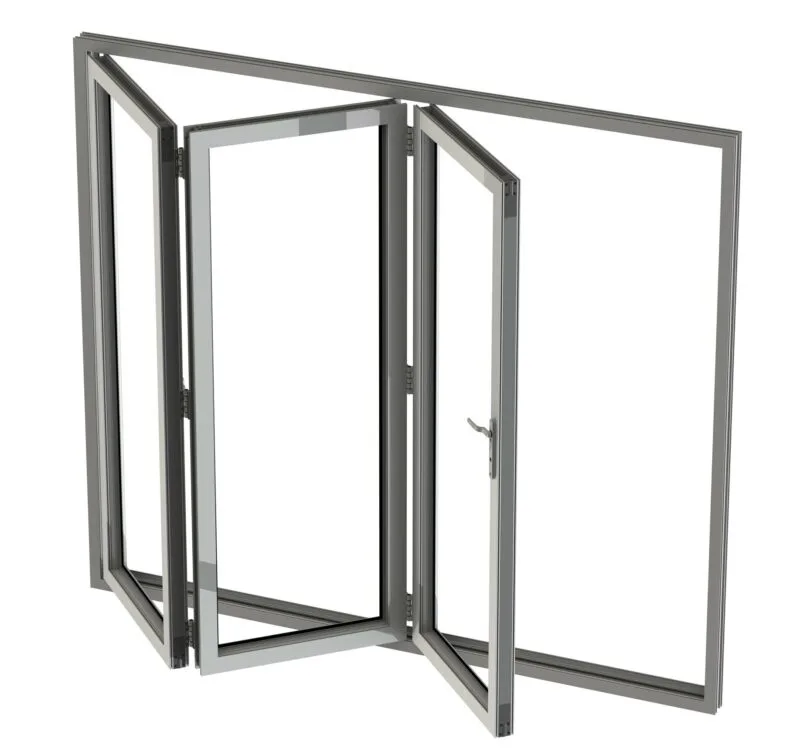
On slimline UPVC bifold doors the pressure goes into an equalising chamber. A flat sill cannot hold a tall column of water, so the section has to give the wind driven film somewhere to sit that is at the same pressure as the outside, and then drain that chamber outward. Without the chamber the water is pushed straight past the inner seal and the door leaks at a pressure its rating claims to survive.
Two things follow for a bulk order. The inner seal has to be a two part brush and fin arrangement, because a single fin sat against a 12 mm upstand carries no pressure; and the chamber has to be open to the outside at both ends, which is a machining step on the sill that is easy to leave out and invisible until the first storm.
The number to ask for is the watertightness class. A door tested to EN 12208 class 7A has held its seal at 300 Pa, which is 22 metres per second. Whether it did that with a 12 mm sill or a 20 mm sill belongs in the test report beside the number, and the frame that carries the sill is specified with the same drawing as the UPVC door and window profiles around it.
What should the order say about the sill detail?
Four lines carry the whole detail: sill height above finished floor, watertightness class, whether the equalising chamber is machined at both ends, and the drainage slot dimensions. Send the site wind load and the finished floor level to kristin@haolvbuilding.com and the sill section, the class and the slot size come back on one drawing, checked against the section the factory would actually machine.
| Sill option | Head it holds | Access | Where it belongs |
|---|---|---|---|
| 12 mm flush sill | 118 Pa, 13.9 m per second | step free | sheltered courtyards and covered terraces |
| 20 mm upstand | 196 Pa, 17.9 m per second | 15 mm step | exposed sites above the third floor |
| 40 mm upstand with channel | 392 Pa, 25.3 m per second | 40 mm step | coastal and wind driven rain zones |
Head of water converts to pressure at 9.81 Pa per mm and to wind speed at 0.6 times 1.225 kg per cubic metre. Access figures follow the 15 mm threshold guidance used in accessible route design, which the 40 mm option misses.
Which leaf widths still fold cleanly at a 70 mm frame?
On a 3,600 mm opening with four leaves the panel comes out at 862 mm, and that is comfortably inside the 900 mm that a 65 mm sash handles with two hinges. Go to five leaves on the same opening and each is 700 mm, which folds sweeter, stacks wider, and adds two hinges plus a carriage to the price.
The stack is where slimline pays for itself twice. Four leaves at 65 mm plus hardware stack into about 300 mm at the jamb, so the clear opening is 3,160 mm out of 3,600, or 88 per cent. A 76 mm frame with a 20 mm sill loses another 12 mm per side and takes the clear opening under 3,140 mm.
The leaf weight stays modest because the sash is slim: 862 by 2,100 mm of 4-16-4 unit is 1.63 square metres at 20 kg per square metre, which is 32.6 kg of glass, and the sash section adds about 7 kg. Four leaves put 158 kg on the head track, and that is the number the fixing schedule has to answer for.
What fails first on a slimline bifold in year five?
The sill gasket on slimline UPVC bifold doors, and it fails silently. An EPDM bulb compressed to 3 mm loses roughly a quarter of its recovery over five years of summer heat, which leaves 2.2 mm and takes the seal below the point where it follows the sash. The door still closes, still latches, and leaks at the corner where the two leaves meet.
The second item is the head track. A top hung carriage with 158 kg on it wears its rollers by roughly 0.1 mm a year on a door that opens twice a day, which is tolerable, and much faster on a door that opens twenty times. That is why the roller class belongs next to the daily cycle count in the specification, and the bifold versus sliding doors comparison turns on exactly this difference in moving parts.
The third is the corner joint between leaves, where the accordion and bifold doors diverge. A bifold leaf hangs on a hinge and swings clear; an accordion leaf slides on a scissor, so its joint wears differently and its seal is a different shape. Mixing the two details on one elevation is how a project ends up with one door that leaks and one that does not.

| Parameter | Typical value | Note |
|---|---|---|
| Product | slimline UPVC bifold doors, PVC-U | 70 mm frame, 65 mm sash |
| Glazing | 4-16-4 sealed unit, 28 mm | U-value 1.3 W per square metre kelvin, low-e and argon optional |
| Leaf width | 862 mm on a 3,600 mm four leaf set | 900 mm is the practical ceiling |
| Leaf mass | 39.6 kg | 32.6 kg glass plus 7 kg sash |
| Set mass | 158 kg on the head track | four leaves, fixing schedule follows it |
| Sill | 12 mm flush, 20 mm and 40 mm on request | 118 / 196 / 392 Pa |
| Watertightness | EN 12208 class 6A to 7A | state the class, not the sill height |
| Clear opening | 3,160 mm out of 3,600 mm | 88 per cent once stacked |
| Standard | EN 12608-1 and EN 14351-1 | profile and product standard |
| Minimum order | 10-20 units | lead time 25-30 days from approved drawing |
Leaf widths, masses and clear openings are calculated for a 3,600 by 2,100 mm four leaf set at 20 kg per square metre of glass, not measured on a delivered door. Sill options and classes are confirmed per order against the section the factory machines.
Frequently asked questions
What is the minimum order for slimline UPVC bifold doors? Minimum order is 10-20 units and lead time is 25-30 days from an approved drawing. A standard size with a stock sill detail ships from an existing schedule; a machined equalising chamber or a 40 mm sill adds a step before assembly.
Which sill should a wholesale order specify on slimline UPVC bifold doors? Match it to the site. 12 mm for a covered terrace, 20 mm from the third floor up on an exposed elevation, 40 mm on a coast. One sill for a whole project defaults to the weakest site on it.
Does a low sill on slimline UPVC bifold doors reduce the price? Slightly, and it moves the cost into another step. The sill section gets simpler and the machining step for the equalising chamber gets added, so the net change is small. What really moves the price is leaf count and roller class.
Is a 158 kg set of slimline UPVC bifold doors too heavy for a UPVC head track? It sits inside what a 70 mm frame with a steel reinforced head carries, provided the fixings are at 600 mm centres and the head is packed solid. The failure mode worth designing out is a head fixed into a hollow lintel, where the load lands on four screws.
Ordering from Haolv
Haolv Building Materials Co., Ltd. has been making doors and windows for 19 years, and the slimline UPVC bifold doors on a set are assembled on the same line as the frames that carry them. Certification for the profiles and the glazing is available on request with the quotation. Minimum order is 10-20 units and lead time is 25-30 days.
Send the site wind load, the finished floor level and the opening sizes to kristin@haolvbuilding.com, or start from Haolv Building Materials Co., Ltd. and the sill section, the class and the leaf count come back with the price.
What this page claims and what it does not: the 5.4 litres per second, the 118 Pa, the 13.9 metres per second and the 158 kg are arithmetic on a stated opening, a stated water head and a stated glass weight of 20 kg per square metre. They are calculated, not measured. The sill section of a delivered set belongs to that die, and the watertightness class is confirmed by the test report for the actual specification.

References
- EN 12208:1999 — Windows and doors. Watertightness. Classification.
- EN 12207:2017 — Windows and doors. Air permeability. Classification.
- EN 12608-1:2016+A1:2020 — Unplasticized polyvinylchloride profiles for the fabrication of windows and doors. Classification, requirements and test methods.
- EN 14351-1:2006+A2:2016 — Windows and doors. Product standard. Performance characteristics.
- EN ISO 10077-1:2017 — Thermal performance of windows, doors and shutters. Calculation of thermal transmittance.
- ISO 21542:2021 — Building construction. Accessibility and usability of the built environment.
Flow rates, water heads and wind speeds in this guide are arithmetic on a stated sill width, a stated water head and the standard air density of 1.225 kg per cubic metre. They are calculations, not measurements from a tested door, and the watertightness class of any set is taken from the test report for that specification.
Fast simple channel to send demands lock favorable price for building window door bulk purchases.